How the Brain Builds Geographic Knowledge
Geography learning becomes more effective when the brain treats information as connected patterns rather than isolated facts. Instead of memorizing names repeatedly, modern learning science encourages learners to build visual relationships, map awareness, and memory pathways. A 50 states quiz with capitals becomes far more valuable when viewed through the lens of spatial intelligence and cognitive geography.
Students often assume that remembering states and capitals is simply a memorization challenge. Neuroscience suggests something very different. Human brains evolved to remember locations, routes, and environments. The same systems that helped people navigate landscapes thousands of years ago now help learners understand maps and geographic relationships.
That is why taking a 50 states quiz with capitals can act as a powerful learning tool rather than a traditional classroom exercise.
Building Cognitive Maps
The brain constantly organizes information into meaningful structures. Scientists call these structures cognitive maps. These mental maps allow us to understand where places exist in relation to one another.
When students practice a 50 states quiz with capitals, they begin building these cognitive structures naturally. For example, remembering Texas alone is useful. Understanding Texas alongside neighboring states, regions, and cities creates stronger mental connections.
Repeated exposure through interactive map exercises gradually strengthens memory networks. The brain adapts through neuroplasticity, which describes the ability of neural pathways to strengthen and reorganize based on experience and repetition. Every completed session supports these processes.
Spatial Intelligence Makes Geography Easier
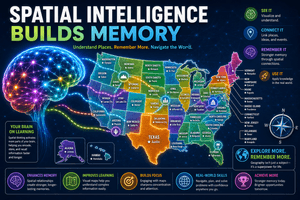
Spatial intelligence is the ability to understand patterns, locations, relationships, and visual organization. People with strong spatial skills often recognize directions and maps quickly, but everyone can improve these abilities with practice.
Taking a 50 states quiz with capitals strengthens spatial thinking because learners repeatedly connect names with physical locations. Instead of seeing information as random lists, learners begin creating visual patterns. For instance, northeastern states may appear clustered together while western states create larger visual spaces. Practicing these spatial exercises reinforces these patterns over time.
The Power of Active Recall
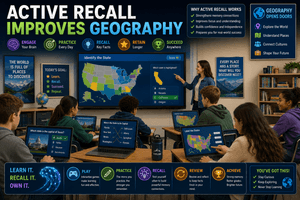
Educational research repeatedly demonstrates that active recall creates stronger learning than passive review. Reading information repeatedly may create temporary familiarity, but retrieval produces long-term retention.
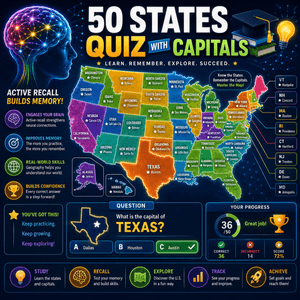
Completing a 50 states quiz with capitals naturally uses active recall because learners retrieve information directly from memory. Every time learners struggle briefly before finding the correct answer, the brain strengthens pathways associated with that information. This explains why this retrieval method becomes more effective than rereading textbook pages. The process requires effort, and effort improves learning.
Why Gamification Helps Memory Formation
Gamification adds challenge, reward, progression, and enjoyment to educational experiences. Rather than viewing learning as work, learners experience engagement and curiosity.
Learning US geography becomes more enjoyable when learners track scores, improve speed, and unlock higher difficulty levels. The brain responds positively to progress, and motivation increases when learners see improvement over time.
Students can begin with a US State Capital Quiz and gradually increase difficulty. Visual recognition can be strengthened through Guess the US States, while additional challenges can come from a US State Name Quiz. Combining these activities with a 50 states quiz with capitals creates richer, well-rounded learning experiences.
Learning Through Multiple Memory Systems
The brain performs best when information enters through multiple channels:
- Visual learning
- Verbal repetition
- Map interaction
- Retrieval practice
- Pattern recognition
A comprehensive 50 states quiz with capitals can include all these elements simultaneously. Students often combine learning methods by using an interactive map of US states and capitals. Others strengthen shape recognition using “identify the state by shape” quizzes, or use a blank US map for practice because drawing information improves recall. Adding these methods to your study routine creates stronger memory networks.
The Role of the Hippocampus in Geography Learning
The hippocampus is one of the brain’s major memory centers, playing an important role in navigation and spatial memory. Researchers studying navigation have discovered that geographic activities strongly engage this region.
Capital memorization games activate these systems because learners mentally travel through locations and relationships. Rather than storing isolated information, learners create connected spatial memories. Repeated practice using a 50 states quiz with capitals gradually makes retrieval feel automatic.
Using Difficulty Progression for Better Results
Learning becomes stronger when challenges increase gradually:
- Begin with recognition tasks.
- Move toward recall exercises.
- Introduce speed challenges and advanced difficulty.
A structured 50 states quiz with capitals supports this progression naturally. Advanced learners often enjoy “hard mode” state capitals quizzes because they create greater retrieval demands. Students also benefit from printable blank maps of the United States. As learners improve, the core fifty-state challenge becomes increasingly engaging.
Pattern Recognition Improves Long-Term Memory
The brain searches constantly for patterns to reduce mental effort and increase understanding. Practicing a 50 states quiz with capitals encourages learners to identify regional similarities and geographic structures. States in similar regions often create natural memory groups, helping students recognize visual patterns instead of isolated names. Over time, mastering these locations transforms into intuitive geographic understanding.
Extending Skills Beyond State Learning
Once learners develop confidence, they often expand into global geography. Strong foundations from learning US geography improve broader geographic awareness.
Students can continue with the Countries of the World Quiz. Visual learners may enjoy the Flags of the World Quiz, while international knowledge can be strengthened through the Capital Cities of the World Quiz.
Whether using multiple-choice world capital quizzes or global map games, the skills developed through a 50 states quiz with capitals often transfer naturally into broader experiences.
Creating a Daily Geography Habit
Consistency matters more than long study sessions. Five to ten minutes of repeated practice often produces stronger results than occasional intensive sessions. Taking a daily 50 states quiz with capitals works especially well as a routine to maintain engagement and strengthen memory pathways.
Students can add the Wordle Geography Game for a daily word challenge, or use the Scramble Words Game to support recall and attention. Users can also explore the Geo Connections Game, while population comparisons become more interesting through the Higher Or Lower Population Game.
Combining activities like the Autocomplete Game and Global Showdown with your core geography practice keeps learning fresh.
Turning Geography Into Lifelong Knowledge
Geography learning should not feel like memorizing disconnected facts. The brain naturally understands locations and relationships when information is organized visually and practiced consistently.
A 50 states quiz with capitals is more than just a test; it helps learners build stronger neural pathways by:
- Improving spatial intelligence
- Encouraging active recall
- Supporting neuroplasticity
- Strengthening cognitive maps
Mastering the fifty states transforms repetitive study into meaningful learning. Through repeated retrieval and engaging practice, this geographic exercise becomes a practical way to train memory, strengthen geographic understanding, and develop lifelong learning skills.