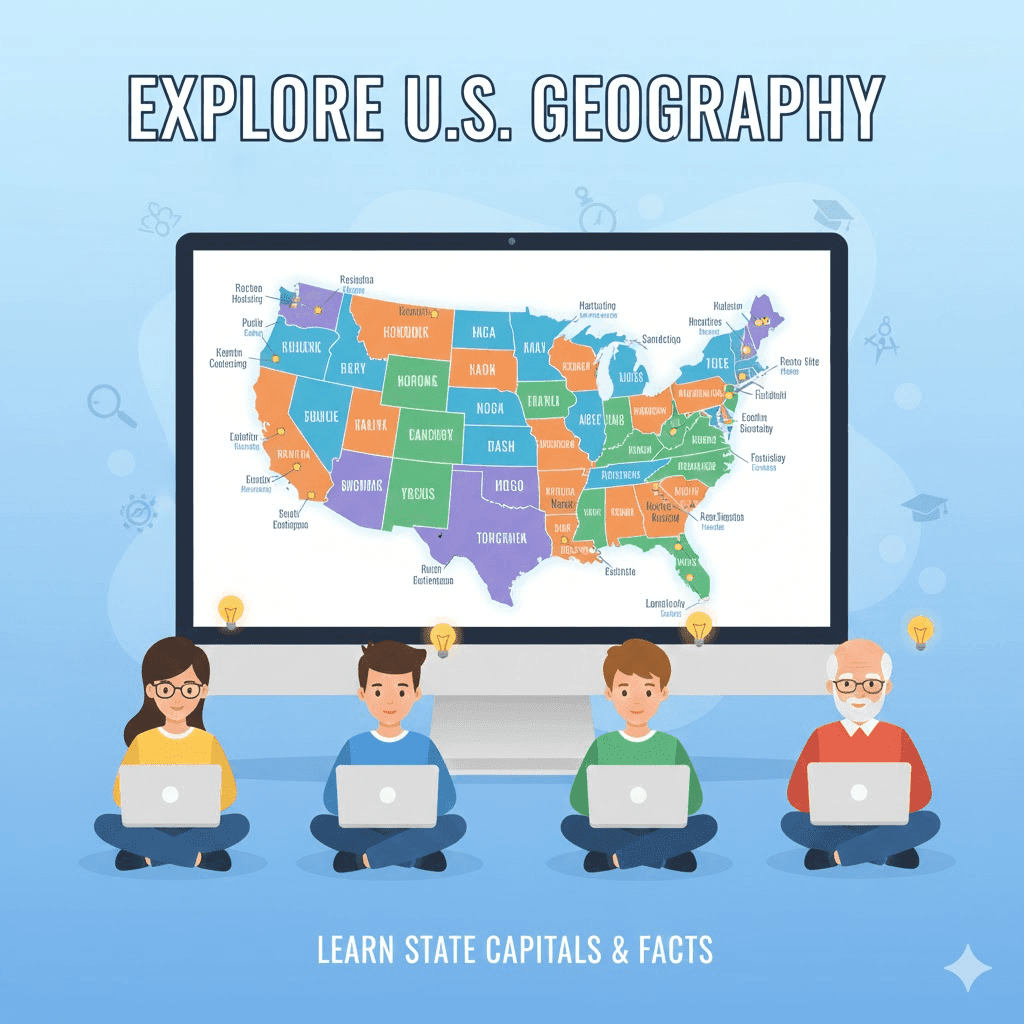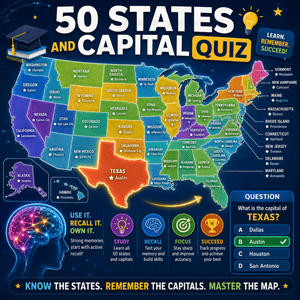
Geography learning becomes significantly more effective when students understand how the brain naturally processes information. Instead of treating states and capitals as disconnected facts, learning science encourages the creation of patterns, visual structures, and active memory systems. A 50 states and capital quiz becomes more than a classroom activity when viewed through the lens of cognitive geography and spatial intelligence.
Modern neuroscience shows that humans are naturally wired to understand spaces and locations. The same systems used for navigation and remembering routes can also help learners master maps, capitals, and regional knowledge. A 50 states and capital quiz takes advantage of these natural abilities.
Students often think memorization means repeating information endlessly. However, research suggests that retrieval and visual associations work far better. A 50 states and capital quiz helps transform passive studying into active learning.
How the Brain Creates Geographic Memory
The human brain constantly organizes information into structures. Rather than storing random facts separately, it builds networks and connections.
When students complete a 50 states and capital quiz, they are creating relationships between places and locations. Instead of only remembering “Austin,” they begin connecting Texas with size, culture, neighboring states, and map position.
This process activates neuroplasticity. Neuroplasticity is the brain’s ability to strengthen neural pathways through repeated experiences. Every time a learner practices a 50 states and capital quiz, those pathways become stronger.
Repeated retrieval improves memory efficiency and creates stronger mental structures.
Spatial Intelligence Improves Geography Learning
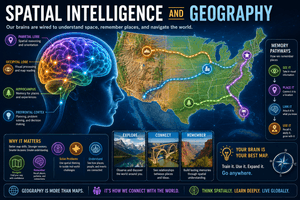
Spatial intelligence refers to the ability to understand locations, relationships, patterns, and visual structures. Some learners naturally think visually, while others strengthen these abilities over time.
A 50 states and capital quiz encourages learners to think spatially instead of memorizing isolated words.
Consider the difference between reading a capital from a list and identifying it on a map. The second approach creates stronger cognitive engagement.
Using a 50 states and capital quiz repeatedly helps learners build internal geographic maps.
These internal maps support faster recall and stronger understanding.
Active Recall Makes Learning Stronger
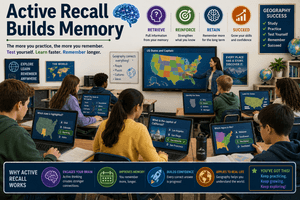
Educational psychology consistently identifies active recall as one of the most powerful learning methods.
Active recall requires learners to retrieve information without immediately seeing the answer.
A 50 states and capital quiz naturally uses this strategy because players actively search memory for answers.
Reading information repeatedly often creates familiarity without true understanding.
However, practicing with a 50 states and capital quiz forces the brain to strengthen memory pathways.
Each successful retrieval tells the brain that the information matters.
The Role of the Hippocampus
The hippocampus plays a major role in memory and spatial navigation.
Scientists have observed strong links between geographic learning and hippocampal activity.
A 50 states and capital quiz activates systems involved in location awareness and navigation.
Instead of storing disconnected facts, the brain builds complete geographic environments.
Repeated use of a 50 states and capital quiz helps strengthen these systems.
Gamification Creates Better Engagement
Gamification applies game elements such as points, challenges, achievements, and rewards to educational experiences.
A 50 states and capital quiz naturally fits this learning style.
Competition and feedback create motivation.
Instant results encourage repetition and improvement.
Students often feel more engaged when learning becomes interactive rather than repetitive.
You can strengthen learning further using US State Capital Quiz.
Visual identification skills can improve through Guess the US States.
Map relationship understanding can develop with US States by Borders Quiz.
Combining these activities with a 50 states and capital quiz creates richer learning experiences.
Building Stronger Cognitive Maps
Cognitive maps are internal representations of locations and relationships.
A 50 states and capital quiz helps learners create these maps naturally.
- Associate states with regions
- Remember neighboring states
- Visualize shapes and boundaries
- Connect capitals with locations
- Practice retrieval regularly
Instead of memorizing disconnected lists, learners build meaningful structures.
Repeated use of a 50 states and capital quiz strengthens these internal systems.
Students using an interactive map of us states and capitals often report stronger retention.
Activities such as identify the state by shape quiz exercises also improve visual recall.
Learning Through Multiple Senses
The brain remembers information more effectively when multiple systems work together.
A 50 states and capital quiz becomes stronger when combined with visual, auditory, and interactive experiences.
- Read capitals aloud
- Draw maps from memory
- Practice digital quizzes
- Create memory stories
- Repeat retrieval sessions
Some students use a 50 states and capitals song quiz approach because rhythm helps memory.
Others benefit from us state capitals quiz printable materials.
Combining strategies makes a 50 states and capital quiz more effective.
Progressive Challenges Improve Retention
The brain responds positively when challenges gradually increase.
Start with recognition tasks.
Move toward recall without hints.
Add time limits.
Finally complete a 50 states and capital quiz under difficult conditions.
Advanced learners sometimes enjoy hard mode state capitals quiz activities.
Some learners practice with a blank us map for practice session to improve visual memory.
A printable blank map of the united states can also support stronger recall.
As challenges increase, the value of a 50 states and capital quiz increases as well.
Expanding Geographic Skills Beyond States
Geography learning does not stop with states and capitals.
Skills developed through a 50 states and capital quiz often transfer into larger geographic understanding.
Students can expand their knowledge using Countries of the World Quiz.
Visual memory can improve through Flags of the World Quiz.
Global knowledge can expand with Capital Cities of the World Quiz.
Some learners enjoy world capitals quiz multiple choice activities.
Others prefer world map quiz educational games or a guess the country by shape game experience.
A strong foundation developed through a 50 states and capital quiz often supports international learning.
Daily Practice Creates Long-Term Results
Short and consistent learning sessions frequently outperform long study sessions.
Daily interaction strengthens memory systems.
Many learners use Wordle Geography Game as a daily challenge.
Others enjoy Scramble Words Game because scramble words geography game activities improve attention.
Additional learning tools include Flag Memory Game, Higher Or Lower Population Game, and Global Showdown.
Adding variety keeps a 50 states and capital quiz engaging and enjoyable.
Consistent use of a 50 states and capital quiz strengthens cognitive flexibility.
Over time, a 50 states and capital quiz becomes more than a memory exercise.
A 50 states and capital quiz builds confidence, improves spatial awareness, and strengthens long-term recall.
Eventually, a 50 states and capital quiz becomes a foundation for lifelong geographic understanding.
The remarkable thing about geography learning is that the brain was designed for it. Through neuroplasticity, spatial intelligence, active recall, and gamification, a 50 states and capital quiz transforms ordinary studying into a meaningful learning experience.