Learning geography becomes more effective when people understand how the brain naturally organizes information. Instead of treating geography as a list of disconnected facts, modern learning science encourages learners to build patterns, visual associations, and spatial understanding. A 50 state capitals test becomes much more than a school exercise when viewed through the lens of cognitive geography and neuroscience.
Researchers studying memory and learning have found that the brain performs better when learners actively retrieve information instead of simply reading it repeatedly. Taking a 50 state capitals test challenges memory pathways and encourages long-term retention. This process improves understanding while making geography more engaging.
Many students initially approach a 50 state capitals test with memorization strategies that depend on repetition alone. While repetition can help temporarily, deeper learning occurs when information connects to visual maps, mental images, and meaningful patterns.
The Brain Creates Internal Maps
Humans naturally create internal maps to navigate the world around them. Ancient survival depended heavily on remembering routes, landscapes, and locations. Today, these same systems help us learn geography.
When students complete a 50 state capitals test, they are not only recalling names. They are developing cognitive maps that organize information spatially.
The hippocampus, one of the brain’s most important memory regions, plays a major role during these exercises because it processes navigation and location-based information.
Rather than storing isolated details, the brain organizes information into connected systems. Repeated practice with geography assessments strengthens these systems over time.
Understanding Spatial Intelligence
Spatial intelligence refers to the ability to understand relationships between locations, objects, and patterns. Strong spatial intelligence helps people read maps, identify structures, and understand geographic relationships.
A 50 state capitals test provides excellent training for spatial intelligence because learners constantly connect state names with locations.
Instead of remembering only “Texas equals Austin,” learners gradually understand where Texas exists relative to neighboring states and regions.
The more frequently learners practice these geographical relationships, the stronger these mental connections become.
Students can strengthen map awareness using Guess the US States and the US State Name Quiz.
Why Active Recall Improves Retention
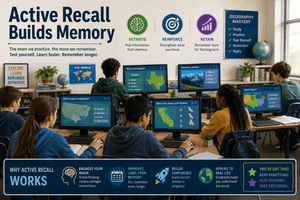
Educational research repeatedly shows that active recall outperforms passive study methods.
Active recall occurs when learners retrieve answers from memory instead of rereading material.
A 50 state capitals test naturally applies active recall because students must produce answers independently.
Each successful retrieval signals to the brain that information matters.
Over time, repeated study sessions reinforce neural pathways and improve recall speed.
Students often discover that recalling this information feels easier after repeated practice because the brain becomes more efficient at retrieval.
Neuroplasticity and Geography Learning
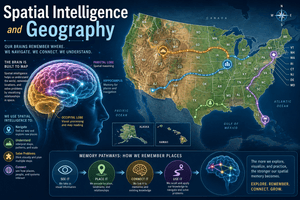
Neuroplasticity describes the brain’s ability to reorganize and strengthen neural networks through experience.
Every time learners complete a 50 state capitals test, neural connections involved in geographic memory become stronger.
Repeated learning activities gradually transform difficult information into familiar knowledge.
Instead of thinking, “I need to memorize this,” students begin thinking, “I recognize this pattern.”
That shift makes active testing more effective than memorization alone.
Gamification Makes Learning More Enjoyable
Gamification combines educational content with elements like scores, challenges, progress tracking, and rewards.
A 50 state capitals test becomes more engaging when presented as a game. Benefits include:
- Timed challenges
- Progress levels
- Achievement goals
- Memory streaks
- Competitive score systems
Students can improve learning with the US State Capital Quiz.
Advanced players can use the US States by Borders Quiz.
Gamified systems turn what could be a tedious memorization task into an enjoyable challenge.
Many learners using a hard mode state capitals quiz notice stronger concentration and faster recall.
Building Strong Mental Associations
Memory improves when information connects with multiple ideas.
Mastering a 50 state capitals test becomes easier when learners create associations. Great strategies include:
- Connecting capitals with landmarks
- Associating regions with climate
- Visualizing neighboring states
- Creating memorable stories
- Using visual maps repeatedly
For example, visual learners often use a blank US map for practice during study sessions.
Others benefit from a printable blank map of the United States because drawing locations reinforces memory.
Repeated interaction with spatial data gradually builds stronger mental structures.
Visual Learning and Geography Success
The human brain processes images quickly and efficiently.
A 50 state capitals test works especially well when visual methods support traditional learning.
Students frequently improve results by combining text-based learning with maps.
Interactive experiences such as an interactive map of US states and capitals increase engagement.
Visual learners also enjoy “identify the state by shape” quiz activities.
These assessments paired with visual exercises create stronger learning outcomes.
Expanding Memory Through Related Games
Learning becomes more effective when multiple cognitive systems work together.
Many learners combine a 50 state capitals test with additional geography activities.
- Strengthen visual memory using the Flag Memory Game.
- Improve pattern recognition through the Geo Connections Game.
- Build word association skills with the Scramble Words Game.
Some learners enjoy scramble words geography game activities because they challenge memory differently.
Combining activities with core geography lessons creates broader cognitive development.
Daily Practice Produces Better Results
Long study sessions are not always necessary.
Research suggests shorter sessions repeated consistently often outperform occasional intensive study.
A daily 50 state capitals test routine can improve retention dramatically.
Five or ten minutes of focused practice every day strengthens memory systems.
Students who complete these tests repeatedly often notice better recall after several weeks.
Daily learning habits also reduce stress because information becomes familiar over time.
Moving Beyond States and Capitals
Geographic skills developed through memorizing US locations can transfer into broader areas of knowledge.
Once learners become comfortable with state geography, they often explore larger challenges.
- Try the Countries of the World Quiz.
- Explore global symbols with the Flags of the World Quiz.
- Learn international cities using the Capital Cities of the World Quiz.
Students interested in world capitals quiz multiple-choice activities often develop stronger global awareness.
Some also enjoy world map quiz educational games and “guess the country by shape” game challenges.
A strong foundation created through a 50 state capitals test often improves broader geographic learning.
The Science Behind Geography Mastery
The brain was designed to recognize patterns and organize information spatially.
When learners repeatedly complete a 50 state capitals test, they engage systems related to memory, navigation, attention, and recognition.
Repeated retrieval strengthens learning efficiency. Gamification increases motivation. Spatial intelligence builds deeper understanding, and neuroplasticity creates stronger neural pathways.
These mechanisms transform a 50 state capitals test from a simple classroom activity into a powerful learning tool.
A consistent study routine improves confidence and builds long-term geographic literacy.
Over time, learners often discover that recalling this information becomes easier because understanding replaces memorization.
Eventually, mastering these facts becomes more than a challenge. It becomes a system for improving memory, strengthening cognitive skills, and creating a deeper understanding of the world.