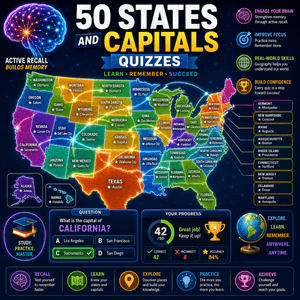
Learning geography becomes much more effective when learners understand how the brain naturally organizes information. Modern educational research shows that people remember locations, patterns, and spatial relationships better than isolated facts. This is one reason why 50 states and capitals quizzes have become valuable learning tools for students and lifelong learners.
Rather than functioning as simple tests, 50 states and capitals quizzes create experiences that strengthen memory pathways. Instead of reading lists repeatedly, learners actively retrieve information and build meaningful connections.
Scientists studying cognitive geography explain that the brain develops internal maps that help people understand the world around them. Activities such as 50 states and capitals quizzes support this natural process.
How the Brain Builds Geographic Knowledge
The human brain evolved to remember places and navigate environments. Long before modern classrooms existed, humans survived by remembering locations and patterns. Today, those same systems help people learn geography.
When learners complete 50 states and capitals quizzes, they engage memory systems associated with navigation and recall. The hippocampus plays a major role in creating these memories. Instead of storing isolated facts, it creates relationships between pieces of information.
Repeated use of 50 states and capitals quizzes helps learners connect states with shapes, neighboring regions, and capitals. This process activates neuroplasticity, the brain’s ability to strengthen neural pathways through repeated experiences.
Spatial Intelligence Makes Geography Easier
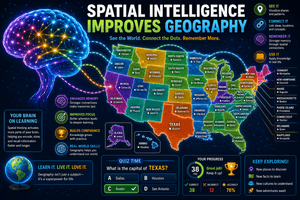
Spatial intelligence refers to the ability to understand locations, distances, patterns, and visual relationships. Students with strong spatial intelligence often visualize maps naturally, but everyone can improve this skill through practice.
50 states and capitals quizzes encourage learners to create mental images of geographic information. Instead of remembering names from a list, learners begin seeing maps inside their minds. For example, learners may connect Colorado with mountains or associate Florida with its recognizable peninsula shape. Over time, 50 states and capitals quizzes become tools for building stronger cognitive maps.
Active Recall Creates Stronger Memory
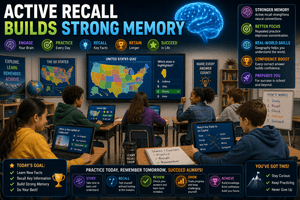
Educational psychology repeatedly shows that active recall produces stronger learning than passive reading. Active recall means retrieving information from memory instead of simply reviewing it.
50 states and capitals quizzes naturally use active recall because learners must search their memory for answers. The brain treats successful retrieval as important and reinforces the memory pathway. Reading a state capital list may create temporary familiarity, but 50 states and capitals quizzes encourage long-term retention. This is one reason teachers increasingly include retrieval-based learning strategies in classrooms.
| Learning Method | Cognitive Process | Memory Performance | Engagement Dynamic |
|---|---|---|---|
| Passive Review (Reading Lists) | Recognition only | Short-term familiarity | Low stimulation / High fatigue |
| Active Recall (Quizzes) | Retrieval & Reinforcement | Long-term retention | High engagement / Stimulating |
Why Gamification Improves Learning
Gamification introduces game elements into education, including scores, progress systems, competition, and rewards. 50 states and capitals quizzes become more engaging when learners see progress and challenge themselves. Games reduce boredom while increasing curiosity. Students often remain motivated longer because interactive activities feel enjoyable.
Many learners strengthen their geography knowledge with the US State Capital Quiz. Others practice visual recognition through Guess the US States. Advanced learners frequently use the US States by Borders Quiz. Combining games with 50 states and capitals quizzes creates more memorable learning experiences.
Creating Strong Cognitive Maps
Cognitive maps are mental representations of locations and relationships. Instead of remembering isolated information, learners organize knowledge into connected systems. 50 states and capitals quizzes strengthen these structures because they repeatedly activate geographic memory. Students gradually learn where places exist relative to each other.
- Identify neighboring states
- Recognize state shapes
- Connect capitals with locations
- Visualize map patterns
- Practice retrieval repeatedly
Regular use of 50 states and capitals quizzes supports stronger recall and deeper understanding.
Using Multiple Learning Channels
The brain learns more effectively when information enters through multiple sensory pathways. 50 states and capitals quizzes work well alongside visual, auditory, and interactive learning methods. Students can read state names aloud, draw maps from memory, and practice online games.
Many learners use a US state capitals quiz printable format because writing information improves retention. Others prefer an interactive map of US states and capitals experience. Combining multiple methods with 50 states and capitals quizzes creates richer learning environments.
Building Confidence Through Gradual Difficulty
Learning becomes more effective when challenges increase gradually. Beginners often start by recognizing states and capitals. Intermediate learners identify locations without visual clues. Advanced learners attempt timed challenges using 50 states and capitals quizzes.
Some students enjoy hard mode state capitals quiz activities because they demand faster thinking. Others use blank US map for practice exercises to strengthen visual memory. Repeated difficulty progression turns 50 states and capitals quizzes into powerful brain training systems.
Memory Games and Geography Training
Geography learning becomes stronger when paired with memory activities. 50 states and capitals quizzes naturally connect with pattern recognition and recall exercises. Students often use the Flag Memory Game for additional visual learning. Brain training memory game flags activities strengthen recognition skills. Many learners also enjoy the Geo Connections Game. Adding these activities alongside 50 states and capitals quizzes increases engagement and retention.
Expanding Beyond States and Capitals
Geography knowledge often expands naturally after learners master states and capitals. Strong foundations developed through 50 states and capitals quizzes improve performance across other topics. Students can continue exploring the Countries of the World Quiz.
Visual learners may enjoy the Flags of the World Quiz. Global learners can practice with the Capital Cities of the World Quiz. Some people enjoy world capitals quiz multiple choice activities for broader knowledge development. Others prefer world map quiz educational games and guess the country by shape game experiences. Skills gained from 50 states and capitals quizzes frequently transfer into global geography success.
The Role of Neuroplasticity
Neuroplasticity explains how the brain changes through repeated learning experiences. Every successful retrieval creates stronger neural pathways. 50 states and capitals quizzes repeatedly activate these pathways. The more learners practice, the easier retrieval becomes.
Over time, learners require less effort because 50 states and capitals quizzes reinforce automatic recognition. Instead of memorizing information temporarily, learners develop lasting knowledge structures.
The Core Formula of Memory Retention: If R represents long-term recall stability and S is spatial neural connectivity built via active retrieval channels, then R → ∞ as repetitive retrieval frequency f(S) ≥ μ, where μ represents the neuroplastic threshold of structural automated recall.
Making Geography Part of Daily Learning
Daily practice usually produces better results than occasional long study sessions. Short interactive activities maintain attention and improve consistency. Students frequently use the Wordle Geography Game for daily challenges.
Others enjoy the Scramble Words Game because scramble words geography game activities improve focus. Additional options include the Higher Or Lower Population Game, Autocomplete Game, and Global Showdown.
Adding variety keeps 50 states and capitals quizzes enjoyable. Consistent practice with 50 states and capitals quizzes supports stronger memory development. Daily interaction with 50 states and capitals quizzes gradually improves confidence. Over time, learners discover that 50 states and capitals quizzes become less about testing and more about understanding. The combination of spatial intelligence, active recall, and cognitive geography transforms learning into an engaging experience. Most importantly, 50 states and capitals quizzes help learners build lasting geographic literacy that extends beyond classrooms and exams.