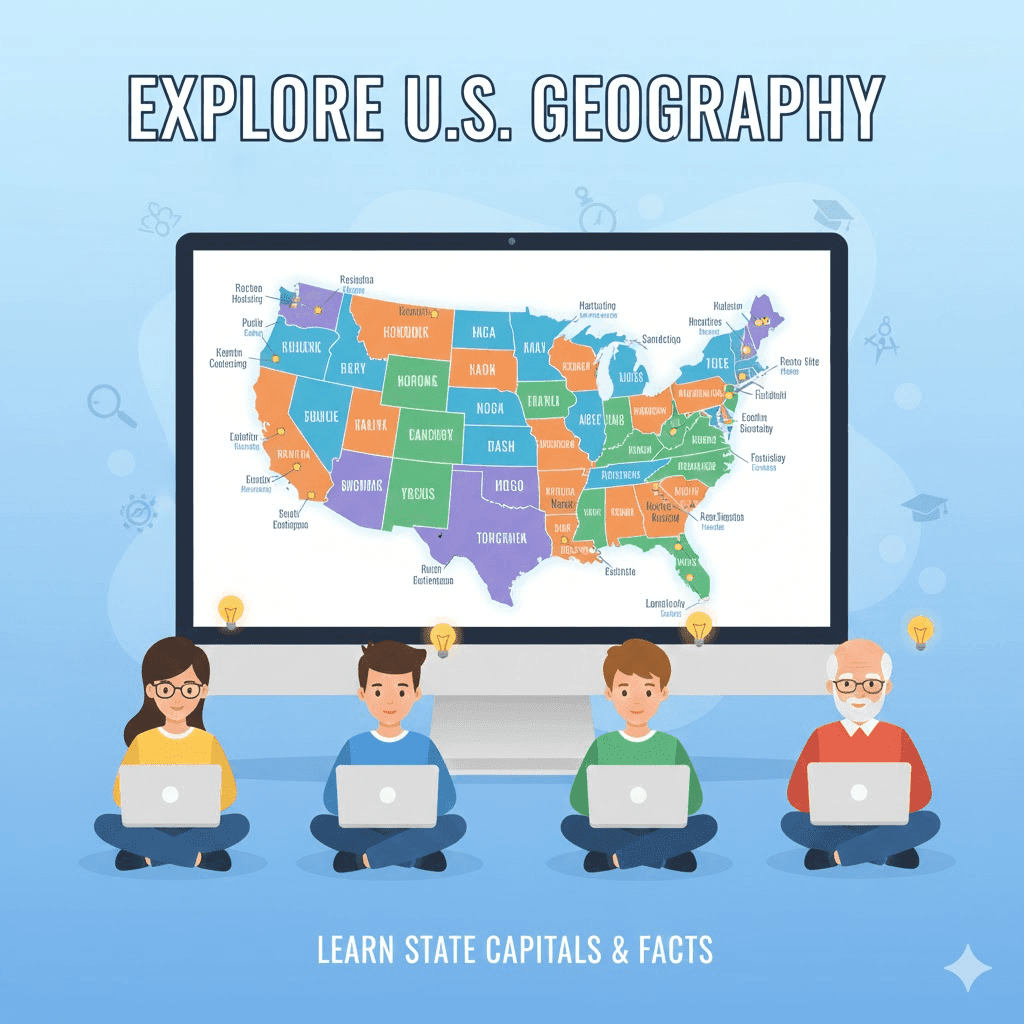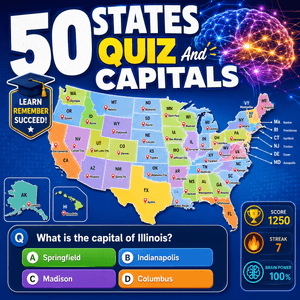
Geography learning has evolved far beyond memorizing lists and repeating information from textbooks. Modern cognitive science reveals that people remember locations more effectively when learning becomes interactive, visual, and connected to how the brain naturally organizes information. A 50 states quiz and capitals activity can become one of the most effective tools for strengthening memory, building spatial awareness, and improving long-term knowledge retention.
Instead of seeing geography as a collection of facts, learners can view it as an opportunity to train the brain. Through active recall, cognitive geography, and spatial intelligence, a 50 states quiz and capitals experience becomes a complete learning system rather than a simple educational exercise.
The human brain evolved to understand places, recognize patterns, and remember routes. That natural ability can be strengthened through repeated geographic challenges.
How the Brain Naturally Learns Geography
Human brains are designed to build mental representations of the world. Long before digital maps existed, people relied on spatial memory for survival. Remembering locations of water sources, routes, landscapes, and communities was essential.
Today, these same systems continue helping us learn. A 50 states quiz and capitals activity activates brain areas responsible for navigation and memory.
The hippocampus plays a particularly important role. Scientists often describe it as part of the brain’s internal navigation system. Every time learners practice a 50 states quiz and capitals challenge, they strengthen neural pathways associated with memory retrieval.
Repeated learning experiences gradually improve retention because of neuroplasticity.
Neuroplasticity is the brain’s ability to change and reorganize itself based on repeated experiences.
Spatial Intelligence Creates Stronger Memory
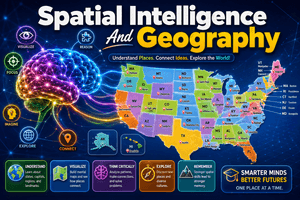
Spatial intelligence refers to understanding how objects and locations relate to one another. Geography naturally supports this type of thinking because maps require visual organization.
A 50 states quiz and capitals exercise does more than teach names. It teaches relationships.
Instead of remembering a capital independently, learners begin connecting information to surrounding states, landmarks, and regions.
For example, learners may associate western states with mountain ranges or northeastern states with specific historical regions.
These patterns transform isolated information into meaningful cognitive structures.
Repeated practice with a 50 states quiz and capitals challenge gradually strengthens these mental maps.
The Power of Active Recall
Many students spend hours rereading material and highlighting pages. Research consistently shows that retrieval practice produces stronger results.
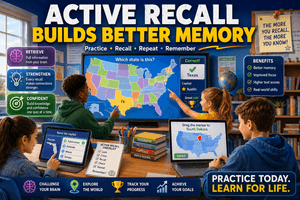
Active recall requires learners to retrieve information directly from memory instead of passively viewing answers.
A 50 states quiz and capitals activity naturally uses active recall principles.
When learners attempt to remember a state capital before seeing the answer, their brains work harder.
That effort is important because stronger effort often creates stronger retention.
The brain interprets successful retrieval as valuable information and strengthens associated pathways.
Repeated sessions with a 50 states quiz and capitals challenge increase memory performance over time.
Gamification Makes Learning More Engaging
Gamification adds challenge, rewards, progression, and excitement to learning experiences.
A 50 states quiz and capitals activity can feel less like studying and more like solving a puzzle.
Game mechanics stimulate curiosity and encourage repeated participation.
For example, learners can attempt:
- Timed challenges
- Memory competitions
- Progress tracking
- Speed rounds
- Difficulty levels
Students can strengthen knowledge further using US State Capital Quiz.
Visual learners often enjoy Guess the US States.
Additional practice can come from US State Name Quiz.
Combining these experiences with a 50 states quiz and capitals challenge creates richer learning environments.
Creating Cognitive Maps
The brain stores geographic knowledge more effectively when learners build cognitive maps.
Cognitive maps are internal representations of physical spaces.
Rather than memorizing information randomly, learners organize knowledge into structures.
A 50 states quiz and capitals exercise strengthens these structures by creating repeated associations.
For example, learners may remember:
- State shapes
- Neighboring regions
- Capital locations
- Population patterns
- Geographic landmarks
These connections gradually improve memory performance.
Students often use an interactive map of us states and capitals approach because visual learning supports stronger recall.
Some learners also practice with a blank us map for practice exercise.
Using a printable blank map of the united states can improve spatial understanding.
Progressive Difficulty Improves Brain Performance
Learning works best when challenges increase gradually.
Start with recognition exercises.
Then move toward recall challenges.
Later introduce time pressure.
Finally, attempt a complete 50 states quiz and capitals challenge without support.
Advanced learners often enjoy hard mode state capitals quiz activities because they create stronger retrieval demands.
More difficult practice strengthens memory pathways.
A 50 states quiz and capitals routine becomes increasingly valuable as complexity grows.
Visual Recognition Supports Geographic Learning
The brain processes images quickly and efficiently.
Visual learning frequently increases retention because multiple brain systems become involved simultaneously.
A 50 states quiz and capitals activity works especially well when visual exercises are included.
Students can strengthen recognition using:
- State outline challenges
- Map completion tasks
- Color-coded regions
- Interactive maps
- Pattern recognition games
Many learners enjoy guess the us state by border shape activities because visual retrieval increases engagement.
Others use identify the state by shape quiz exercises for stronger recognition.
Combining visual exercises with a 50 states quiz and capitals challenge creates deeper learning.
Expanding Learning Through Geography Games
Geography learning becomes more exciting when learners explore different formats.
A 50 states quiz and capitals challenge can connect naturally with broader geography activities.
Explore Countries of the World Quiz for global learning.
Strengthen visual memory using Flags of the World Quiz.
Develop international knowledge through Capital Cities of the World Quiz.
Many learners enjoy flags of the world quiz with answers because visual recognition improves recall.
Others explore world capitals quiz multiple choice activities to build global knowledge.
A strong foundation from a 50 states quiz and capitals routine often supports broader geographic understanding.
Brain Training Through Multiple Learning Channels
Educational psychologists frequently recommend using multiple learning channels simultaneously.
A 50 states quiz and capitals approach works effectively when learners combine visual, verbal, and interactive methods.
- Speak answers aloud
- Draw maps from memory
- Use quizzes regularly
- Repeat retrieval sessions
- Create associations
Some students use a 50 states and capitals song quiz approach because rhythm improves memory.
Others combine daily geography word challenge exercises with map activities.
Multiple learning methods strengthen a 50 states quiz and capitals experience.
Daily Practice Builds Long-Term Results
Long study sessions often create mental fatigue. Smaller daily sessions usually produce better retention.
Consistent practice with a 50 states quiz and capitals challenge gradually creates stronger memory pathways.
Daily learners often enjoy Wordle Geography Game.
Others improve focus using Scramble Words Game.
Students can also practice with Higher Or Lower Population Game.
Additional challenges include Autocomplete Game and Global Showdown.
Adding variety keeps a 50 states quiz and capitals routine engaging.
Repeated use of a 50 states quiz and capitals challenge gradually develops stronger cognitive flexibility.
Over time, a 50 states quiz and capitals activity becomes less about memorization and more about understanding geographic relationships.
Learning geography ultimately means understanding how places connect and interact. Through active recall, neuroplasticity, gamification, and spatial intelligence, a 50 states quiz and capitals experience becomes a powerful method for improving memory, building confidence, and developing lifelong geographic literacy.
Strong geography skills create stronger thinking skills, and every 50 states quiz and capitals session moves learners one step closer toward mastering the map.