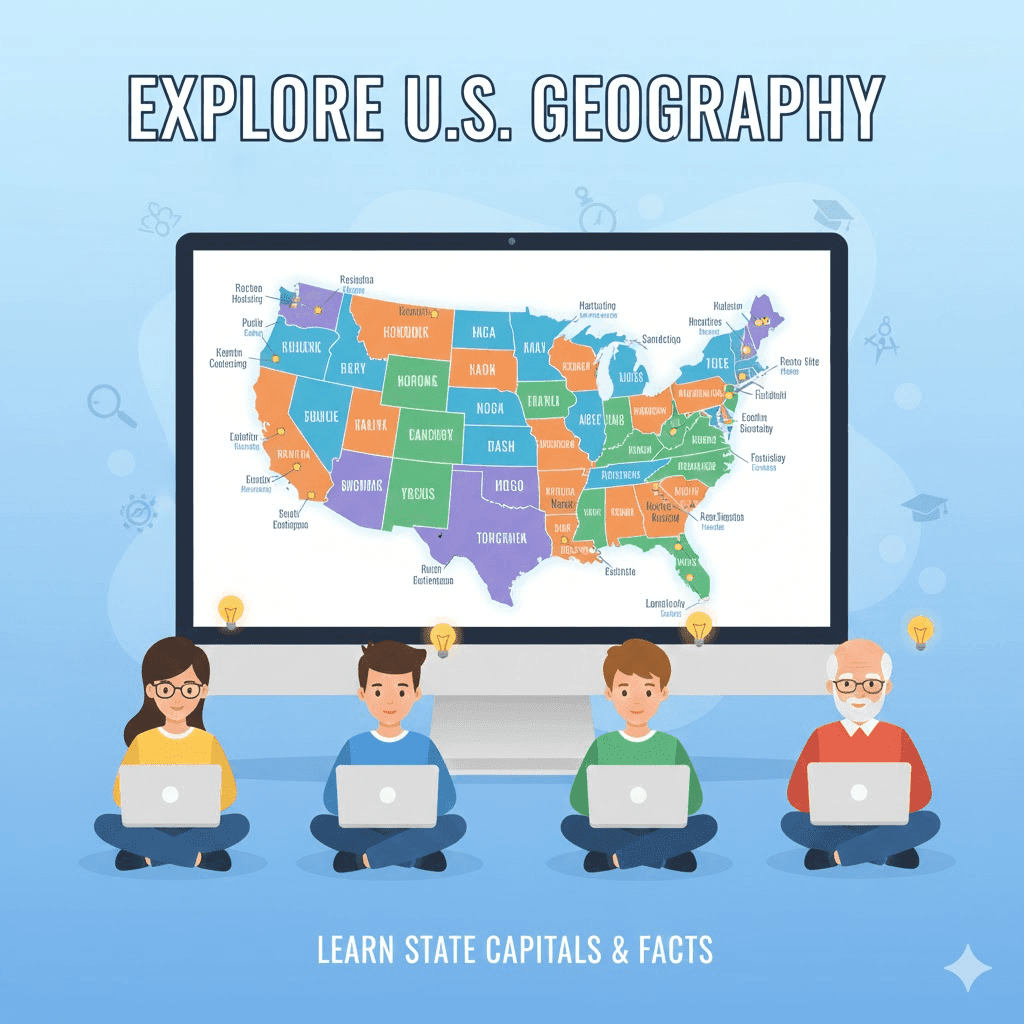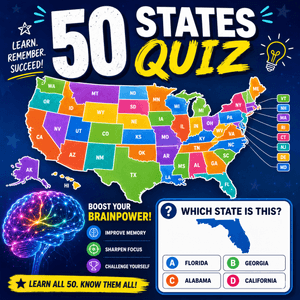
Geography is more than remembering names on a map. Modern research in learning science suggests that the brain learns location-based information differently from ordinary facts. Instead of relying on repetitive memorization, learners build stronger knowledge through visualization, active recall, and pattern recognition. A 50 states quiz becomes much more than a classroom activity when approached using these principles.
Students often spend hours reading state lists repeatedly and become frustrated when information disappears after a few days. The reason is simple: passive review rarely creates strong memory pathways. A 50 states quiz encourages learners to retrieve information actively and create meaningful geographic relationships.
The brain naturally understands places and movement. Humans evolved by remembering routes, landscapes, and locations. Because of this, a 50 states quiz aligns closely with how memory systems actually function.
How Geography Connects with the Brain
The human brain contains systems specifically involved in spatial memory and navigation. The hippocampus, which plays a major role in memory formation, becomes highly active when people process locations and environments.
When learners repeatedly use a 50 states quiz, they strengthen pathways associated with spatial understanding.
Rather than storing information as isolated facts, the brain creates mental structures connecting locations and relationships.
This process helps explain why interactive learning usually produces better outcomes than passive memorization.
Why Spatial Intelligence Matters
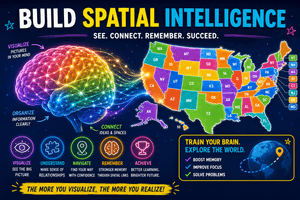
Spatial intelligence refers to understanding how locations and objects relate to one another. Strong spatial thinkers can easily visualize patterns and understand map relationships.
A 50 states quiz develops spatial intelligence because learners connect state names with locations and shapes.
Instead of remembering Texas only as a word, students may visualize its position, neighboring states, and recognizable outline.
Repeated use of a 50 states quiz gradually creates stronger mental maps.
Active Recall Improves Retention
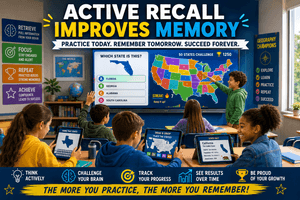
Active recall is one of the most effective learning methods identified by educational research.
Instead of reviewing information repeatedly, active recall forces learners to retrieve answers from memory.
A 50 states quiz naturally applies this technique.
When a student attempts to remember a state’s location or identify it correctly, the brain strengthens neural pathways.
Repeated retrieval improves long-term retention much more effectively than passive reading.
Many students pair a 50 states quiz with US State Capital Quiz for stronger recall.
The Role of Neuroplasticity
Neuroplasticity refers to the brain’s ability to adapt and reorganize itself.
Each time learners practice a 50 states quiz, the brain strengthens important pathways.
Repeated engagement signals that geographic information matters.
Over time, recall becomes easier and faster.
Eventually, a 50 states quiz feels less like memorization and more like recognition.
Learning Through Gamification
Games increase motivation because they provide challenge and immediate feedback.
A 50 states quiz becomes more engaging when learners track scores and progress.
- Timed challenges
- Achievement streaks
- Difficulty levels
- Competitive learning
- Memory goals
Visual learning improves with Guess the US States.
Advanced learners may enjoy US States by Borders Quiz.
Students looking for a us states quiz no outlines challenge often use border-recognition exercises to strengthen map awareness.
Building Strong Cognitive Maps
Cognitive maps are internal representations of environments and locations.
A 50 states quiz helps learners organize information more efficiently.
- Recognize state patterns
- Remember neighboring states
- Visualize regions
- Connect capitals with locations
- Identify state shapes
Students often improve with us states map quiz for middle school activities.
Many also enjoy identify the state by shape quiz challenges.
Repeated use of a 50 states quiz gradually strengthens these mental structures.
Using Multiple Learning Channels
The brain learns more effectively when multiple systems participate simultaneously.
A 50 states quiz works especially well alongside:
- Drawing maps
- Reading capitals aloud
- Visual memory exercises
- Interactive games
- Retrieval practice
Some learners prefer a 50 states and capitals song quiz because rhythm supports memory.
Others use a blank us map for practice approach.
A printable blank map of the united states can also strengthen visual understanding.
Expanding Geography Skills Beyond States
Strong foundations often improve broader geographic understanding.
After practicing a 50 states quiz, learners can explore world geography topics.
Try Countries of the World Quiz.
Improve visual recognition with Flags of the World Quiz.
Explore global capitals through Capital Cities of the World Quiz.
Many learners also enjoy world map quiz educational games and guess the country by shape game activities.
Making Geography a Daily Habit
Small daily sessions often outperform occasional long study periods.
Daily challenges maintain engagement and strengthen memory pathways.
Practice with Wordle Geography Game for a daily geography word challenge.
Use Scramble Words Game because scramble words geography game activities strengthen pattern recognition.
Additional activities include Higher Or Lower Population Game, Autocomplete Game, and Global Showdown.
A 50 states quiz strengthens memory retrieval, improves spatial awareness, builds stronger cognitive maps, and creates long-term geographic understanding. Learning geography becomes easier when the brain actively participates in the process.
External resources:
National Geographic,
Britannica,
USGS