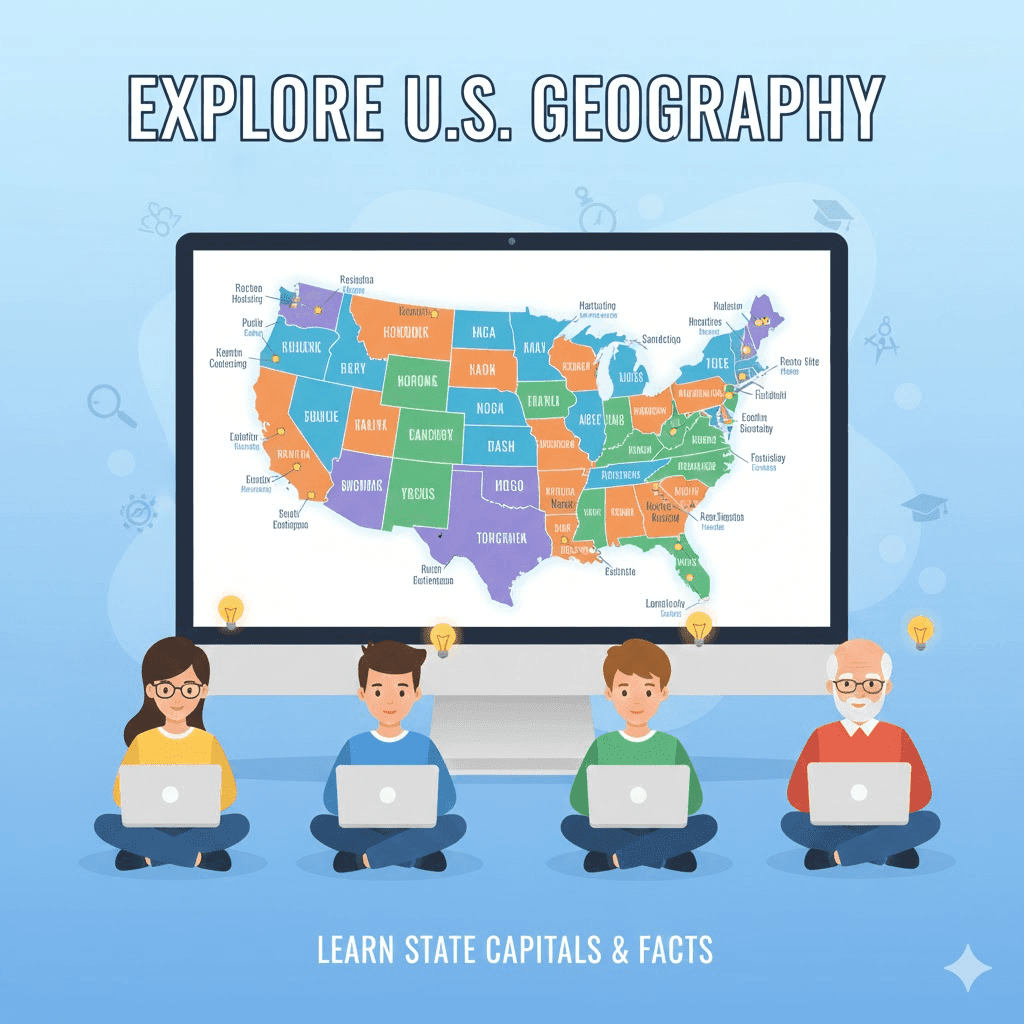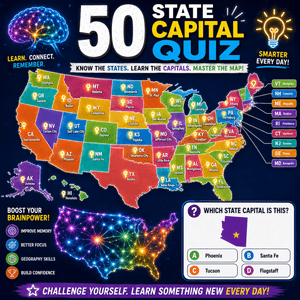
Geography learning becomes significantly more effective when learners understand how the brain naturally processes information. Instead of viewing maps and capitals as isolated facts, modern learning science suggests building relationships, visual patterns, and memory pathways. A 50 state capital quiz is more than a classroom activity. It becomes a tool for strengthening memory and developing cognitive skills.
Researchers studying cognitive geography and memory have discovered that the brain learns location-based information differently from ordinary facts. Humans evolved by remembering environments, routes, and locations. As a result, the human brain naturally builds internal maps.
When students use a 50 state capital quiz, they engage systems connected with memory retrieval, visual learning, and pattern recognition. Rather than forcing memorization, learners begin creating mental structures that improve long-term retention.
How Geography Learning Activates the Brain
The brain constantly organizes information into patterns. Geography naturally supports this process because maps create visual structures that help memory.
A 50 state capital quiz activates the hippocampus, which plays a major role in memory formation and navigation. Scientists often describe the hippocampus as part of the brain’s internal mapping system.
Instead of remembering only a capital city name, learners begin connecting states with regions, neighboring states, landmarks, and geographic characteristics.
Repeated practice with a 50 state capital quiz gradually strengthens these pathways.
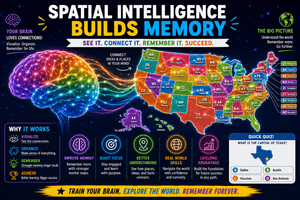
Understanding Spatial Intelligence
Spatial intelligence refers to understanding relationships between places and objects. Some individuals naturally visualize maps well, while others strengthen this ability through practice.
A 50 state capital quiz helps learners improve spatial intelligence because it requires connecting information with locations.
- Recognizing state positions
- Identifying regional clusters
- Understanding map patterns
- Remembering neighboring states
- Building visual associations
Repeated interaction with a 50 state capital quiz helps learners create stronger cognitive maps.
Students using an interactive map of us states and capitals often improve faster because visual experiences strengthen recall.
Why Active Recall Improves Learning
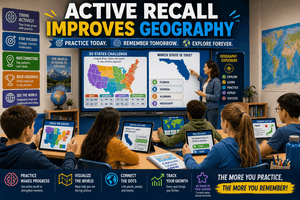
Educational psychologists consistently identify active recall as one of the strongest learning techniques.
Instead of passively reading lists, active recall requires learners to retrieve answers directly from memory.
A 50 state capital quiz naturally applies active recall because players must remember answers before seeing results.
Every successful retrieval tells the brain that information matters.
Repeated use of a 50 state capital quiz gradually transforms difficult information into automatic knowledge.
Neuroplasticity and Memory Growth
Neuroplasticity describes the brain’s ability to change and strengthen pathways through experience.
Whenever learners repeatedly practice a 50 state capital quiz, the brain reorganizes and improves its memory networks.
The more frequently information is retrieved, the stronger these pathways become.
This explains why a 50 state capital quiz often feels difficult initially but becomes easier with consistent practice.
Using Gamification for Geography Success
Games improve engagement because they provide challenge, rewards, and progress.
A 50 state capital quiz becomes more exciting when learners turn studying into a game.
- Timed challenges
- Daily streak goals
- Competitive scores
- Difficulty progression
- Achievement milestones
Students frequently improve recall through US State Capital Quiz.
Visual learning improves with Guess the US States.
Advanced learners often use US States by Borders Quiz.
Adding these experiences alongside a 50 state capital quiz creates stronger learning outcomes.
Building Better Cognitive Maps
Cognitive maps are mental representations of environments and locations.
A 50 state capital quiz helps learners organize information into larger structures.
Instead of memorizing isolated facts, learners begin seeing relationships and patterns.
Students often improve further through us states map quiz for middle school activities and identify the state by shape quiz exercises.
A blank us map for practice can also strengthen visual memory.
Combining Multiple Learning Methods
The brain remembers information more effectively when multiple learning systems participate.
A 50 state capital quiz works best when combined with:
- Visual learning
- Speaking answers aloud
- Drawing maps
- Interactive quizzes
- Repeated retrieval practice
Some learners prefer a 50 states and capitals song quiz because rhythm helps memory retention.
Others use a printable blank map of the united states to practice visual recall.
Expanding Beyond States and Capitals
Strong foundations in geography often improve broader learning.
After mastering a 50 state capital quiz, learners frequently expand into global topics.
Continue learning with Countries of the World Quiz.
Strengthen visual recognition through Flags of the World Quiz.
Improve international knowledge with Capital Cities of the World Quiz.
Many learners enjoy world capitals quiz multiple choice activities and world map quiz educational games.
Others practice using guess the country by shape game challenges.
Making Geography a Daily Habit
Daily practice generally creates stronger memory than occasional long study sessions.
Short learning periods reduce fatigue and strengthen recall.
Many learners enjoy Wordle Geography Game.
Others use Scramble Words Game because scramble words geography game activities improve pattern recognition.
Additional activities include Higher Or Lower Population Game, Autocomplete Game, and Global Showdown.
A 50 state capital quiz improves memory retrieval, strengthens spatial awareness, supports cognitive geography skills, and builds stronger recall pathways.
Learning geography becomes more powerful when the brain actively participates in the process. Through active recall, neuroplasticity, and spatial intelligence, a 50 state capital quiz becomes more than a quiz. It becomes a brain-training system for lifelong learning.
External resources:
National Geographic,
Britannica,
USGS