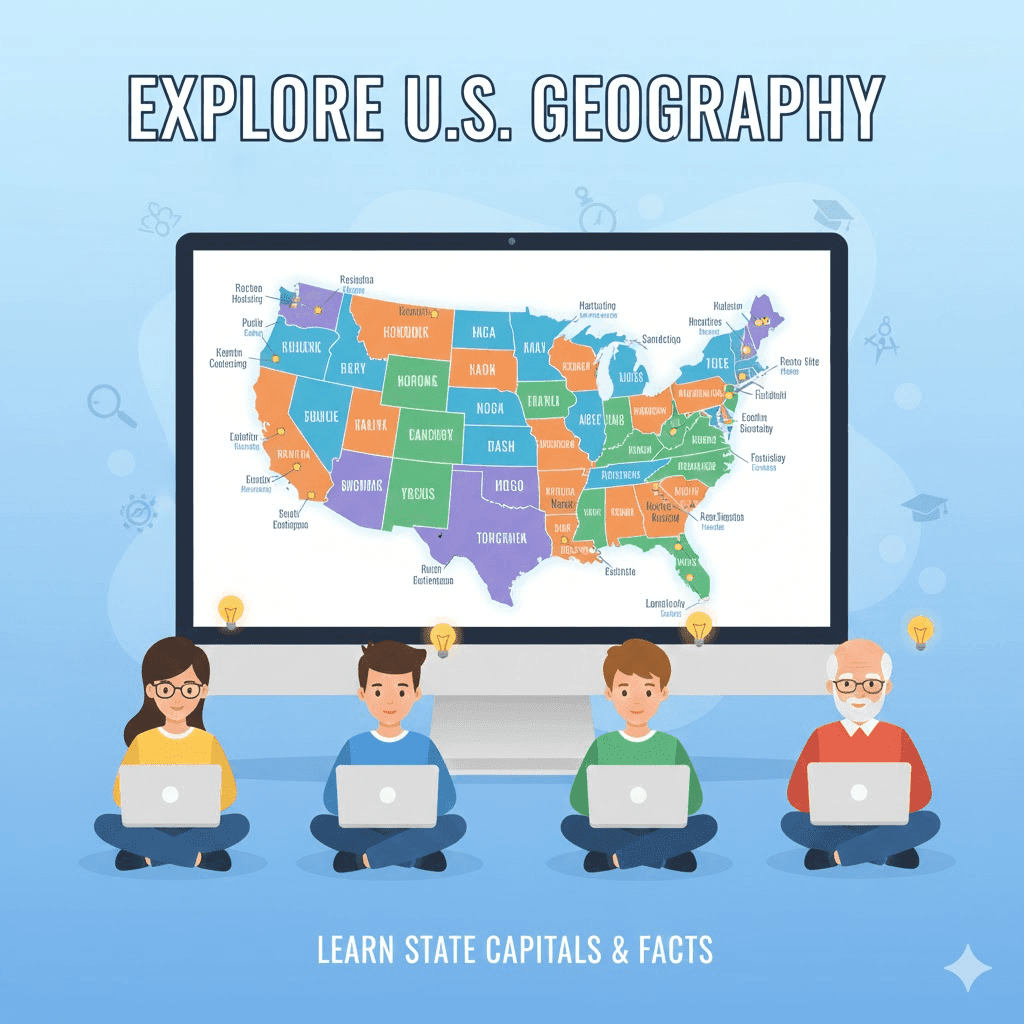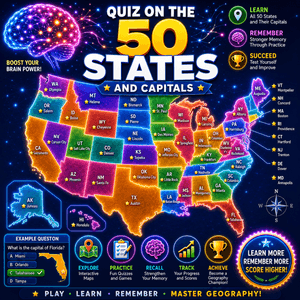
Geography becomes more meaningful when learners understand how the brain naturally remembers places, patterns, and locations. Traditional memorization often focuses on reading long lists of states and capitals repeatedly. Modern cognitive science shows that learners retain information much more effectively when they actively retrieve knowledge and build mental connections. That is why a quiz on the 50 states and capitals can become much more than an educational activity.
Instead of treating states and capitals as isolated facts, learners can use interactive geography activities to strengthen spatial intelligence and cognitive geography skills. These learning methods help the brain organize information into memorable patterns that remain accessible over time.
Scientists studying memory and learning have discovered that the brain creates stronger pathways when learners repeatedly recall information rather than simply reading it. A quiz on the 50 states and capitals naturally uses this principle.
How the Brain Creates Geographic Memory
The brain evolved to remember environments, routes, and locations. Long before maps and digital technology existed, humans relied on spatial awareness to survive.
Today, these same systems continue helping people learn geography. Interactive state and capital activities activate navigation-related memory systems and encourage stronger recall.
The hippocampus plays a major role in this process. This region of the brain helps organize information connected with location and memory.
Repeated practice with educational geography exercises strengthens pathways associated with geographic memories.
As learners continue practicing, recall gradually becomes faster and more automatic.
Spatial Intelligence Makes Learning Easier
Spatial intelligence refers to understanding relationships between locations, objects, and patterns.
A states and capitals learning activity helps learners develop this ability because they connect state names with map positions.
For example, learners may remember California as a western coastal state while associating Texas with its large shape and central southern location.
Repeated interaction with a quiz on the 50 states and capitals gradually strengthens these mental connections.
Over time, learners begin constructing detailed cognitive maps.
Active Recall Is More Powerful Than Memorization
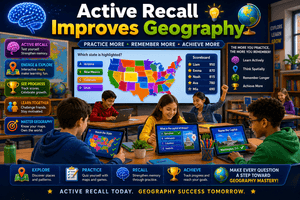
Educational research consistently shows that active recall is among the strongest learning methods available.
Instead of reviewing information repeatedly, active recall requires learners to retrieve answers directly from memory.
A quiz on the 50 states and capitals naturally applies this technique.
Each time a learner remembers a state capital successfully, the brain strengthens the pathway responsible for that memory.
State capital practice activities therefore support stronger long-term retention.
Students often notice that repeated retrieval sessions improve performance much faster than passive reading.
Neuroplasticity and Geography Learning
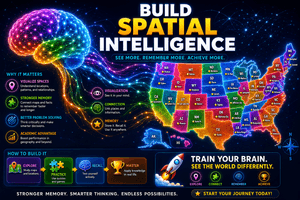
The human brain constantly adapts to experiences. This ability is called neuroplasticity.
When learners repeatedly practice geography recall exercises, the brain strengthens important neural pathways.
The more frequently information is retrieved, the stronger those pathways become.
Over time, a quiz on the 50 states and capitals becomes easier because the brain organizes information more efficiently.
Gamification Improves Motivation
Learning becomes more enjoyable when game elements are introduced.
A quiz on the 50 states and capitals becomes highly engaging when learners experience progress and achievement.
- Timed challenges
- Daily streak goals
- Increasing difficulty levels
- Competitive score systems
- Achievement rewards
Students frequently strengthen recall with US State Capital Quiz.
Visual recognition improves through Guess the US States.
Advanced learners often enjoy US States by Borders Quiz.
Adding these experiences alongside geography learning activities creates stronger engagement.
Creating Mental Maps Through Repetition
Cognitive maps are mental representations of places and relationships.
A quiz on the 50 states and capitals helps learners gradually build these structures.
- Remember neighboring states
- Associate capitals with regions
- Identify geographic patterns
- Recognize state shapes
- Visualize map locations
Repeated practice strengthens these connections.
Students often improve further with us states map quiz for middle school activities.
Many learners also enjoy identify the state by shape quiz challenges.
Using Multiple Learning Methods
The brain retains information more effectively when multiple learning channels participate.
A quiz on the 50 states and capitals works especially well alongside visual and auditory methods.
- Drawing state maps
- Reading capitals aloud
- Practicing retrieval sessions
- Using visual memory activities
- Creating geographic stories
Some learners use a 50 states and capitals song quiz because rhythm supports memory.
Others practice with a blank us map for practice approach.
A printable blank map of the united states also strengthens visual understanding.
Combining these methods produces stronger learning outcomes.
Expanding Beyond States and Capitals
Once learners develop strong foundations, they often perform better across broader geography topics.
A quiz on the 50 states and capitals frequently becomes a starting point for global learning.
Expand your skills with Countries of the World Quiz.
Improve visual recognition with Flags of the World Quiz.
Explore global knowledge through Capital Cities of the World Quiz.
Many learners enjoy world capitals quiz multiple choice activities and world map quiz educational games.
Others prefer guess the country by shape game experiences.
A quiz on the 50 states and capitals often creates stronger confidence for advanced geography learning.
Building Daily Geography Habits
Short and consistent learning sessions often outperform occasional long study sessions.
Daily repetition reduces mental fatigue and strengthens memory systems.
Many learners enjoy Wordle Geography Game because daily geography word challenge activities encourage regular learning.
Others practice using Scramble Words Game because scramble words geography game activities improve pattern recognition.
Additional activities include Higher Or Lower Population Game, Autocomplete Game, and Global Showdown.
Interactive geography activities improve memory retrieval.
State and capital practice strengthens spatial awareness.
Geographic learning exercises develop cognitive skills.
Repeated recall builds stronger memory pathways.
Educational challenges encourage active participation.
Map-based exercises improve geographic understanding.
Consistent practice supports long-term learning.
Learning geography becomes more effective when the brain participates actively in the process. Through active recall, spatial intelligence, and repeated engagement, a quiz on the 50 states and capitals becomes more than a classroom exercise. It becomes a powerful tool for improving memory and building geographic understanding.
External learning resources:
National Geographic,
Britannica,
USGS.