The human brain is naturally wired to seek out patterns, categorize information, and draw profound links between seemingly disparate pieces of data. In the realm of cognitive geography, mastering the globe is rarely just about memorizing a static list of borders and coordinates. True spatial intelligence involves understanding the intricate web of relationships that bind our world together. This is where the standard methods of rote memorization fall short, and where the innovative architecture of a geography connections puzzle game steps in to revolutionize how we learn. By shifting the focus from simple declarative memory to complex relational thinking, a geography connections puzzle game offers an unparalleled cognitive workout that delights as much as it educates.
Traditional map quizzes serve a vital purpose in establishing baseline knowledge, acting as the foundational building blocks of geographic literacy. However, once that foundation is laid, the brain craves a higher level of intellectual stimulation. It wants to know not just where a country is, but how it relates to its neighbors, what historical threads it shares with nations across the ocean, and what demographic realities shape its borders. Entering the arena of a geography connections puzzle game forces the learner to actively synthesize these diverse data points. Every session of a geography connections puzzle game acts as a catalyst for neuroplasticity, requiring the brain to physically rewire itself to accommodate multi-layered, thematic understanding.
In this comprehensive exploration, we will dive deep into the neuroscience of lateral thinking and spatial reasoning. We will uncover exactly why a geography connections puzzle game is uniquely suited to elevate your cognitive health, how it utilizes active recall to cement long-term knowledge, and why educators and lifelong learners alike are turning to the geography connections puzzle game as the ultimate tool for achieving true, holistic geographic mastery.
The Neuroscience of Lateral Cartographic Thinking
To fully grasp the power of a geography connections puzzle game, we must first look at the brain’s prefrontal cortex. This region is the command center for executive function, responsible for logic, problem-solving, and the ability to hold multiple pieces of information in working memory simultaneously. While simply recalling the shape of a country primarily activates the hippocampus and visual cortex, engaging with a geography connections puzzle game sets the entire prefrontal cortex ablaze with electrical activity.
When you are presented with a grid of sixteen seemingly random geographic terms in a geography connections puzzle game, your brain must perform rapid, parallel processing. It retrieves the definition and location of each item, then cross-references those items against hundreds of potential thematic categories. This intense demand on working memory is what makes a geography connections puzzle game so effective at staving off cognitive decline. The American Psychological Association frequently notes that cognitive exercises requiring complex categorization are among the best defenses against age-related memory loss. By continually playing a geography connections puzzle game, you are effectively providing resistance training for your executive function.
Furthermore, a well-structured geography connections puzzle game leverages the psychological concept of “semantic networks.” Our brains do not store information in isolated silos; they store it in interconnected webs. When a player identifies a link—such as realizing that four specific countries are all landlocked nations in South America—the geography connections puzzle game reinforces that specific semantic pathway. The more frequently these pathways are activated by a geography connections puzzle game, the faster and more intuitive the player’s lateral thinking becomes across all aspects of their life.
It is also crucial to acknowledge the role of dopamine in this learning process. The “aha!” moment experienced when a player successfully solves a category in a geography connections puzzle game triggers a powerful dopamine release. This neurotransmitter is vital for solidifying memory consolidation. Because a geography connections puzzle game provides these satisfying moments of logical deduction, it creates a highly motivating, continuous feedback loop that encourages sustained educational engagement without the fatigue typical of traditional studying.
Building the Foundation for Complex Puzzles
Before a learner can fully appreciate the complexities of a geography connections puzzle game, they must first establish a robust internal mental map. Lateral thinking relies heavily on the quality of the data stored in long-term memory. If a player does not possess basic spatial recall, playing a geography connections puzzle game can become an exercise in frustration rather than cognitive growth. Therefore, pedagogical scaffolding is essential.
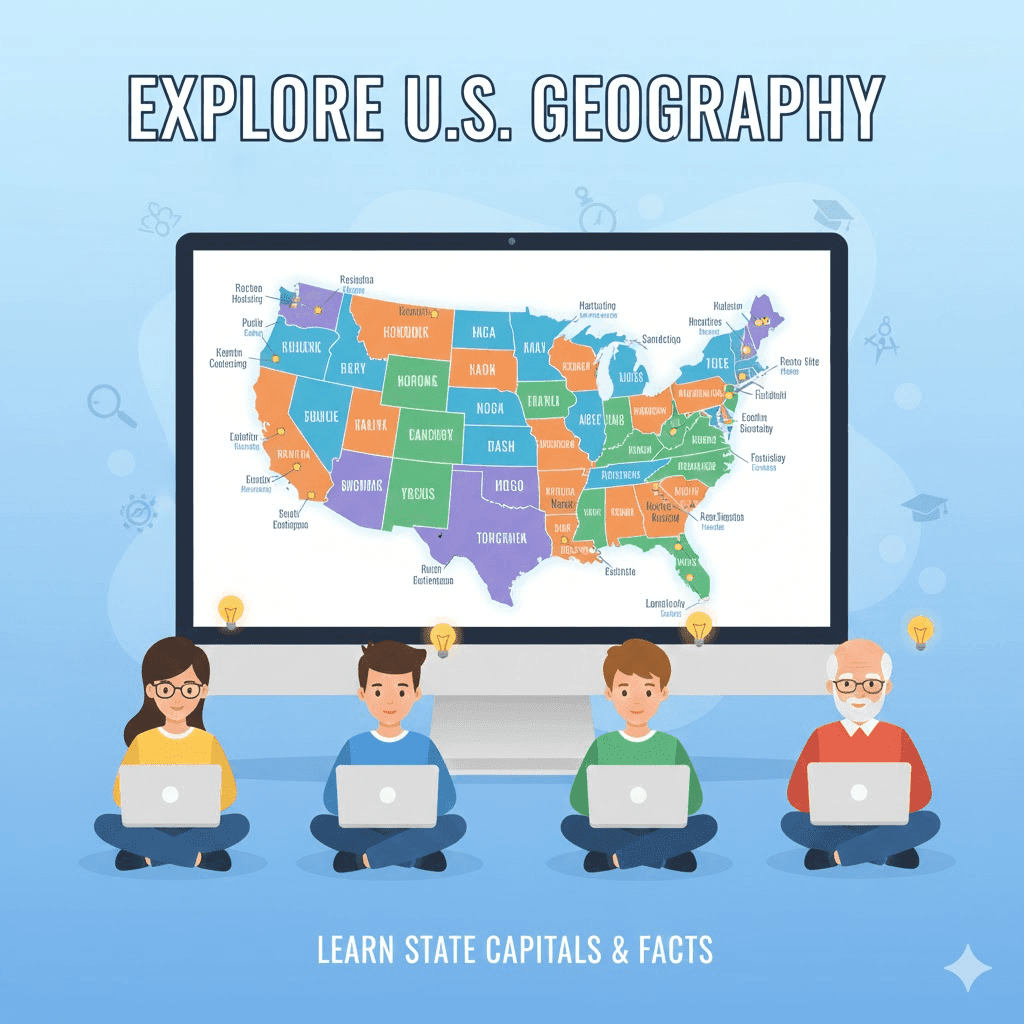
For users in North America, mastering domestic geography is the logical starting point. Engaging with foundational tools provides the raw materials necessary to eventually succeed at a geography connections puzzle game. For instance, repeatedly practicing with a US State Capital Quiz ensures that political centers are firmly memorized. Simultaneously, focusing on visual spatial awareness by playing Guess the US States helps the brain isolate and recognize the unique geometry of each territory. These localized exercises build the rapid recall speed required when these elements later appear in a geography connections puzzle game.
To push this foundational knowledge toward relational thinking, learners should explore tools that remove standard borders. The US States by Borders Quiz is an excellent transitional tool. It forces the learner to think about topology—who neighbors whom—which is a frequent category type found within any comprehensive geography connections puzzle game. Before taking a timed assessment, studying an interactive map of us states and capitals allows students to visually map out these relationships at their own pace, effectively pre-loading their semantic networks for the lateral challenges to come.
Orthographic skills are equally critical. A geography connections puzzle game often uses text-based grids, meaning rapid word recognition is vital. Practicing with a US State Name Quiz bridges the gap between visual maps and written nomenclature. By solidifying this foundational data through varied, active recall methods, a learner transforms their brain into a highly efficient geographic database, perfectly primed to excel at the analytical demands of a geography connections puzzle game.
Linguistic Deduction and Global Categorization
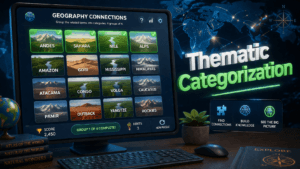
Once the domestic foundation is secure, the scope of a geography connections puzzle game expands dramatically to encompass the entire globe. The sheer volume of international data—nearly two hundred countries, their capitals, their flags, and their physical features—provides endless possibilities for complex categorization. A global geography connections puzzle game requires the player to constantly shift their perspective between physical geography, human geography, and even linguistic patterns.
Linguistic deduction plays a massive role in advanced thematic puzzles. A geography connections puzzle game might group items based entirely on their orthographic properties. For example, recognizing that a set of countries all share the suffix “-stan” or that certain capital cities contain exactly five letters. To train the brain for these specific linguistic challenges, integrating word-based geographic games is highly strategic. Playing the Wordle Geography Game trains the brain to analyze country names by letter placement, while a Scramble Words Game disrupts reliance on whole-word visual recognition. Both tools build the linguistic agility necessary to spot orthographic patterns hidden within a tricky geography connections puzzle game.
Beyond linguistics, global spatial recall must be sharp. A player cannot group African nations by their colonial history if they cannot first locate them. A rigorous Countries of the World Quiz provides the spatial certainty needed to confidently tackle a global geography connections puzzle game. Furthermore, some of the most engaging puzzles rely heavily on visual vexillology. Recognizing common color schemes, such as the Pan-Arab colors, is a classic category in a geography connections puzzle game. Practicing with a Flags of the World Quiz or a fast-paced Flag Memory Game builds the dual-coding memory required to link these visual symbols back to their textual representations on the puzzle board.
When you combine spatial awareness, visual recognition, and linguistic agility, you unlock the true educational potential of a geography connections puzzle game. It ceases to be just a test of what you know, and becomes a thrilling test of how flexibly you can manipulate what you know.
Advanced Gamification: Demographics, Politics, and Trivia
The beauty of a modern geography connections puzzle game is its ability to incorporate diverse, interdisciplinary data sets. Geography does not exist in a vacuum; it is deeply intertwined with demographics, pop culture, and modern politics. By injecting these elements into the categorical mix, a geography connections puzzle game becomes a holistic test of global literacy. This variety prevents cognitive habituation, ensuring that the brain is always encountering novel challenges.
Consider the inclusion of population data. A sophisticated geography connections puzzle game might challenge players to group the four most populous nations in Asia, or to identify countries with a population under one million. To build the intuitive grasp of scale required for this, learners can regularly play the Higher Or Lower Population Game. This specific type of quantitative training ensures that when demographics appear as a category in a geography connections puzzle game, the player’s brain is already calibrated to make accurate mathematical comparisons.
Similarly, political and cultural knowledge is frequently tested. Identifying global capitals is a standard pillar of geographic education, but a geography connections puzzle game will elevate this by asking players to group capitals by their hemisphere or their continent. A world capitals quiz multiple choice format is an excellent way to drill this declarative knowledge before it is tested relationally in the puzzle. For those wanting to test their associative memory purely on capitals, the Capital Cities of the World Quiz provides the perfect training ground.
Furthermore, a geography connections puzzle game thrives on unexpected trivia. A category might revolve around nations that share a specific historical event or even modern cultural touchstones. Exploring niche assessments like the Trump Tweet Quiz illustrates how deeply geopolitical statements are tied to specific locations and cultural contexts. By expanding one’s trivia base, the player becomes adept at spotting the most obscure links. Engaging with a geography trivia categories game helps simulate this exact process, training the brain to categorize random facts into cohesive, logical groups—the very heart of a successful geography connections puzzle game strategy.
Integrating Puzzles into Daily Learning Routines

Understanding the cognitive benefits of a geography connections puzzle game is only the first step; actively integrating it into daily life is where the true transformation occurs. Because a geography connections puzzle game relies on complex lateral thinking, it is an ideal tool for preventing the mid-day cognitive slump. Taking a ten-minute break to solve a geography connections puzzle game acts as a mental palate cleanser, redirecting focus, stimulating the prefrontal cortex, and leaving the player feeling refreshed and intellectually invigorated.
For educators, introducing a geography connections puzzle game into the classroom completely changes the dynamic of geographic instruction. Instead of assigning tedious worksheets, teachers can project a geography connections puzzle game onto the smartboard and have the class collaborate to find the hidden links. This fosters incredible peer-to-peer discussion, as students must verbally justify their reasoning for why certain countries belong together. The direct application of this pedagogy is best seen when utilizing the Geo Connections Game, which perfectly encapsulates the collaborative, problem-solving spirit required by modern educational standards.
If an educator wants to maintain a sense of mystery and deductive reasoning before introducing full thematic puzzles, they might start a lesson with a guess the hidden country game. This builds the deductive logic necessary to later succeed at a complex geography connections puzzle game. Moreover, exploring how the general public searches for geographic terms via the Autocomplete Game adds a fascinating sociological layer to classroom discussions, showing students that geography is a living subject deeply connected to human behavior.
For individuals who thrive on high-stakes environments, the skills developed through consistent practice with a geography connections puzzle game translate perfectly to competitive arenas. A player who has mastered lateral thinking will dominate in a Global Showdown, as their brain is already trained to rapidly cross-reference facts, populations, and capitals faster than those who only practiced rote memorization. The geography connections puzzle game is the ultimate training ground for competitive geographic agility.
Conclusion: Rewiring the Geographic Mind
The evolution of geographic education has brought us far beyond the era of dusty atlases and repetitive flashcards. In our quest to build stronger, more resilient minds, the geography connections puzzle game has emerged as a scientifically backed, profoundly engaging solution. By demanding that players use their executive function to find thematic, logical, and linguistic links between spatial facts, a geography connections puzzle game provides a complete cognitive workout that traditional quizzes simply cannot match.
As we navigate an increasingly complex and interconnected world, our internal mental maps must be equally sophisticated. We must understand not just the “where,” but the “how” and the “why.” Consistently engaging with a geography connections puzzle game guarantees that your brain is constantly forming new neural pathways, expanding its semantic networks, and developing the lateral thinking skills necessary for true spatial intelligence. The National Geographic Education initiatives continually stress the importance of understanding human and physical systems, and there is no better tool to conceptualize those systems than a dynamic, challenging puzzle.
Whether you are a lifelong learner looking to preserve your cognitive health, a teacher seeking to ignite a passion for lateral thinking in your students, or simply a trivia enthusiast eager for a new challenge, the answer lies in relational learning. Embrace the challenge, test your mental agility, and let a geography connections puzzle game redefine the way you see the world.