In our modern, technologically driven world, it is incredibly easy to outsource our spatial intelligence to the digital devices resting in our pockets. Turn-by-turn navigation apps and instant search engines have largely replaced the need to maintain a robust, internal mental map of the world. While this convenience is undeniable, cognitive scientists and educators are increasingly warning of the hidden cost: a steady decline in our innate spatial reasoning and working memory. As we age, fighting against this cognitive complacency becomes vital. This is precisely why engaging with a difficult geography quiz for adults is no longer just a leisurely pursuit; it is a scientifically backed method for preserving mental agility, stimulating neuroplasticity, and reclaiming our geographic literacy.
During our school years, geographic education was often mandated, forcing our developing brains to memorize continents, capitals, and topography. However, once we enter the adult workforce, that rigorous spatial training typically stops. The intricate neural pathways that once allowed us to effortlessly locate distant nations or recognize complex border shapes begin to prune themselves away through lack of use.
To halt and reverse this process, we must introduce intentional, high-level cognitive friction back into our daily routines. A properly designed difficult geography quiz for adults provides exactly this type of friction. By pushing the boundaries of what we can quickly recall, a difficult geography quiz for adults forces the brain to wake up, re-establish those dormant connections, and synthesize vast amounts of spatial data.
This comprehensive guide will explore the fascinating intersection of adult learning theory, cognitive neuroscience, and cartography. We will examine why passive learning strategies fail in later life, how the rigorous demands of a difficult geography quiz for adults can literally reshape your brain’s physical structure, and how you can utilize a curated sequence of interactive, gamified tools to systematically rebuild your spatial intelligence from the ground up.
Neuroplasticity and the Adult Brain
For a long time, the prevailing scientific belief was that the human brain stopped developing in early adulthood, after which it entered a slow, inevitable decline. Modern neuroscience has completely dismantled this myth. We now know that the adult brain is highly neuroplastic; it retains the remarkable ability to reorganize itself, forge new synaptic connections, and even generate new neurons throughout our entire lifespan. However, this neuroplasticity is strictly governed by the principle of “use it or lose it.” To trigger this growth, the brain must be consistently challenged by novel, complex tasks. A difficult geography quiz for adults serves as the perfect catalyst for this neurological rejuvenation.
When you sit down to tackle a difficult geography quiz for adults, you are specifically targeting the hippocampus and the prefrontal cortex. The hippocampus manages spatial memory and navigation, while the prefrontal cortex handles executive function, focus, and the retrieval of facts. A true difficult geography quiz for adults demands that these two regions communicate rapidly. As you struggle to recall the exact location of a central Asian nation or differentiate between similarly shaped African countries, your brain releases Brain-Derived Neurotrophic Factor (BDNF). This protein is essential for the survival and growth of neurons. Therefore, the mental sweat you experience during a difficult geography quiz for adults is actually the biological process of your brain getting stronger.
The American Psychological Association frequently highlights that engaging in mentally demanding hobbies is one of the most effective strategies for delaying age-related cognitive decline. A difficult geography quiz for adults is superior to passive hobbies because it is inherently multifaceted. It requires visual processing, linguistic decoding, and spatial orientation all at once. By subjecting yourself to the rigorous intellectual demands of a difficult geography quiz for adults on a regular basis, you are building a vast cognitive reserve that protects your brain’s processing speed and working memory well into the future.
The Supremacy of Active Recall in Adult Learning
Adult learners often make the mistake of relying on passive study methods. They might watch a historical documentary or briefly scan an interactive atlas, assuming the information is being absorbed. However, cognitive psychology clearly demonstrates that passive review results in incredibly low retention rates. If you truly want to master global cartography, you must embrace the struggle of active recall. This is the core pedagogical engine that drives the success of any difficult geography quiz for adults. Active recall involves searching your own brain for the answer before looking it up.
When you encounter a question on a difficult geography quiz for adults and your mind briefly goes blank, that moment of cognitive strain is where the actual learning occurs. The effort required to dig through your memory banks signals to your brain that this specific piece of information is valuable and must be prioritized for long-term storage. A difficult geography quiz for adults facilitates this process seamlessly, providing an environment where you are constantly tested, corrected, and re-tested. This immediate feedback loop ensures that false memories are instantly overwritten with accurate spatial data.
Furthermore, adult learners benefit tremendously from spaced repetition, a technique naturally built into the digital framework of a high-quality difficult geography quiz for adults. By encountering the same tricky geographic concepts at strategically timed intervals, the brain solidifies the memory trace. A difficult geography quiz for adults will purposely re-introduce concepts you previously missed, forcing you to engage in active recall repeatedly until the knowledge becomes deeply ingrained, unconscious competence.
Mastering Domestic Topography: The Advanced Stage
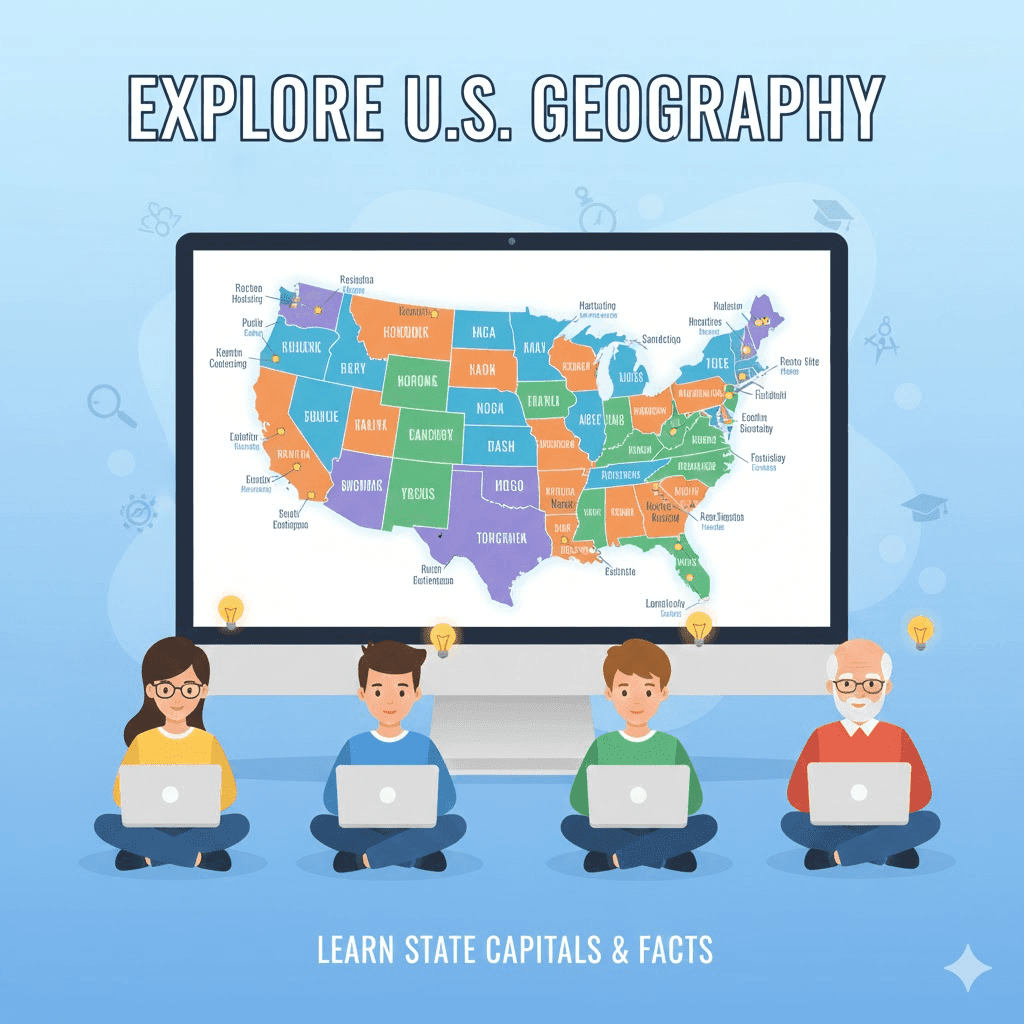
Before launching into the overwhelming complexity of global maps, adult learners should ensure their foundational domestic knowledge is impenetrable. However, a standard elementary-level state quiz is insufficient for triggering adult neuroplasticity. To achieve real cognitive growth, you must engage with domestic geography on hard mode. The baseline expectation for a difficult geography quiz for adults is that the training wheels—like border outlines and multiple-choice lifelines—are completely removed.
For example, while recognizing the shape of Texas is simple, a true hard mode state capitals quiz will demand that you type out the capital’s name with perfect spelling in a strictly timed environment. This blends orthographic processing with spatial memory. To push your visual isolation skills further, engaging with Guess the US States without the context of the surrounding map forces your visual cortex to rely solely on pure geometric recognition. This is the exact type of abstract spatial reasoning required to succeed in a difficult geography quiz for adults.
Topological reasoning—understanding the relationships between distinct physical spaces—is another hallmark of advanced geographic literacy. A fantastic way to prepare for a difficult geography quiz for adults is to play the US States by Borders Quiz. This eliminates the visual crutch of the coastlines and forces you to deduce a location entirely based on its neighbors. By mastering these complex, localized relationships, your brain builds the intricate cognitive scaffolding necessary to excel when a difficult geography quiz for adults eventually expands its scope to the entire planet.
To ensure linguistic precision is maintained alongside visual recall, incorporating a US State Name Quiz and a US State Capital Quiz into your routine guarantees that your declarative memory is just as sharp as your spatial memory. This multifaceted approach to domestic mapping is the ultimate prerequisite for global mastery.
Scaling the Summit: Global Complexity and Vexillology
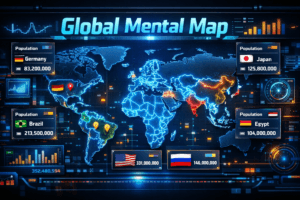
The true test of spatial intelligence arrives when the scope shifts to the international stage. The Earth comprises nearly two hundred sovereign nations, featuring incredibly dense political borders, complex histories, and shifting geopolitical realities. A comprehensive difficult geography quiz for adults will test your ability to navigate this vast data set without hesitation. It requires a mental map that is not only accurate but highly optimized for rapid data retrieval.
When tackling the global stage, starting with a rigorous Countries of the World Quiz establishes the spatial baseline. However, to truly elevate the experience to the level of a difficult geography quiz for adults, you must integrate specialized data fields like vexillology (the study of flags). Flags are dense visual codes that represent the cultural and political identity of a nation. Integrating them into your study routine via a world flag quiz hard mode requires your brain to engage in intense dual-coding, linking a vibrant visual symbol to an abstract spatial location.
Whether you are participating in a standard Flags of the World Quiz or testing your rapid visual processing with a Flag Memory Game, you are training your brain to notice minute details and subtle color variations. This visual discrimination is a critical component of executive function. A difficult geography quiz for adults will frequently utilize these visual markers to test the depth of your associative memory.
Political centers add another layer of immense difficulty. Attempting a Capital Cities of the World Quiz or focusing specifically on the dense, historically rich borders via a capitals of europe quiz game forces you to maintain thousands of distinct textual and spatial associations. A well-crafted difficult geography quiz for adults uses these capitals as the ultimate test of declarative geographic knowledge, proving that your mental map is populated with precise, actionable data.
Linguistic Dexterity and Lateral Thinking
Cognitive geography is not limited strictly to maps and visual symbols; it is deeply intertwined with linguistics and lateral thinking. The most challenging iterations of a difficult geography quiz for adults will intentionally blur the lines between spatial reasoning and word puzzles, demanding extreme cognitive flexibility. How we spell, manipulate, and categorize the names of places drastically influences how our brains store that information.
By engaging with linguistic-based geography tools, you force your brain to approach spatial data from an entirely new angle. For instance, the Wordle Geography Game requires you to deduce a country’s name using only its letter structure and placement. Similarly, the Scramble Words Game disrupts your reliance on visual whole-word recognition, forcing your language centers to work in overdrive. These orthographic challenges are often hidden inside a difficult geography quiz for adults, acting as intellectual curveballs that test your mental agility.
Beyond spelling, lateral thinking—the ability to find hidden connections between seemingly unrelated facts—is the hallmark of true expertise. A difficult geography quiz for adults frequently abandons simple point-and-click mapping in favor of thematic categorization. Playing a Geo Connections Game trains this exact skill, challenging you to group nations by shared historical empires, climate zones, or economic alliances. This type of relational learning ensures that your performance on a difficult geography quiz for adults is driven by deep, holistic comprehension rather than superficial memorization.
Integrating Demographics and Socioeconomic Data
A static map only tells half the story of our planet. True geographic literacy requires an understanding of human geography—how populations are distributed, how economies scale, and how societies interact with their physical environments. The ultimate difficult geography quiz for adults will invariably push beyond physical borders to test your grasp of these vital demographics.
Understanding the scale of human populations completely alters how you perceive a map. The National Geographic Society emphasizes that spatial thinking must include human systems to be genuinely comprehensive. To build an intuitive understanding of global scale, participating in a world population comparison quiz or playing the Higher Or Lower Population Game is essential. These exercises force your brain to reconcile the physical size of a nation with its demographic reality—a cognitive balancing act that frequently appears in a difficult geography quiz for adults.
Furthermore, geography is deeply tied to modern culture, politics, and technology. A truly modern difficult geography quiz for adults might test your knowledge of how different regions interact with the digital world. The Autocomplete Game provides a fascinating sociological lens, asking you to deduce how the global population searches for specific geographic entities. Even recalling specific, location-tied political events via unconventional tools like the Trump Tweet Quiz exercises your ability to link cultural context to spatial locations. By synthesizing demographics, culture, and physical space, a difficult geography quiz for adults guarantees a comprehensive, well-rounded intellect.
Gamification, Competition, and Consistency

The neuroplastic benefits of a difficult geography quiz for adults can only be fully realized through consistent, long-term engagement. To maintain this consistency, the learning environment must be inherently motivating. This is where gamification plays a critical role. By incorporating timers, leaderboards, and scoring streaks, a digital difficult geography quiz for adults leverages the brain’s dopamine reward system. Dopamine is essential for motivation and memory consolidation, transforming the hard work of learning into a highly addictive, positive experience.
For adult learners, finding the time to study can be challenging. However, the micro-learning format of a difficult geography quiz for adults perfectly suits busy professional schedules. Replacing ten minutes of mindless social media scrolling with an intense session of a difficult geography quiz for adults provides a potent cognitive workout that leaves you feeling intellectually refreshed and sharper for the rest of your day.
For those who thrive on adrenaline, taking your skills into a competitive arena is the ultimate test. Entering a Global Showdown forces you to apply everything you have learned from your difficult geography quiz for adults training under extreme pressure. Competing against peers not only validates your geographic mastery but also provides the high-stakes environment necessary to forge permanent, instantaneous neural recall.
Conclusion: Reclaiming Your Cognitive Map
The decision to actively maintain and expand your spatial intelligence is a profound commitment to your lifelong cognitive health. We cannot allow our internal mental maps to degrade in the face of digital convenience. By embracing the rigorous intellectual challenge of a difficult geography quiz for adults, we actively fight back against cognitive decline, stimulating neuroplasticity, and reinforcing our working memory.
A difficult geography quiz for adults is far more than a simple test of trivia. It is a comprehensive workout for the mind, demanding intense visual processing, rapid declarative recall, linguistic dexterity, and complex lateral thinking. It forces us to synthesize raw geometric borders with vibrant flags, dense populations, and cultural history.
As you navigate through the carefully curated layers of geographic learning—from hard mode domestic topography to the highest peaks of global interconnectivity—you will discover that the world is a constantly evolving, fascinating puzzle. Accept the challenge, commit to the process of active recall, and let a difficult geography quiz for adults serve as your ultimate tool for building an agile, resilient, and brilliant geographic mind.