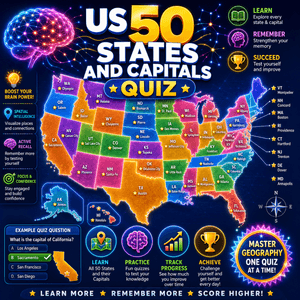
Learning geography becomes far more exciting when people understand how the brain naturally processes locations and maps. Many learners assume that success depends entirely on memorization, but modern cognitive science suggests something different. A us 50 states and capitals quiz can become an effective brain-training tool when combined with active recall, spatial intelligence, and engaging learning strategies.
Traditional studying often involves reading state names repeatedly and hoping the information stays in memory. Unfortunately, passive reading creates weak retention. A us 50 states and capitals quiz activates the brain in a much more effective way because learners repeatedly retrieve information instead of simply reviewing it.
The difference matters because the human brain evolved around navigation and understanding physical spaces. Geography naturally fits into the brain’s learning systems and allows learners to build meaningful connections between places and information.
Why Geography Is Different From Other Subjects
Think about how people remember directions in daily life. Most people do not memorize every street as an isolated fact. Instead, they create a mental picture.
The brain stores relationships, landmarks, and patterns. A us 50 states and capitals quiz works similarly because learners build stronger connections between states and locations.
Instead of remembering individual facts separately, learners begin identifying patterns and understanding how regions connect with one another. Repeated practice gradually strengthens these geographic relationships and improves recall.
The Hippocampus and Mental Navigation
The hippocampus plays an important role in memory formation and navigation.
Scientists studying spatial memory have found that navigation tasks strongly activate this region.
A us 50 states and capitals quiz takes advantage of the same system because learners mentally travel across maps rather than memorizing isolated facts.
This process strengthens memory and spatial understanding. Over time, learners begin recognizing state positions naturally without depending entirely on memorization techniques.
Spatial Intelligence Creates Better Recall
Spatial intelligence refers to understanding how objects and places relate to each other.
Some individuals naturally visualize maps effectively, while others gradually improve these skills through practice and repetition.
Over time, a us 50 states and capitals quiz helps develop stronger cognitive maps that improve retrieval and learning efficiency.
Visualizing groups of states, neighboring regions, and geographic patterns creates stronger mental structures for long-term retention.
Active Recall Changes How Memory Works
One of the strongest learning techniques identified by educational research is active recall.
Instead of rereading information, active recall requires learners to retrieve answers from memory.
A us 50 states and capitals quiz naturally uses this process.
Repeated retrieval signals to the brain that information matters. As a result, the brain begins strengthening pathways associated with that information.
This explains why interactive quizzes often perform better than passive studying methods.
Research and Educational Resources
Educational research consistently shows that active recall and spatial learning techniques improve long-term retention. Learners interested in understanding memory science can explore resources from National Geographic, which provides educational geography content and learning materials.
Students can also learn more about memory and brain function through educational resources from Encyclopaedia Britannica, which explains the role of the hippocampus in learning and navigation.
Additional educational studies and learning resources are available through National Geographic Education, helping learners understand how geography improves critical thinking and spatial awareness.
Using Games to Increase Motivation
Learning becomes more enjoyable when challenge and curiosity enter the process.
- Timed challenges
- Achievement goals
- Daily practice streaks
- Difficulty progression
- Friendly competition
Students can strengthen recall with US State Capital Quiz.
Visual map skills improve through Guess the US States.
Advanced learners often enjoy US States by Borders Quiz.
Combining these tools with a us 50 states and capitals quiz can increase engagement and create a more enjoyable learning experience.
Neuroplasticity and Repeated Learning
The brain constantly adapts to experiences through neuroplasticity.
Whenever learners repeatedly practice with a us 50 states and capitals quiz, neural pathways become stronger.
The brain gradually recognizes repeated information as valuable and stores it more efficiently.
Consistent practice transforms difficult recall into automatic retrieval and increases confidence during learning.
Daily Geography Habits Produce Bigger Results
Consistency usually matters more than long study sessions.
Short learning periods repeated every day create stronger results.
Many learners use a us 50 states and capitals quiz as part of their daily learning routine.
Even spending five or ten minutes each day can significantly improve geographic knowledge over time.
Interactive activities improve recall, strengthen visual memory, and build confidence.
A us 50 states and capitals quiz can become more than an educational activity. Through active recall, spatial intelligence, and consistent practice, it becomes a powerful way to train the brain and build stronger geographic literacy.