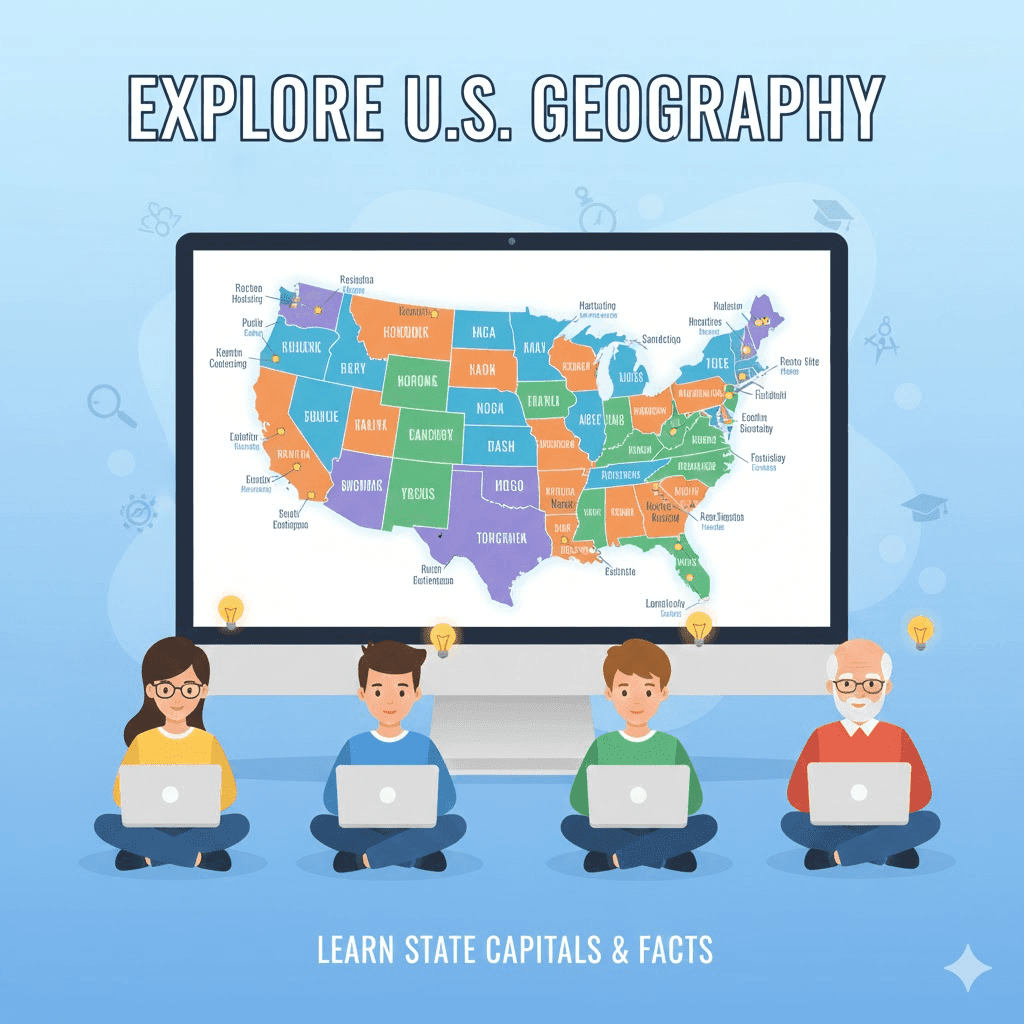
The transition into upper elementary school marks a significant milestone in a child’s cognitive development, particularly when it comes to understanding the world around them. For educators and parents, finding the right tools to harness this developmental leap is crucial. One of the most effective tools available is a well-designed 50 states quiz for 5th grade. During these formative years, students transition from understanding simple, immediate spatial relationships—like the layout of their neighborhood—to grasping abstract, large-scale geographic concepts, such as the political and physical boundaries of a massive nation. A thoughtfully constructed 50 states quiz for 5th grade bridges the gap between abstract maps and tangible understanding.
Historically, teaching the geography of the United States relied heavily on repetitive tasks that rarely engaged a child’s higher-order thinking skills. Students would stare at textbooks and attempt to memorize lists of names and locations without any relational context. Today, pedagogical experts recognize that active engagement is the key to deep learning. Implementing a 50 states quiz for 5th grade into the curriculum shifts the learning paradigm from passive absorption to active recall. When a child engages with a 50 states quiz for 5th grade, they are not just looking at a map; they are mentally reconstructing it, testing their own spatial memory in real-time.
This article will explore the deep pedagogical benefits of interactive geography, specifically focusing on how a 50 states quiz for 5th grade aligns with the cognitive abilities of ten- and eleven-year-olds. We will delve into how gamification reduces learning anxiety, why moving away from static maps is essential for spatial intelligence, and how to effectively sequence a curriculum using a 50 states quiz for 5th grade to ensure lasting geographic literacy.
Cognitive Development and Spatial Reasoning in Upper Elementary
To understand why a 50 states quiz for 5th grade is so effective, we must first look at how the brain of a typical ten-year-old functions. According to developmental psychology, children in this age group are firmly in the concrete operational stage, meaning they are becoming adept at logical thought but still rely heavily on concrete, visual references. A 50 states quiz for 5th grade provides exactly this: a logical framework (the boundaries of the country) populated by concrete visual puzzles (the shapes and locations of individual states).
During this stage, spatial reasoning undergoes a rapid expansion. Students become capable of holding a mental image of a map in their minds and manipulating it. When they interact with a 50 states quiz for 5th grade, they are exercising their working memory. The National Council for the Social Studies emphasizes that geography education should help learners understand the physical and human characteristics of places. A 50 states quiz for 5th grade fulfills this by forcing students to recall not just a name, but its exact orientation relative to the rest of the continent.
Furthermore, a 50 states quiz for 5th grade leverages neuroplasticity—the brain’s ability to form new neural connections. Every time a student successfully identifies a state’s location during a 50 states quiz for 5th grade, the synaptic pathways responsible for that spatial memory grow stronger. Conversely, when they make a mistake on a 50 states quiz for 5th grade, the immediate feedback allows their brain to quickly correct the error, updating their internal mental map with astonishing speed and efficiency.
Moving Beyond the Traditional Blank Map
For generations, the standard assessment tool in geography classrooms was the blank us map for practice. While a blank us map for practice still has its place in the classroom as an offline assessment, it lacks the interactive dynamism required to hold the attention of modern digital natives. When a student uses a blank us map for practice, they do not receive immediate feedback. If they label Colorado as Wyoming, they will not know their mistake until the teacher grades the paper days later. This delay hinders the learning process.
In contrast, a digital 50 states quiz for 5th grade provides instantaneous feedback. This immediate correction is the cornerstone of effective gamified learning. By integrating a 50 states quiz for 5th grade into the weekly lesson plan, teachers can provide their students with a low-stakes environment to test their knowledge. The instant gratification of seeing a state turn green upon a correct click on a 50 states quiz for 5th grade releases dopamine, a neurotransmitter that solidifies memory and boosts motivation.
Moreover, a printable blank map of the united states can be overwhelming for a student just beginning to learn domestic geography. Staring at fifty empty geometric shapes can induce cognitive overload. A well-designed 50 states quiz for 5th grade, however, can scaffold the experience. It might highlight a specific region first or provide multiple-choice prompts, breaking the massive task of memorizing a continent down into manageable, interactive chunks. Thus, the 50 states quiz for 5th grade becomes a mentor rather than just a testing instrument.
Scaffolding Geography Skills Through Gamification
Effective teaching relies on scaffolding—introducing a concept in its simplest form and gradually increasing the complexity as the student gains mastery. A high-quality 50 states quiz for 5th grade fits perfectly into a scaffolded social studies curriculum. Before asking students to tackle the entire country, educators can start with shape recognition. Playing a game like Guess the US States helps students isolate the unique silhouette of each territory, teaching them that geography is as much about geometry as it is about location.
Once shape recognition is established, the 50 states quiz for 5th grade can evolve to include spatial orientation. Students must learn where these shapes fit within the larger puzzle of North America. This is where an interactive map of us states and capitals becomes an invaluable precursor to testing. Students can explore the interactive map of us states and capitals at their own pace, investigating the spatial relationships between the East Coast, the Midwest, and the Pacific Northwest, before putting that knowledge to the test in a timed 50 states quiz for 5th grade.
To further deepen their relational understanding, students can move beyond a standard 50 states quiz for 5th grade and explore topological connections. The US States by Borders Quiz is a brilliant pedagogical tool for ten-year-olds. It strips away the comfort of the continental outline and forces the child to identify a state based purely on its neighbors. This advanced variation of a 50 states quiz for 5th grade guarantees that the student has moved beyond rote memorization and has developed a true, robust mental map of the nation.
Orthography and Nomenclature in Geographic Education
Geography is not exclusively a visual science; it is deeply tied to language and orthography. Knowing where Massachusetts is located is only half the battle; knowing how to spell it is the other. A comprehensive 50 states quiz for 5th grade must account for language arts integration. Many students can point to the correct location on a map but struggle with the nomenclature. Therefore, a 50 states quiz for 5th grade should frequently incorporate typing and spelling mechanics.
Using a tool like the US State Name Quiz acts as an excellent companion to a visual 50 states quiz for 5th grade. It requires students to correctly recall and spell the names of the states they are spatially identifying. This dual-coding process—linking visual spatial memory with linguistic spelling memory—creates highly resilient neural networks. For students who enjoy word puzzles, combining geography with orthographic challenges provides a fresh perspective. The Wordle Geography Game and the Scramble Words Game are fantastic ways to keep the linguistic side of geography engaging while reinforcing the vocabulary necessary to succeed on a 50 states quiz for 5th grade.
Furthermore, mastering the spelling and naming conventions of domestic geography prepares students for the much more complex nomenclature of global geography. If a student builds confidence through a 50 states quiz for 5th grade, they will feel much more prepared when they eventually encounter the diverse linguistic challenges of a global map. A 50 states quiz for 5th grade builds the foundational confidence necessary for lifelong geographic inquiry.
Expanding the Map: Capitals and Demographics
Once a student has consistently mastered a foundational 50 states quiz for 5th grade, it is time to layer on additional data points. The most natural progression is to introduce the political centers of each state. A US State Capital Quiz demands that students form associative memories, linking a specific city to the state shape they learned from their 50 states quiz for 5th grade practice. This associative linking is a critical cognitive skill that will serve them well across all academic disciplines.
Beyond capitals, 5th grade is an excellent time to introduce basic concepts of human geography, such as population and demographics. A 50 states quiz for 5th grade can sometimes include trivia about state sizes and populations, but dedicated tools can take this further. Playing the Higher Or Lower Population Game challenges students to think critically about how people are distributed across the landmass they have been studying. It adds a layer of quantitative reasoning to the spatial foundation built by the 50 states quiz for 5th grade.
Understanding these demographics helps students realize that the map they learned via their 50 states quiz for 5th grade is not just a collection of lines; it represents millions of people, diverse cultures, and varying economies. The Department of Education encourages interdisciplinary learning, and blending a 50 states quiz for 5th grade with demographic data perfectly marries social studies with fundamental mathematics and sociology.
Preparing for the Future: Middle School Readiness
A primary goal of fifth-grade education is to prepare students for the increased academic rigor of middle school. The transition from elementary geography to secondary social studies is significant. A mastery of domestic geography through a 50 states quiz for 5th grade is the baseline expectation for incoming sixth graders. If a student struggles with a 50 states quiz for 5th grade, they will likely fall behind when asked to analyze historical migrations, the Civil War, or regional economics in middle school.
By using a 50 states quiz for 5th grade to solidify this knowledge early, educators ensure their students are ready for the next level. In fact, consistently practicing with a 50 states quiz for 5th grade naturally evolves into readiness for a us states map quiz for middle school. The us states map quiz for middle school will likely demand faster recall, harder spelling constraints, and perhaps the identification of major rivers and mountain ranges. The foundational confidence built by a friendly, interactive 50 states quiz for 5th grade is what makes tackling that middle school curriculum possible without overwhelming anxiety.
The beauty of interactive digital quizzes is that they scale with the learner. A platform that offers a 50 states quiz for 5th grade often provides settings to increase the difficulty, seamlessly transitioning a student from elementary-level prompts to a rigorous us states map quiz for middle school standard. This continuity of learning tools provides a comforting familiarity as academic expectations rise.
From Local to Global: The Geographic Stepping Stone
While a 50 states quiz for 5th grade focuses intensely on domestic geography, its ultimate pedagogical purpose is to serve as a stepping stone to global awareness. Once a student understands how to construct a mental map of their own country, they can apply those exact same cognitive strategies to the rest of the world. The spatial reasoning skills honed on a 50 states quiz for 5th grade are universally applicable.
When a ten-year-old feels confident that they have conquered the 50 states quiz for 5th grade, they are naturally curious to explore further. This is the perfect moment to introduce global content. A Countries of the World Quiz can feel insurmountable to a beginner, but to a child who has already mastered a 50 states quiz for 5th grade, it is simply the next level of the game. They understand the mechanics of interactive maps, they understand borders, and they understand associative learning.
To keep the global transition fun and engaging, visual learners can dive into a Flags of the World Quiz or a Flag Memory Game. These visual exercises provide a colorful break from political boundaries while still building a global mental database. For those who want to test their associative memory on an international scale, the Capital Cities of the World Quiz offers the ultimate challenge. None of this global mastery is possible, however, without the firm cognitive foundation laid down by the repetitive, engaging practice of a 50 states quiz for 5th grade.
Cultivating Critical Thinking and Lateral Connections
As students master the direct spatial relationships taught by a 50 states quiz for 5th grade, their brains become capable of more abstract, lateral thinking regarding geography. They start to notice patterns. Why are the states in the West so much larger than the states in the Northeast? Why are certain borders straight lines while others are jagged? A good 50 states quiz for 5th grade sparks these inquiries, turning a simple memory game into an exercise in critical thinking.
Educators can leverage this curiosity. By using resources like PBS LearningMedia alongside a 50 states quiz for 5th grade, teachers can explain that straight borders are often the result of longitude and latitude lines, while jagged borders usually follow natural features like rivers or mountain ridges. This transforms the 50 states quiz for 5th grade from a test of what things are to an exploration of why things are.
For students ready to push their lateral thinking further, games that require making unexpected connections are ideal. The Geo Connections Game forces learners to group geographic entities based on shared, sometimes obscure, traits. Additionally, exploring how society interacts with geography through a modern lens, like playing the Autocomplete Game, shows students that geography is a living, breathing subject that influences daily internet searches, culture, and human behavior. All of this high-level thinking originates from the spatial confidence built by a 50 states quiz for 5th grade.
Implementing Gamified Geography in the Classroom

Knowing the benefits of a 50 states quiz for 5th grade is one thing; successfully implementing it into a busy classroom environment is another. The key is consistency and low stakes. A 50 states quiz for 5th grade should not be reserved only for a massive Friday exam. Instead, it should be used as a daily warm-up or a rewarding cool-down activity. Five minutes a day interacting with a 50 states quiz for 5th grade yields vastly superior long-term retention compared to an hour of cramming on a Thursday night.
Teachers can also foster a sense of healthy competition. Projecting a 50 states quiz for 5th grade onto a smartboard and having the class work together to beat the clock encourages teamwork and peer-to-peer teaching. For individual challenge, students can participate in a Global Showdown style leaderboard within their classroom, tracking their improving speeds on the 50 states quiz for 5th grade over the course of the semester.
It is crucial to celebrate improvement rather than just perfection. If a student goes from identifying twenty states on their 50 states quiz for 5th grade to identifying thirty, that is a massive cognitive achievement. The design of digital geography tools inherently supports this growth mindset, as the 50 states quiz for 5th grade provides endless opportunities to reset, try again, and see tangible progress.
Conclusion: Building Lifelong Navigators
In conclusion, the geography curriculum for ten- and eleven-year-olds is a critical window for cognitive development. The tools we choose to utilize during this time can dictate a child’s spatial intelligence for the rest of their academic career. Relying solely on passive observation is no longer sufficient. The implementation of a dynamic, interactive 50 states quiz for 5th grade is essential for fostering active recall, spatial reasoning, and associative memory.
By breaking down the map into engaging, gamified puzzles, a 50 states quiz for 5th grade removes the anxiety traditionally associated with geography tests. It transforms learning from a chore into a highly rewarding cognitive challenge. As students conquer their local map, they build the neurological infrastructure necessary to understand global geopolitics, diverse cultures, and complex spatial relationships. Ultimately, a 50 states quiz for 5th grade does much more than teach a child the location of Ohio; it equips them with the mental compass they need to confidently navigate an increasingly interconnected world.