The human brain is a remarkable cartographer. Long before the invention of satellite imagery or digital navigation, our ancestors relied on an intricate internal compass to survive, migrate, and thrive. Today, the study of how we perceive, process, and navigate spatial information is known as cognitive geography. In an era where digital tools often do the navigating for us, nurturing our spatial intelligence has never been more critical. This is precisely where world map quiz educational games emerge not merely as pastimes, but as powerful cognitive exercises designed to rewire our spatial reasoning.
For decades, traditional geography education relied heavily on rote memorization—staring at static atlases and repeating lists of capitals until they temporarily stuck in short-term memory. However, neuroscientists and educators now understand that the brain learns geography best through active engagement, dynamic problem-solving, and spatial interactivity. By integrating world map quiz educational games into daily learning routines, students and adults alike can transition from passive observers of the globe to active cartographers of their own mental maps.
The beauty of world map quiz educational games lies in their ability to disguise rigorous cognitive workouts as entertainment. They leverage the brain’s natural reward systems, turning the daunting task of mastering global topography into a series of achievable, dopamine-inducing milestones. As we explore the intersection of neuroscience, gamification, and geographic education, we will uncover exactly how world map quiz educational games are revolutionizing the way we understand our planet, and why they are the ultimate tool for developing lifelong spatial intelligence.
The Neuroscience of Spatial Intelligence
To understand the profound impact of world map quiz educational games, we must first look deep inside the brain’s temporal lobe to a seahorse-shaped structure called the hippocampus. The hippocampus is the neurological epicenter for spatial memory and navigation. It is the very region of the brain that houses “place cells” and “grid cells,” which fire to create a mental coordinate system of our physical environment. When we engage with world map quiz educational games, we are actively stimulating this critical neural network.
Neuroplasticity is the brain’s remarkable ability to reorganize itself by forming new neural connections throughout life. High-quality world map quiz educational games are specifically structured to promote neuroplasticity within the hippocampus. Every time a learner is forced to recall the exact location of a country or the shape of a border, they strengthen the synaptic pathways associated with spatial reasoning. This means that playing world map quiz educational games physically alters the brain, enhancing its capacity to hold and manipulate complex spatial data.
The National Geographic Society has long emphasized the importance of spatial thinking—the ability to visualize and interpret locations, distances, and geographic relationships. Spatial thinking is not just about knowing where places are; it is about understanding why they are there and how they relate to one another. Thoughtfully designed world map quiz educational games force players to think relationally. Instead of memorizing isolated facts, users of world map quiz educational games learn to contextualize geography, mapping out mental networks of neighboring regions, continental divides, and geopolitical boundaries.
Furthermore, the cognitive demands of world map quiz educational games help stave off cognitive decline. Just as physical exercise strengthens muscles, regular engagement with world map quiz educational games provides the mental resistance training necessary to maintain a sharp, agile mind. For educators and lifelong learners, acknowledging the neurological benefits of world map quiz educational games is the first step toward building a more spatially intelligent society.
Active Recall and Gamification in Geographic Learning

One of the most robust findings in cognitive psychology is the “testing effect,” which proves that actively retrieving information from memory is far more effective for long-term retention than passively reviewing material. This principle of active recall is the engine that drives the success of world map quiz educational games. When a player is prompted to identify a location on a blank map, they must dig deep into their cognitive reserves. This struggle to remember—facilitated seamlessly by world map quiz educational games—cements the knowledge far more securely than simply reading a textbook.
Coupled with active recall is the power of spaced repetition, a technique often built into the algorithms of modern world map quiz educational games. By reintroducing challenging geographic concepts at strategic intervals, world map quiz educational games prevent the natural degradation of memory over time. Gamification adds another layer of efficacy. The points, timers, and progress tracking inherent in world map quiz educational games trigger the release of dopamine, a neurotransmitter associated with pleasure, motivation, and learning reinforcement.
This dopamine feedback loop transforms frustration into determination. If a student fails to identify a country on their first try, the immediate, low-stakes feedback provided by world map quiz educational games encourages them to try again instantly. Unlike high-stakes classroom exams, world map quiz educational games create a safe environment for trial and error. By embracing failure as a stepping stone, world map quiz educational games foster a growth mindset in geographic education.
Moreover, the interactive nature of world map quiz educational games caters to various learning styles. Visual learners benefit from color-coded maps and striking flag designs, while kinesthetic learners benefit from the physical act of clicking, dragging, and navigating digital interfaces. The multisensory engagement offered by world map quiz educational games ensures that cognitive geography is accessible, enjoyable, and deeply impactful for a diverse audience of learners.
Constructing a Local Mental Map: North American Geography
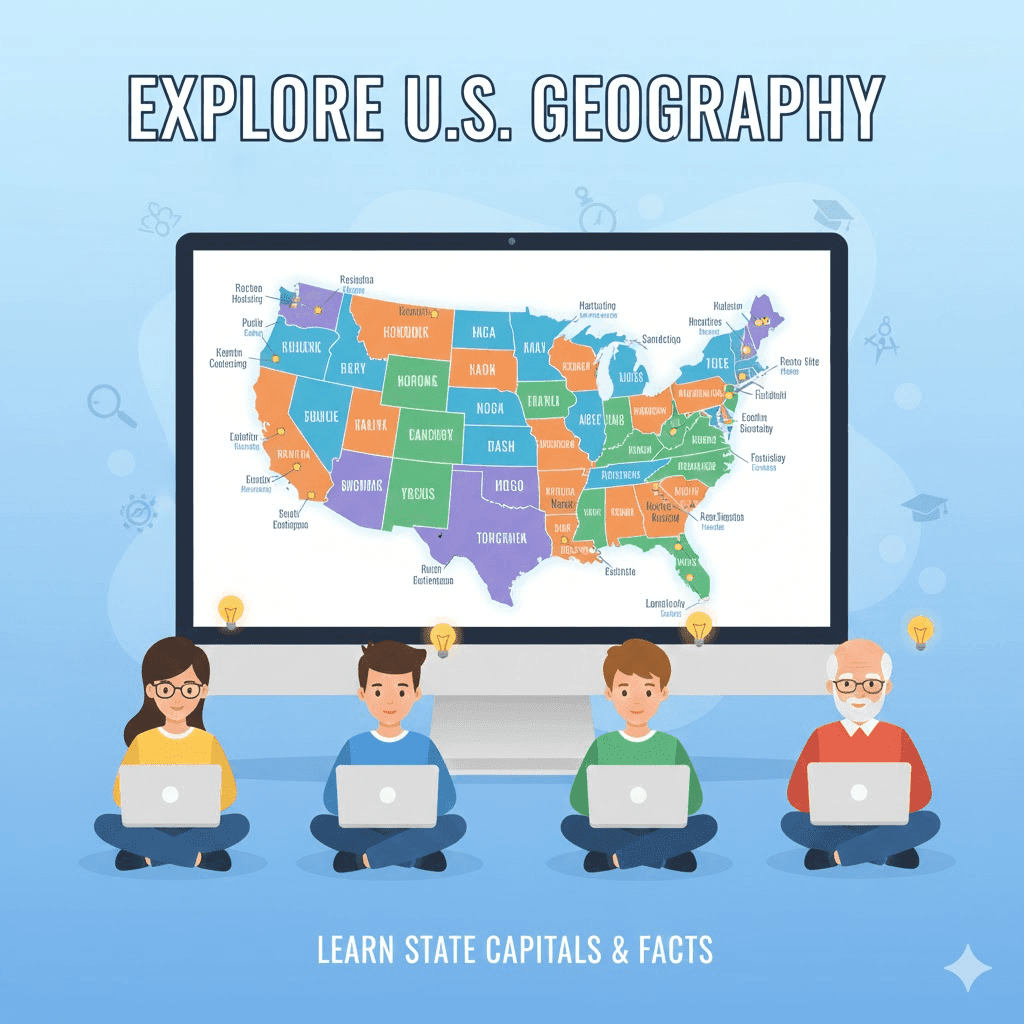
When introducing learners to the complexities of spatial intelligence, it is often most effective to begin with local or familiar geography. Building a strong foundational mental map of one’s own region provides the cognitive scaffolding necessary to tackle global cartography later. For users in North America, mastering the intricacies of the United States is a common starting point in many world map quiz educational games.
The cognitive challenge of identifying states requires an understanding of both topological space (how regions connect) and Euclidean space (distances and shapes). A foundational tool like an interactive map of us states and capitals can serve as an excellent study guide, but it is the active testing phase that solidifies the knowledge. For example, engaging with a US State Capital Quiz forces the brain to form strong associative links between a specific geographic territory and its political center.
Visual shape recognition is another crucial component of cognitive geography trained by world map quiz educational games. Our brains are naturally adept at pattern recognition, and recognizing the unique silhouettes of states exercises this visual cortex. Playing a game like Guess the US States helps learners abstract the concept of a state from its position on a map to its standalone geometry. To push this spatial reasoning even further, world map quiz educational games often introduce relational challenges. The US States by Borders Quiz is a prime example of topological learning, where players must identify a state based solely on the puzzle pieces surrounding it, deeply reinforcing the interconnected nature of geography.
Beyond shapes and borders, orthographic processing—the ability to understand the conventions of written language—intersects with geography. A US State Name Quiz challenges learners to correctly recall and spell the names they have spatially mapped. By combining these varied modes of testing, focused world map quiz educational games ensure that learners develop a multifaceted, robust understanding of domestic geography before scaling their spatial intelligence to the global stage.
Expanding Horizons: Global Topography and Associative Memory
Once a foundational mental map is established, the true power of world map quiz educational games is unleashed on the global stage. The Earth comprises nearly 200 sovereign nations, each with its own borders, capitals, and symbolic flags. Managing this vast amount of data requires advanced associative memory, a skill expertly honed by global world map quiz educational games. By breaking down the world into digestible, interactive challenges, these tools prevent cognitive overload while maximizing retention.
The foundation of global literacy begins with spatial identification. A robust Countries of the World Quiz acts as a comprehensive workout for the hippocampus, demanding that players navigate continents, oceans, and complex geopolitical borders from memory. As learners engage with these global world map quiz educational games, they begin to see the world not as isolated landmasses, but as an interconnected global community. The Encyclopedia Britannica highlights that true geographic mastery involves understanding human and physical systems, a perspective naturally fostered when the globe is memorized organically.
A crucial element of associative memory in geography is vexillology—the study of flags. Flags are dense visual data points that represent a nation’s history, culture, and values. Integrating visual symbols into world map quiz educational games strengthens dual-coding in the brain, linking a visual image (the flag) with a spatial location (the country). Taking a Flags of the World Quiz or playing a fast-paced Flag Memory Game requires rapid neural firing, improving both recall speed and visual discrimination. These specialized world map quiz educational games are excellent for training the brain to notice subtle details and color patterns.
Furthermore, linking a nation to its political center requires a different type of declarative memory. A Capital Cities of the World Quiz challenges learners to maintain thousands of discrete associations. When players want to test their comprehensive global knowledge in a high-stakes, highly gamified environment, they can participate in a Global Showdown. This type of competitive format within world map quiz educational games perfectly illustrates how adrenaline and peer-based gamification can hyper-accelerate the geographic learning process.
Linguistic and Thematic Connections in Geography
Cognitive geography is not limited strictly to visual maps and borders; it also heavily involves linguistic processing and thematic categorization. How we name places, the letters we use, and the categories we place them in all influence how our brains store geographic data. Innovative world map quiz educational games have begun to blur the lines between traditional word puzzles and spatial learning, creating unique cognitive challenges.
By blending orthographic puzzles with geographic knowledge, developers of world map quiz educational games tap into different neural pathways. For instance, the Wordle Geography Game forces players to think about country names purely through letter placement and deductive logic. Similarly, a Scramble Words Game disrupts the brain’s reliance on whole-word recognition, requiring the learner to mentally reassemble geographic terms. These linguistically driven world map quiz educational games ensure that players truly know the vocabulary of the globe, not just the visual shapes.
Thematic and logical connections are also crucial. Geography is inherently relational. Identifying how seemingly disparate locations or geographic concepts share common traits is a high-level cognitive skill. Engaging with a geography connections puzzle game, or its specific iteration, the Geo Connections Game, challenges players to find the hidden links between places. This type of lateral thinking is a hallmark of the most advanced world map quiz educational games.
Additionally, modern digital culture has created new avenues for geographic exploration through technology usage patterns. Have you ever wondered what the world is searching for regarding specific locations? A search engine autocomplete map quiz or a dedicated Autocomplete Game provides a fascinating sociological lens on geography. By guessing how people search for geographic entities, users of these unique world map quiz educational games learn about cultural perceptions and global stereotypes, adding a rich, qualitative layer to their spatial intelligence.
Critical Thinking, Demographics, and Cultural Intersections
A truly comprehensive geographic education extends beyond physical borders and into the realm of human geography—demographics, culture, and contemporary events. The most impactful world map quiz educational games integrate these elements, requiring players to analyze quantitative data and understand the cultural zeitgeist. This intersection of spatial knowledge and data analysis forms the pinnacle of cognitive geography.
Understanding population distribution is essential for comprehending global economics, resource allocation, and geopolitics. The United States Geological Survey (USGS) frequently highlights how population density impacts environmental and physical landscapes. Engaging with a higher or lower population quiz is an excellent way to build an intuitive grasp of global demographics. Playing the Higher Or Lower Population Game forces the brain to calibrate its understanding of scale. These specific world map quiz educational games challenge the common misconceptions people hold about the sizes and densities of different nations, fostering a more accurate, data-driven worldview.
Geography also intersects heavily with modern political culture and communication. Understanding the origin of statements, the location of events, and the context of global leaders is part of navigating the modern world map. Interestingly, some world map quiz educational games use pop culture and political history to test memory and context. A Trump Tweet Quiz, for example, while seemingly unorthodox, tests a user’s ability to recall specific cultural and political moments in time, which are often inextricably linked to geographic locations and geopolitical policies. By including cultural context, world map quiz educational games become holistic educational tools that prepare learners for real-world global citizenship.
Conclusion: The Future of Spatial Learning
The evidence is clear: the integration of world map quiz educational games into our learning routines offers unparalleled benefits for the developing and aging brain alike. By moving away from passive memorization and embracing the principles of active recall, gamification, and neuroplasticity, we can cultivate a profound and lasting spatial intelligence.
Through consistent engagement with world map quiz educational games, learners build intricate, multilayered mental maps that span from local borders to complex global networks. They learn to associate visual symbols like flags with spatial territories, connect linguistic patterns to geographic names, and understand the demographic weight of nations. Most importantly, world map quiz educational games transform the vast, complex globe into an accessible, engaging, and deeply rewarding puzzle.
As digital landscapes continue to evolve, the importance of maintaining our internal cognitive maps will only grow. Embracing world map quiz educational games is not just a method for acing a geography test; it is a commitment to lifelong cognitive health, global awareness, and an enduring curiosity about the world we share. Whether you are a student, an educator, or a trivia enthusiast, the journey to geographic mastery begins with a single, interactive click.