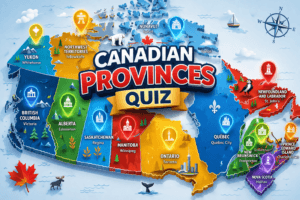
In the realm of cognitive geography, how we learn and retain spatial information is a subject of deep scientific study. The human brain is not naturally wired to memorize political borders or arbitrary city names; rather, it is evolved to navigate physical environments using spatial anchors. When you take a canadian provinces and capital cities quiz, you are essentially tricking your brain into treating a two-dimensional map as a vital, navigable landscape. This process leverages neuroplasticity, building new neural pathways as you repeatedly connect a name to a specific shape and location. Every attempt at a canadian provinces and capital cities quiz strengthens these neural connections, transitioning the information from fragile short-term memory into robust long-term retention.
Furthermore, relying on interactive gamification rather than static learning materials creates a profoundly different cognitive experience. While a traditional world geography map quiz pdf might offer a visual reference, it lacks the interactive feedback loop necessary for deep learning. A digital canadian provinces and capital cities quiz provides immediate correction, which triggers the brain’s reward centers when you get an answer right, and engages error-correction protocols when you get it wrong. This dynamic interaction makes learning not just effective, but highly enjoyable.
Spatial Intelligence and Cognitive Geography
To truly appreciate the value of a canadian provinces and capital cities quiz, we must first understand spatial intelligence. Spatial intelligence is the capacity to understand, reason, and remember the spatial relations among objects or space. When you visualize the shape of Ontario or try to pinpoint the exact location of Edmonton relative to Calgary, you are exercising your spatial intelligence. Engaging regularly with a canadian provinces and capital cities quiz is like taking your brain to a mental gymnasium. The hippocampus, a small seahorse-shaped structure in the brain, plays a critical role in this process. It houses specialized neurons known as place cells and grid cells, which act as our internal GPS system.
Because of this neurological benefit, a canadian provinces and capital cities quiz operates as an excellent visual memory game for adults who want to keep their minds sharp. Just as crosswords or Sudoku challenge linguistic and numerical faculties, a canadian provinces and capital cities quiz challenges spatial memory and visual processing. The more you interact with the geography, the more intuitive the spatial relationships become, allowing you to mentally traverse the globe with ease.
The Power of Active Recall

The secret to mastering geography lies in a psychological principle known as active recall. Active recall involves actively stimulating your memory during the learning process, rather than passively reviewing notes. Every time you are prompted by a canadian provinces and capital cities quiz to identify the capital of Saskatchewan, you are forcing your brain to retrieve that information. If you simply read that “Regina is the capital of Saskatchewan,” the memory trace is incredibly weak. However, when a canadian provinces and capital cities quiz asks you the question and you must retrieve the answer “Regina” without assistance, you dramatically strengthen the memory trace.
This methodology is highly adaptable across various regions and formats. For instance, once you have perfected your Canadian geography, you might apply the exact same active recall strategies to a US State Capital Quiz to master the geography of Canada’s southern neighbor. You can further test your continental knowledge by trying to Guess the US States or taking a specialized US States by Borders Quiz. The underlying cognitive mechanism remains exactly the same. Taking a canadian provinces and capital cities quiz acts as the perfect foundational training ground for these broader geographical challenges.
Mapping the Western Provinces
Let us break down the cognitive load of a canadian provinces and capital cities quiz by exploring the distinct regions of the country, starting with the West. The western provinces—British Columbia, Alberta, Saskatchewan, and Manitoba—offer a unique spatial challenge. British Columbia is defined by its rugged coastline and mountainous terrain. A common hurdle in any canadian provinces and capital cities quiz is remembering that its capital, Victoria, is situated on an island, distinct from the sprawling metropolis of Vancouver.
Moving east, the Prairie Provinces present a different kind of visual test. Alberta, with its capital Edmonton, shares a perfectly straight vertical border with Saskatchewan. Recognizing these straight-line borders is a specific skill honed by a canadian provinces and capital cities quiz. Saskatchewan’s capital, Regina, and Manitoba’s capital, Winnipeg, act as critical spatial anchors in the vast expanse of the prairies. When you take a canadian provinces and capital cities quiz, differentiating the rectangular shapes of Saskatchewan and Manitoba becomes an exercise in fine visual discrimination.
To master these shapes, learners often benefit from engaging in varied puzzle formats. For example, linguistic learners might reinforce their geographical vocabulary by playing a Wordle Geography Game or a Scramble Words Game, which helps cement the spelling of tricky names like Saskatchewan. After practicing the spelling, returning to a canadian provinces and capital cities quiz ensures that the linguistic knowledge is correctly paired with the spatial map.
The Central Powerhouses: Ontario and Quebec
The central region of Canada contains the country’s most populous and economically significant provinces: Ontario and Quebec. In a canadian provinces and capital cities quiz, this area frequently trips up beginners. A major cognitive hurdle is distinguishing between the national capital, Ottawa, and the provincial capitals. Ontario’s capital is Toronto, while the national capital, Ottawa, sits right on the border of Ontario and Quebec. A well-designed canadian provinces and capital cities quiz will specifically test this nuance, forcing the learner to untangle the overlapping spatial and political data.
Quebec, the largest province by area, is geographically dominant. Its capital, Quebec City, is located further northeast along the St. Lawrence River than the commercial hub of Montreal. Understanding this river-based settlement pattern is key to conquering a canadian provinces and capital cities quiz. The Canadian Geographic emphasizes how historical waterways shaped modern borders, a fact that provides helpful context when studying. By understanding why cities were built where they were, a canadian provinces and capital cities quiz transforms from a rote memory test into an engaging historical puzzle.
Because Ontario and Quebec share significant borders with the United States, learners mapping this region often benefit from understanding the broader continental context. Taking a US State Name Quiz to learn the states that border the Great Lakes provides excellent external spatial anchors that will ultimately improve your performance on a canadian provinces and capital cities quiz.
Navigating the Atlantic Provinces
The eastern seaboard of Canada is composed of the Atlantic Provinces: New Brunswick, Nova Scotia, Prince Edward Island (PEI), and Newfoundland and Labrador. For many, this is the most challenging section of a canadian provinces and capital cities quiz. The dense clustering of small landmasses requires high spatial resolution. PEI is Canada’s smallest province, and its capital, Charlottetown, is a tiny dot on the map. A high-quality canadian provinces and capital cities quiz will force you to zoom in and differentiate the island of PEI from the peninsula of Nova Scotia, home to Halifax.
New Brunswick, with its capital Fredericton, serves as the land bridge to the rest of Canada. Meanwhile, Newfoundland and Labrador present a two-part geographic entity; the island of Newfoundland holds the capital, St. John’s, while the massive region of Labrador is attached to the mainland. Mastering this complex maritime geography through a canadian provinces and capital cities quiz is a profound exercise in detail-oriented learning. It is similar to the cognitive flexibility required when you try to guess the flag by color combination; you must rely on subtle, distinct visual cues to arrive at the correct answer.
The Vast Northern Territories
Finally, a comprehensive canadian provinces and capital cities quiz must include the three northern territories: Yukon, Northwest Territories, and Nunavut. These regions are immense, sparsely populated, and incredibly important to Canada’s geographic identity. The Yukon, bordering Alaska, has Whitehorse as its capital. The Northwest Territories is anchored by Yellowknife, located on the shores of Great Slave Lake. Nunavut, the largest and newest territory, features Iqaluit on Baffin Island.
Placing these remote capitals correctly is the hallmark of someone who has truly mastered a canadian provinces and capital cities quiz. The sheer scale of the north can distort mental maps, making interactive practice vital. Resources from Britannica provide in-depth information on the unique geography of the Arctic, which can supplement the spatial practice you gain from a canadian provinces and capital cities quiz. Understanding the sheer size of these territories can also be contextualized by playing a Higher Or Lower Population Game, which highlights the stark contrast between Canada’s massive land area and its relatively concentrated population.
Gamification in Geographic Education
The integration of gamification into education has revolutionized how we learn about the world. A canadian provinces and capital cities quiz is not just a test; it is an engaging educational game. Educators frequently utilize a canadian provinces and capital cities quiz as part of their geography trivia games for classroom activities. The competitive element, whether students are trying to beat the clock or achieve a perfect score, naturally increases focus and retention. When used as a north america map quiz for kids, it introduces foundational geographic concepts in a low-stakes, highly rewarding environment.
Beyond local geography, the gamified principles found in a canadian provinces and capital cities quiz can be scaled globally. Once a student feels confident with Canada, they can seamlessly transition to a Countries of the World Quiz or a Capital Cities of the World Quiz. The skills developed—such as identifying border shapes, using spatial anchors, and practicing active recall—are universally applicable. For visual learners, pairing a map quiz with a Flags of the World Quiz or a Flag Memory Game creates a multi-sensory learning experience that deeply embeds the geographic data into long-term memory.
Advanced Learning Strategies
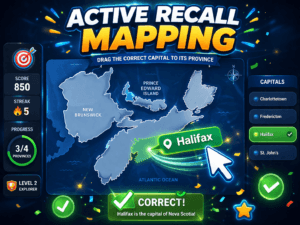
If you want to achieve a flawless score on a canadian provinces and capital cities quiz, you need a strategy. Rote memorization will only get you so far. Instead, employ cognitive chunking. Do not try to learn all thirteen entities at once. First, take a canadian provinces and capital cities quiz focusing solely on the West. Once you score 100%, move to the East. By breaking the map into manageable chunks, a canadian provinces and capital cities quiz becomes much less intimidating.
Another powerful strategy is to find mnemonic devices. Creating a memorable story or acronym that links the province to its capital can drastically reduce errors during a canadian provinces and capital cities quiz. Furthermore, connecting geographical data to other fields of knowledge can create stronger mental associations. For example, relating spatial geography to political or cultural trivia, much like navigating a Geo Connections Game or even an Autocomplete Game, forces your brain to access the geographic information from multiple distinct neural pathways. You could even test your critical thinking with a Trump Tweet Quiz just to give the spatial part of your brain a quick break before returning to map mastery.
Broadening Your Geographic Horizons
The journey of geographic discovery does not end with a single nation. The spatial intelligence cultivated by repeatedly practicing a canadian provinces and capital cities quiz prepares your mind for grander challenges. Understanding how vast landmasses are divided politically and geographically is a fundamental skill for global citizenship. The USGS highlights the importance of mapping and geographic literacy in understanding global environmental and political systems. By engaging with a canadian provinces and capital cities quiz, you are taking a crucial step toward broader geographic literacy.
Eventually, you can test your comprehensive worldview by participating in a Global Showdown, pitting your knowledge of the Canadian shield against your knowledge of the European plains or the African savannas. Every time you engage with these tools, starting with a fundamental canadian provinces and capital cities quiz, you are building a richer, more detailed mental model of the world we inhabit.
Conclusion
In summary, mastering the geography of the Great White North is a rewarding endeavor that offers profound cognitive benefits. Through the power of active recall, gamification, and targeted spatial practice, a canadian provinces and capital cities quiz elevates learning from a tedious chore to a stimulating mental exercise. It builds neuroplasticity, enhances spatial intelligence, and provides a solid foundation for lifelong geographic curiosity.
Whether you are using it to ace a school exam, to facilitate engaging classroom activities, or simply to keep your adult mind agile and sharp, a canadian provinces and capital cities quiz is an indispensable educational tool. So, embrace the challenge, visualize the map, and let the interactive power of a canadian provinces and capital cities quiz guide you to total geographic mastery.