
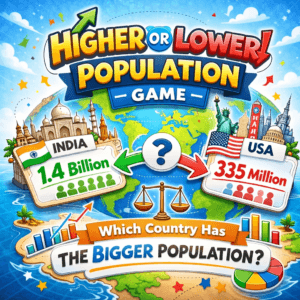
Higher Or Lower Population Game: The Ultimate Challenge
🌍 Population Showdown
Which country has more people?
Loading...
Loading...
Welcome to the ultimate Higher Or Lower Population Game on GeoMapGame, a thrilling and highly educational digital experience that tests your knowledge of global demographics. In a world with over 8 billion people, understanding how human life is distributed across the planet is an incredibly fascinating subject. We often assume that larger countries have more people, or that wealthy nations are the most populated. This Higher Or Lower Population Game is specifically designed to challenge those assumptions, turning global statistics into a fast-paced, addictive, and incredibly fun challenge.
The premise of the game is elegantly simple but notoriously difficult to master. You are presented with one country and its exact population. Then, a second country appears. Your only task is to decide: does the second country have a higher or lower population than the first? This binary choice is what makes the Higher Or Lower Population Game so engaging for players of all ages. It forces you to rely on your geographical instincts, your memory of world news, and your understanding of global development. It is the perfect population guessing game for trivia lovers.
Whether you are a student preparing for a human geography exam, a teacher looking for an interactive classroom activity, or a casual gamer looking to kill some time productively, this platform delivers. By taking raw data and turning it into a competitive format, the Higher Or Lower Population Game bridges the gap between entertainment and education. Join thousands of players worldwide as you build your streak, beat your high score, and discover the true scale of the human race.
What is the Higher Or Lower Population Game?
The Higher Or Lower Population Game is an interactive, browser-based trivia challenge that pits two nations against each other in a battle of demographics. Unlike traditional quizzes that ask you to type out a specific number—which is nearly impossible for most people to remember accurately—this game simplifies the cognitive load into a simple comparative choice. You only need to know relative sizes to succeed in the Higher Or Lower Population Game.
When you start a session, the screen displays a baseline country, such as “Canada,” along with its population of approximately 39 million. Next to it, a challenger appears, such as “Uganda.” You must click the “Higher” or “Lower” button based on your intuition or knowledge. If you are correct, Uganda becomes the new baseline, and a new challenger appears. This endless chain is the core mechanic of the Higher Or Lower Population Game, pushing you to build the longest streak possible before making a mistake.
This format is often referred to as a country population quiz, but the streak-based gameplay elevates it beyond a simple test. It creates a state of “flow” where players can rapidly make decisions, receive instant feedback, and adjust their mental models of the world in real-time. It is this immediate gratification loop that makes the Higher Or Lower Population Game a standout module in our suite of geography puzzles.
How to Play: A Step-by-Step Guide
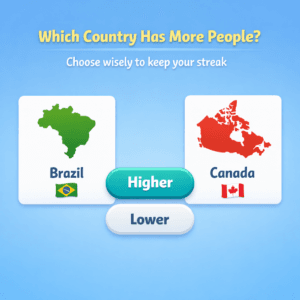
We have designed the user interface to be as intuitive as possible, ensuring that players from any background can immediately understand how to play. Here is a detailed breakdown of the gameplay flow when you launch the Higher Or Lower Population Game:
- Step 1: The Baseline. The game displays the first country on the left side of the screen, revealing its exact population figure. Take a moment to register this number.
- Step 2: The Challenger. On the right side of the screen, a new country appears. Its population is hidden.
- Step 3: The Decision. You must analyze the two nations. Does the challenger have more people or fewer people? Click the “Higher” or “Lower” button to lock in your answer.
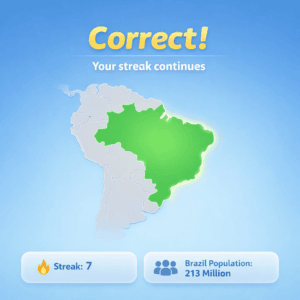
- Step 4: The Reveal. The Higher Or Lower Population Game immediately reveals the challenger’s population. If you guessed correctly, you earn a point, your streak increases by one, and the challenger moves to the left side to become the new baseline.
- Step 5: Game Over. If you guess incorrectly, the streak ends. You will see your final score and have the option to restart immediately.
Because the mechanics are so simple, mastering the Higher Or Lower Population Game relies entirely on your geographical knowledge rather than your gaming reflexes. It is a pure test of intellect and global awareness, making it a top-tier population guessing game.
Why This Format is So Addictive
There is a psychological reason why the Higher Or Lower Population Game is so incredibly hard to put down. Human brains are naturally wired for comparative thinking. We are much better at understanding “bigger vs. smaller” than we are at remembering absolute numbers like “126,450,000.” By tapping into this cognitive preference, the Higher Or Lower Population Game makes learning feel natural and unforced.
Furthermore, the streak mechanic introduces a high-stakes element to the country population quiz experience. When you have correctly guessed 15 countries in a row, the tension becomes palpable. The fear of losing your progress makes every click matter. You will find yourself pausing, debating internally, and visualizing the map of the world before making your next move in the Higher Or Lower Population Game. This emotional investment is what transforms a simple data comparison into a thrilling gaming experience.
Educational Benefits of Playing
While it is undoubtedly fun, playing the Higher Or Lower Population Game offers profound educational benefits. In modern geography and social studies curriculums, understanding population distribution is crucial. It dictates economic power, geopolitical influence, and environmental impact.
By engaging with the Higher Or Lower Population Game, players naturally develop a highly accurate mental map of human density. You will quickly learn that landmass does not equal population. This population guessing game highlights the massive demographic weight of regions like South Asia and Sub-Saharan Africa, correcting common Eurocentric or Western-centric biases. You learn to recognize the sheer scale of countries like India, China, Indonesia, and Pakistan.
Teachers frequently use the Higher Or Lower Population Game as a classroom warm-up activity. It sparks incredible discussions. When a student loses a streak because they didn’t realize Bangladesh has a higher population than Russia, it creates a perfect “teachable moment” about population density versus physical geography. This makes the country population quiz format an invaluable tool for modern educators.
Common Surprises and Misconceptions
One of the best parts of the Higher Or Lower Population Game is the sheer number of surprises it throws at you. Our mental models of the world are often outdated or heavily influenced by a country’s media presence rather than its actual demographic reality. Here are some common traps players fall into when playing the Higher Or Lower Population Game:
1. The Size Illusion
Players often assume massive countries have massive populations. For example, Canada and Australia are geographically gigantic. However, when Canada is pitted against a much smaller country like Vietnam in the Higher Or Lower Population Game, many players incorrectly guess that Canada has the higher population. In reality, Vietnam has nearly 100 million people, completely dwarfing Canada’s demographic size.
2. The European Bias
European countries feature heavily in global news, leading players to overestimate their size. In this population guessing game, seeing the United Kingdom (approx. 67 million) go up against Ethiopia (approx. 126 million) often ends streaks. Recognizing the rapid population growth in African nations is key to succeeding in the Higher Or Lower Population Game.
3. The Asian Giants
While everyone knows China and India have over a billion people, the secondary giants often catch players off guard. Indonesia (over 270 million) and Pakistan (over 240 million) frequently cause players to lose their streak in the Higher Or Lower Population Game if they underestimate the incredible density of the Asian continent.
Strategies for High Scores
If you want to dominate the leaderboards and achieve legendary streaks in the Higher Or Lower Population Game, you need to employ some strategic thinking. Here are expert tips for mastering this country population quiz:
- Memorize the Top 10: You should automatically know the order of the top ten most populated countries. Knowing that India, China, USA, Indonesia, Pakistan, Nigeria, Brazil, Bangladesh, Russia, and Mexico are at the top provides a massive advantage within the Higher Or Lower Population Game context.
- Think in Tiers: Group countries into mental tiers. The “Micro” tier (under 1 million, like Iceland or Fiji), the “Standard” tier (10-50 million, like most European nations), and the “Mega” tier (100 million+). When faced with a choice in the Higher Or Lower Population Game, quickly assign both countries to a tier to guide your guess.
- Consider Geography and Climate: Harsh climates cannot support large populations. If the Higher Or Lower Population Game gives you a desert nation (like Namibia) or a frozen nation (like Mongolia), the population will almost certainly be “Lower” when compared to a tropical or temperate nation of similar size.
- Beware of Island Nations: Islands can be tricky in this population guessing game. While Java (part of Indonesia) is incredibly dense, most small Caribbean or Pacific island nations have populations well under 5 million.
Accuracy and Authoritative Data Sources
In a data-driven game, accuracy is everything. We are committed to ensuring that the statistics used in the Higher Or Lower Population Game are reliable, up-to-date, and globally recognized. We do not use estimations from unverified sources. Instead, our database is regularly updated using figures from the most trusted global institutions.
The primary data driving the Higher Or Lower Population Game comes directly from the United Nations World Population Prospects report, which tracks demographic trends across all sovereign nations. We also cross-reference our numbers with data from the World Bank Open Data portal to ensure the highest level of integrity. By utilizing these authoritative sources, we guarantee that this country population quiz is not just a game, but a reflection of the real world in 2026.
Because global populations are constantly shifting—with some nations experiencing rapid growth and others facing demographic decline—we commit to updating the Higher Or Lower Population Game backend continuously. This means the game remains an accurate educational tool year after year.
Who Should Play This Game?
The beauty of the Higher Or Lower Population Game is its universal appeal. It is not limited to a specific demographic; anyone with a curious mind will find it highly entertaining. We see a wide variety of users benefiting from the Higher Or Lower Population Game:
Students and Academics: Those studying human geography, sociology, or international relations use this population guessing game to build a better intuitive grasp of global demographics. It is an excellent supplementary tool for exam preparation.
Trivia Enthusiasts: If you are the person who always answers the geography questions at the local pub quiz, the Higher Or Lower Population Game is your ideal training ground. It sharpens your mind and provides you with fascinating facts to share.
Casual Gamers: You do not need a degree in demographics to enjoy the Higher Or Lower Population Game. The simple, binary nature of the gameplay makes it a fantastic way to pass the time while commuting, waiting in line, or relaxing at home.
Frequently Asked Questions (FAQ)
1. What is the Higher Or Lower Population Game?
The Higher Or Lower Population Game is an interactive web game where players are shown two countries and must guess which one has the larger population to build a continuous winning streak.
2. Is the Higher Or Lower Population Game free to play?
Yes, absolutely. Like all educational tools on GeoMapGame, the Higher Or Lower Population Game is completely free, with no paywalls or required registrations.
3. How often is the data updated in the game?
We update the database for the Higher Or Lower Population Game annually using the latest official reports from the United Nations and the World Bank to ensure total accuracy.
4. Does the Higher Or Lower Population Game use real data?
Yes. We strictly use officially recognized demographic data. We do not use estimates for this country population quiz; every number is backed by global institutional research.
5. Can I use this population guessing game in my classroom?
We highly encourage it! The Higher Or Lower Population Game is unblocked and safe for school environments, making it a perfect interactive activity for geography and social studies teachers.
6. What happens if I guess incorrectly?
If you make a wrong choice in the Higher Or Lower Population Game, your current streak ends. You will be shown your final score and given the option to start a brand new game immediately to try and beat your record.
Conclusion: Start Your Demographic Journey Today
There is an entire world of fascinating data waiting for you to explore. The Higher Or Lower Population Game takes the dry statistics of global demographics and turns them into an exciting, competitive, and highly educational experience. Every time you click “Higher” or “Lower,” you are refining your understanding of the planet and the billions of people who share it.
Don’t just look at a map—understand the people who live there. Challenge your friends, test your instincts, and see how long of a streak you can build. Dive into the Higher Or Lower Population Game today and prove that you are a true master of world geography. Play now, learn constantly, and see if you have what it takes to top the leaderboards in the ultimate country population quiz!
Also check out: Flag Memory Game: The Ultimate Geography Challenge