
Geo Connections Game: The Ultimate Map Puzzle
Geo-Connections
Welcome to the incredible world of the Geo Connections Game on GeoMapGame, the premier digital destination for map lovers and trivia enthusiasts alike. If you are searching for a fresh, brain-teasing challenge that tests both your lateral thinking and your global knowledge, this Geo Connections Game is exactly what you need. Combining the viral mechanics of modern word grouping puzzles with the vast, fascinating world of maps, countries, and landmarks, this platform offers a truly unique educational experience. We know that finding a reliable daily geography game can be tough in a sea of generic quizzes, which is why we have engineered this interactive grid to be the absolute best of its kind.
In the Geo Connections Game, you aren’t just memorizing political borders or pointing blindly at a map. You are tasked with finding the hidden links between seemingly unrelated places. It is a true geography connection puzzle that requires you to think about linguistics, history, culture, and topography all at the same time. Whether you are a student studying for an exam, a teacher looking for classroom activities, or a casual trivia fan, the Geo Connections Game will push your cognitive skills to the limit and continuously expand your understanding of the world.
What is the Geo Connections Game?
So, what exactly is the Geo Connections Game? At its core, it is a highly addictive logic puzzle where players are presented with a grid of 16 geographical terms. These terms could be absolutely anything: cities, sovereign nations, sprawling rivers, towering mountain ranges, or even local currencies. The ultimate goal of the Geo Connections Game is to sort these 16 tiles into four distinct groups of four, where each group shares a specific, unbreakable common theme.
For example, a typical geo connections puzzle might feature a grid containing the words “Paris,” “London,” “Berlin,” and “Rome.” The link here is straightforward: they are all famous European capital cities. However, the true beauty of the Geo Connections Game lies in its trickery and misdirection. The puzzle designers intentionally include “red herrings”—words that could easily fit into multiple categories simultaneously. “Paris” might also fit into a theoretical category of “Cities with a famous tower” or “Cities that hosted the Summer Olympics.” This overlapping complexity makes every single geography connection puzzle a thrilling mental exercise that demands careful consideration.
This is not just another random trivia generator; it is a meticulously crafted daily geography game. Every 24 hours, a brand new Geo Connections Game is released, giving the entire global community of players a fresh set of tiles to decipher. This shared experience is what makes logging in every day so incredibly rewarding.
How to Play: A Step-by-Step Guide
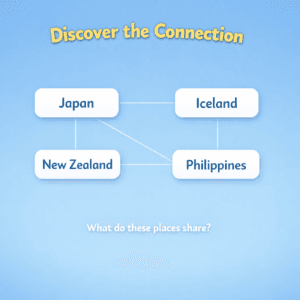
Learning how to play the Geo Connections Game is remarkably simple, but mastering the nuances of the grid takes time, patience, and a deep well of knowledge. Here is a step-by-step guide to tackling your very first geo connections puzzle:
- Analyze the Grid: When you first launch the Geo Connections Game, take a deep breath and read all 16 tiles carefully before making any moves. Look for immediate, obvious patterns, but be wary of traps.
- Select Four Tiles: Click or tap on four tiles that you confidently believe share a geographical link. As a high-quality daily geography game, the interface is engineered to be incredibly smooth and responsive across all devices, from desktop monitors to mobile phones.
- Submit Your Guess: Once your four tiles are selected, hit the submit button. If you are correct, those tiles will lock in, change color, and reveal the official category name. This validation is the most satisfying moment in the Geo Connections Game!
- Watch Your Mistakes: If you are wrong, the system will let you know. If you have three correct tiles and one wrong one, the Geo Connections Game will usually warn you that you are “one away.” You have a limited number of mistakes (typically four) before your session ends in defeat.
- Solve the Remaining Groups: Continue grouping the remaining tiles until all four categories are solved and the board is cleared.
This intuitive and elegant design is exactly why this geography connection puzzle has captured the attention of so many dedicated players. It is exceptionally easy to understand, yet incredibly difficult to execute perfectly on your first try.
Why This Puzzle Format is So Engaging
The human brain is naturally wired for pattern recognition. We instinctively want to categorize and organize the chaotic world around us. The Geo Connections Game taps directly into this deeply rooted psychological phenomenon. By forcing players to look beyond the surface level of a word, a geo connections puzzle stimulates the brain’s complex problem-solving centers.
Unlike a standard multiple-choice quiz where you either know the factual answer or you don’t, the Geo Connections Game allows you to deduce the correct answer through logical elimination. If you know that three items definitely belong together, you can often deduce the mysterious fourth item just by analyzing the remaining options on the board. This deductive reasoning makes it a profoundly rewarding geography connection puzzle.
Furthermore, the social aspect of a daily geography game cannot be understated. Because everyone in the world is playing the exact same Geo Connections Game on any given day, you can share your results (without revealing spoilers) with friends, family, and coworkers. Comparing your color-coded results grid with others creates a wonderful sense of community, shared struggle, and friendly competition.
Example Categories and Themes
If you are entirely new to the Geo Connections Game, you might be wondering what kind of categories to expect. The creators of this geo connections puzzle work tirelessly to ensure a balanced mix of difficulty levels. Drawing inspiration from popular formats like NYT Connections, the four groups are typically color-coded by difficulty once solved: Yellow (easiest), Green (medium), Blue (hard), and Purple (tricky). Here is exactly what you might encounter during your daily geography game session:
The Yellow Category: Straightforward Geography
The easiest group in the Geo Connections Game usually relies on basic, well-known geographical facts. You might see four countries that all share a physical border with Germany (e.g., France, Poland, Austria, Denmark). Or perhaps it is a simple geography connection puzzle involving four major rivers located in Africa (Nile, Congo, Niger, Zambezi). Identifying the yellow group quickly is crucial for clearing up the board and reducing visual clutter.
The Green Category: Cultural and Historical Links
Moving up in difficulty, the Geo Connections Game often tests your knowledge of human geography. A green category in a geo connections puzzle might involve “Countries that were never colonized by Europe” or “Cities that have hosted the Winter Olympics.” This level requires you to know more than just where a place is located; you must understand its historical context. This impressive depth is what makes it a superior daily geography game.
The Blue Category: Flags, Currencies, and Trivia
The blue group in the Geo Connections Game is where things get genuinely tough. You might need to group countries that feature a dragon on their national flag (Bhutan, Wales) or nations that use a variation of the “Rupee” as their official currency. A tough geography connection puzzle at this blue level easily separates the casual players from the true geography nerds.
The Purple Category: Wordplay and Lateral Thinking
This is the ultimate hallmark of a brilliant geo connections puzzle. The purple category in the Geo Connections Game often relies heavily on the spelling, pronunciation, or linguistic quirks of the words themselves, rather than the physical geography. For example, you might look for “Countries that end in the letter ‘Q'” (Iraq) or “Capital cities containing double letters” (Amman, Tallinn). This unexpected linguistic twist elevates the experience from a standard trivia test to an elite geography connection puzzle.
The Educational Power of Map Puzzles in Classrooms
Teachers across the globe are constantly searching for innovative, modern ways to make social studies and earth sciences engaging for their students. Incorporating a high-quality daily geography game is often the perfect solution. Traditional methods of memorizing dry lists of capitals or passively coloring in blank maps can quickly become tedious for young learners. However, when students are presented with a dynamic geo connections puzzle, their competitive instincts and natural curiosity are immediately activated.
In a lively classroom setting, educators can easily project the daily challenge onto a smartboard and have the entire class work collaboratively. This group problem-solving encourages students to debate enthusiastically, articulate their logical reasoning, and share obscure facts they might have learned outside of school. For instance, when debating a tricky geography connection puzzle, one student might recognize a country’s currency while another remembers its primary export. Together, they can crack the code. According to resources from National Geographic Education, interactive and game-based learning significantly improves spatial thinking and the long-term retention of global facts.
Furthermore, this type of daily geography game fosters essential critical thinking skills. It teaches students that the world is interconnected in myriad, invisible ways. A country is not just defined by its longitudinal coordinates on a map; it is defined by its climate, its people, its political alliances, and its history. A well-designed geo connections puzzle brilliantly highlights these invisible threads that tie seemingly disparate regions together.
Why Geography Matters in a Connected World
Before diving deeper into advanced trivia tactics, it is worth asking: why is learning about the world so critically important today? In an era characterized by instant global communication and massive international trade, having a solid mental map of the earth is no longer just a neat party trick—it is a vital component of modern cultural literacy. When we truly understand where countries are located relative to one another, we can better comprehend complex geopolitical conflicts, climate change impacts, and fragile economic supply chains.
Furthermore, familiarizing ourselves with the capitals, currencies, and topographical features of distant nations fosters a deep sense of global empathy. It reminds us that we share this blue planet with billions of other people, each with their own rich histories and vibrant cultures. Playing interactive quizzes and puzzles is a low-stress, highly effective way to build this essential knowledge base from the comfort of your own home.
Advanced Strategies for Solving Like a Pro
If you genuinely want to maintain a flawless winning streak and impress your friends with your puzzle-solving prowess, you need to employ some advanced strategies. Approaching a geography connection puzzle without a concrete plan is a surefire way to burn through your available mistakes. Here are some expert tips to help you conquer the board:
- Do Not Guess Prematurely: The absolute biggest mistake new players make is clicking the first four related items they see. The cunning designers of this daily geography game intentionally include five or six items that fit an obvious category just to bait you into wasting a precious turn. Always scan the entire grid to ensure there aren’t multiple overlapping words before committing.
- Use the Shuffle Button: When you stare at a static grid for too long, your brain can get locked into false, unbreakable patterns. Hitting the shuffle button reorganizes the tiles, giving you a desperately needed fresh visual perspective. Often, seeing two words next to each other in a new arrangement will trigger a sudden realization, unlocking the geo connections puzzle instantly.
- Work Backwards from the Hardest Category: Sometimes, the absolute easiest way to solve the board is to figure out the tricky wordplay category first. Look for words that have strange spellings, unusual prefixes, or obvious rhyming patterns. If you can isolate the purple group early, the rest of the geography connection puzzle becomes significantly easier because the dangerous red herrings are permanently removed.
- Recognize the Trickery of Homophones: Sometimes, the creators will throw in a word that sounds exactly like a country or city but is spelled slightly differently, or they will use a location name that doubles as a common household object. For instance, “Turkey” could refer to the nation or the bird, and “Chad” could be the African country or a common first name. Recognizing these double meanings is critical.
- Brush Up on Topography: Most people are decent at identifying major countries, but they stumble when it comes to physical features. Take some time to memorize the longest rivers in Asia, or the major mountain ranges of the Americas. A robust understanding of physical features will give you a massive advantage when the grid shifts away from political boundaries.
- Take a Break: If you are staring at the screen and getting incredibly frustrated, walk away. Your subconscious mind will continue working on the complex problem in the background. Many top players report that stepping away from their daily geography game for just ten minutes allows them to return and solve it immediately.
The Evolution of Online Geography Trivia
The internet has completely revolutionized how we learn about the physical world. In the early days of the web, map games were strictly limited to simple point-and-click flash games where you merely had to click on a country’s blank outline. While effective for basic memorization, they lacked intellectual depth. Then came the incredible era of visual exploration games, which dropped players into a random street view location and asked them to figure out where they were based entirely on visual clues like road signs, architecture, and vegetation.
Now, we are proudly entering a new era of text-based and logic-based challenges. The massive rise of daily word puzzles showed that players love a quick, daily mental workout that they can easily share with their social network. The creation of a geo connections puzzle is the natural, inevitable evolution of this trend. It strips away the frustrating need for fast reflexes or high-speed internet and instead focuses purely on intellect, memory, and knowledge retrieval.
This evolution is incredibly important because it makes global literacy more accessible to absolutely everyone. You don’t need a high-end gaming PC to participate; you just need a standard web browser and a curious mind. By making learning accessible and highly social, we are helping to foster a more globally aware, educated internet population.
Frequently Asked Questions
Is this challenge free to play?
Yes, our platform is completely, 100% free for all users. We firmly believe that high-quality educational tools should be accessible without restrictive paywalls.
When does the new puzzle reset?
A brand new challenge is generated every single day at midnight local time. This consistent schedule makes it a perfect addition to your morning coffee routine.
Can I play past puzzles?
We currently focus entirely on the daily communal experience, meaning everyone across the globe solves the exact same board on the same day. However, we may introduce a comprehensive archive feature in the near future.
What if I don’t know much about geography?
That is the true beauty of this system! You will learn as you play. Even if you fail, reading the revealed answers will teach you fascinating facts about the world that you can use the next time you log in.
Is it mobile-friendly?
Absolutely. The tile grid is perfectly optimized for smartphones and tablets, allowing you to comfortably play on your commute or while waiting in line at the grocery store.
Why did I get marked incorrect when my group was right?
Sometimes, you might select four items that technically do share a valid trait (e.g., “They are all located in Europe”). However, the puzzle is specifically designed with highly targeted categories in mind. If your category is too broad, it is highly likely that you have stolen a tile needed for a much more specific group elsewhere on the board.
Is there a timer?
No, there is absolutely no time limit. You can spend as long as you need analyzing the grid. Many people keep the tab open all day, returning to it whenever they have a spare moment to ponder the remaining tiles.
Conclusion: Join the Global Community Today
There has quite simply never been a better time to test your knowledge of the planet we call home. We invite you to dive headfirst into the Geo Connections Game today and see if you possess what it takes to achieve a perfect, mistake-free score. Whether you are aiming to be the ultimate trivia champion of your friend group, or you just want a fun, relaxing way to keep your brain sharp as you age, this daily geography game is waiting for you.
Challenge your friends, learn about new cultures, and master the ultimate geography connection puzzle right here on GeoMapGame. The world is a massive, complex puzzle, and it is time for you to start putting the pieces together. Good luck, and happy solving!
Also check out: Higher Or Lower Population Game: The Ultimate Challenge