Unlocking the Power of Spatial Intelligence Through Geography
Have you ever looked at a blank map and felt a moment of hesitation? You know the state is somewhere in the Midwest, but is it Nebraska or Kansas? This common mental stumble isn’t just about forgetting a name; it is a lapse in your brain’s spatial indexing system. Geography is far more than memorizing lists of names. It is a complex cognitive workout that engages deep neural pathways responsible for orientation, memory, and visualization. When you engage with a Quiz Map of USA, you are doing more than playing a game—you are actively training your brain to build a robust mental atlas.
In the digital age, we often rely on GPS to tell us where to go, allowing our natural navigational skills to atrophy. However, cognitive geography suggests that actively learning to navigate a map can reignite these dormant faculties. A well-designed Quiz Map of USA forces your brain to bridge the gap between abstract shapes and concrete labels. This process, known as “binding,” is essential for long-term memory retention. By turning geography into an interactive challenge, we move past passive observation and enter the realm of active cognitive development.
This guide will explore the fascinating science behind how we learn geography. We will dissect how tools like a Quiz Map of USA stimulate the hippocampus, why active recall is the gold standard for learning, and how you can leverage these insights to master the United States map once and for all. Whether you are a student, a lifelong learner, or someone simply looking to sharpen their mind, the journey starts with a single click on a map.
The Neuroscience of a Quiz Map of USA
To understand why a Quiz Map of USA is such a potent learning tool, we must look inside the human brain. Deep within the temporal lobe lies the hippocampus, a seahorse-shaped structure critical for learning and memory. This region is home to specialized neurons called “place cells” and “grid cells.” These cells act as the brain’s internal GPS, firing specific electrical patterns when you navigate a physical space or—crucially—when you mentally traverse a map.
When you use a Quiz Map of USA, you aren’t just matching words to pictures. You are activating these spatial neurons. Research shows that people with high “spatial intelligence”—the ability to visualize and manipulate objects in the mind’s eye—often excel in STEM fields. The good news is that spatial intelligence is not fixed; it is plastic. This means it can be improved with practice. Regularly challenging yourself to identify states on a Quiz Map of USA strengthens the synaptic connections in the hippocampus, effectively upgrading your brain’s hardware for spatial reasoning.
Furthermore, the brain processes borders and boundaries differently than open space. A Quiz Map of USA that highlights state borders triggers “boundary vector cells,” which help define the edges of your mental map. This is why guessing a state by its shape alone is harder than seeing it in context—it requires a higher level of cognitive processing. By repeatedly engaging with these visual puzzles, you are teaching your brain to recognize patterns, scale, and orientation, skills that translate far beyond the classroom.
Active Recall: Why Passive Study Fails
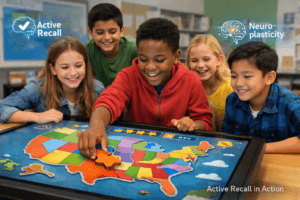
We have all tried the “stare and pray” method of studying: looking at a completed map for hours, hoping the information sticks. Cognitive science tells us this is one of the least effective ways to learn. The brain is efficient; if it doesn’t have to work to retrieve information, it won’t store it deeply. This is where the concept of “Active Recall” transforms the utility of a Quiz Map of USA.
Active recall is the practice of testing yourself before you feel ready. When you look at a blank state on a Quiz Map of USA and force your brain to retrieve the name “North Dakota,” you are strengthening the neural pathway to that memory. The struggle you feel during that split second of uncertainty is actually where the learning happens. It signals your brain that this information is important and needs to be prioritized for long-term storage.
In contrast to passive review, a Quiz Map of USA provides immediate feedback. If you guess incorrectly, the correction helps you recalibrate. This loop of retrieval -> feedback -> correction is the engine of rapid learning. To really supercharge this process, try the US State Capital Quiz. Combining state locations with their capitals forces your brain to create “associative memories,” linking two distinct pieces of data (location and city name) into a single, stronger cognitive unit.
The Role of Gamification in Geography
Why do we can spend hours playing video games but struggle to focus on a textbook for twenty minutes? The answer lies in dopamine. Gamification harnesses the brain’s reward system to make learning addictive. A well-constructed Quiz Map of USA uses elements like scores, timers, and streaks to keep the user engaged. When you successfully identify a state, your brain releases a small hit of dopamine, the “feel-good” neurotransmitter. This positive reinforcement motivates you to continue.
For younger learners, or even adults who find traditional study dry, this is a game-changer. Using a Quiz Map of USA turns a geography lesson into a high-stakes challenge. The fear of failure is replaced by the excitement of beating a high score. This emotional engagement is key to neuroplasticity. The brain prioritizes memories that have an emotional component. The frustration of a wrong guess and the joy of a correct one make the information stickier.
If you want to test this theory, try the Guess the US States game. It simplifies the interface to focus purely on recognition speed. By reducing the friction of learning, gamified tools ensure that you practice longer and more frequently. Consistency is the secret sauce of mastery, and a fun Quiz Map of USA ensures you keep coming back for more.
Strategies to Master the Quiz Map of USA
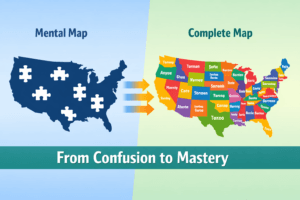
So, you are ready to conquer the map. How do you approach a Quiz Map of USA strategically? Rote memorization of all 50 states at once is a recipe for cognitive overload. Instead, we use a technique called “Chunking.” Chunking involves breaking a large amount of information into smaller, manageable groups. In geography, this naturally aligns with regions.
1. Start with the Edges
The human brain loves anchors. When starting your journey with a Quiz Map of USA, focus on the coastal states first. The distinctive shapes of California, Florida, and Texas act as mental anchors. Once these are secure, you can “fill in” the middle. This utilizes the “boundary effect,” where known edges help you calculate the position of interior items. You can practice this specific skill with the US States by Borders Quiz, which isolates the shapes and neighbors of each state.
2. The MIMAL Column
For the tricky middle section of the map, use mnemonics. A classic tool for the Quiz Map of USA is the MIMAL column: Minnesota, Iowa, Missouri, Arkansas, Louisiana. These five states form a line down the center of the country, looking remarkably like an elf’s profile (Minnesota is the hat, Louisiana the boots). Visual mnemonics like this turn abstract shapes into concrete images, making them impossible to forget during a quiz.
3. Spelling and Etymology
Sometimes, the location isn’t the problem—it’s the spelling. Massachusetts and Mississippi are notorious for tripping up even geography buffs. Integrating a spelling challenge into your routine can help. After a round on the Quiz Map of USA, switch gears to the US State Name Quiz to ensure your orthography matches your cartography. Understanding the origin of names can also provide memory hooks; for example, knowing “Vermont” comes from “Green Mountain” in French helps you place it in the lush northeast.
Beyond Borders: Contextualizing the Map
To truly master the Quiz Map of USA, you need to add layers of context. A map is not just lines on a page; it is a representation of political, cultural, and physical realities. When you understand why a state is shaped the way it is, you remember it better. For instance, many straight borders in the West were drawn by surveyors based on latitude and longitude, whereas Eastern borders often follow rivers and mountain ranges.
You can expand your “cognitive map” by associating states with current events or pop culture. This technique, known as “elaborative encoding,” weaves new information into your existing knowledge base. A fun way to practice this is the Trump Tweet Quiz. While not strictly a map game, it forces you to recall specific contexts and locations mentioned in media, indirectly reinforcing your mental associations with different parts of the country.
Furthermore, language plays a huge role in US geography. The Southwest is heavily influenced by Spanish naming conventions. Recognizing these patterns can offer clues when you are stuck on a Quiz Map of USA. If you see a state name like “Colorado” (colored red) or “Nevada” (snow-covered), you can logically place them in the distinct landscapes of the West. Diversifying your learning with the Wordle Geography Game helps reinforce these linguistic patterns in a low-pressure environment.
Advanced Techniques for the Geography Whiz
Once you have achieved basic proficiency on the standard Quiz Map of USA, it is time to increase the difficulty. Cognitive growth occurs at the edge of your ability. If a task is too easy, your brain goes on autopilot. To keep your spatial intelligence sharp, you must introduce “desirable difficulties.”
One method is to remove visual cues. Can you identify a state just by its silhouette, without seeing it on the full map? This forces your brain to rely entirely on internal visualization rather than relative position. The Scramble Words Game is another excellent way to test your recall under pressure. By mixing up the letters of geographical locations, you force your brain to reconstruct the data from scratch, a powerful exercise for memory durability.
Another advanced tier involves expanding your scope. The United States does not exist in a vacuum. Understanding its place in the world enhances your understanding of the country itself. After a session with the Quiz Map of USA, try zooming out with the Countries of the World Quiz. Seeing the US in relation to Canada and Mexico reinforces the northern and southern borders, solidifying the “edges” of your mental map.
Visual Memory and Pattern Recognition
Humans are visually dominant creatures. A significant portion of our cortex is dedicated to processing visual information. A Quiz Map of USA leverages this biological preference. However, not all visual input is equal. “Iconic memory” is the brain’s fast-decaying store of visual information. To move data from iconic memory to long-term memory, we need attention and repetition.
Flags are powerful visual symbols that can serve as secondary anchors for your map knowledge. While state flags are often less recognizable than national ones, the principle remains. Associating a visual symbol with a geographic location creates a “dual-coding” effect. You can train this visual muscle with the Flags of the World Quiz or the more intensive Flag Memory Game. While these focus on international flags, the cognitive skill of associating a complex visual pattern with a specific name transfers directly to mastering the shapes on a Quiz Map of USA.
For those who love a challenge, trying to identify capitals adds another layer of visual complexity. A city is a point, while a state is a shape. Correlating a point within a shape requires precise spatial memory. The Capital Cities of the World Quiz is a great global companion to your US studies, keeping your brain flexible and ready to switch between different scales of geography.
Why The “Quiz Map of USA” is Essential for Students
In the classroom, geography is often reduced to coloring sheets. This fails to engage the “executive functions” of the brain—the planning and problem-solving centers. A digital Quiz Map of USA changes the dynamic. It allows students to take ownership of their learning. The instant feedback loop allows for self-correction without the embarrassment of being wrong in front of a class. This psychological safety is crucial for effective learning.
Moreover, the standardized testing landscape is evolving. Questions are becoming more integrated, requiring students to connect history, earth science, and economics. All of these disciplines rely on a foundational knowledge of where things are. You cannot understand the Civil War without a mental map of the Mason-Dixon line. You cannot grasp climate zones without knowing where the Rockies sit. A Quiz Map of USA provides the scaffold upon which all this other knowledge is built.
Teachers and parents can gamify this further by setting challenges. Who can get 100% on the Quiz Map of USA in the fastest time? Who can complete the map without making a single error? These micro-competitions foster a culture of learning that feels like play. For more resources on educational standards, reputable sources like National Geographic Education offer excellent supplementary materials that align well with digital quizzes.
The Long-Term Benefits of Geographic Literacy
Why does this matter in the long run? Is a Quiz Map of USA just a party trick? Absolutely not. Geographic literacy is correlated with better decision-making and global awareness. In an interconnected economy, knowing your way around a map is a professional asset. It implies a level of cultural competence and logistical understanding that is highly valued.
Furthermore, keeping the brain active with puzzles and quizzes is shown to delay cognitive decline. The “use it or lose it” principle applies to your hippocampus just as much as your muscles. Regularly engaging with a Quiz Map of USA is a low-impact, high-reward mental workout. It keeps your spatial processing speed high and your memory retrieval pathways clear.
It is also about citizenship. Understanding the layout of your own country fosters a sense of connection. When you hear about a hurricane in Louisiana or a wildfire in California, knowing exactly where those places are on your internal Quiz Map of USA creates a stronger empathetic bridge. It turns abstract news into concrete reality.
Your Roadmap to Success
Mastering the US map is a journey, not a sprint. It requires patience, strategy, and the right tools. By utilizing a Quiz Map of USA, you are leveraging cutting-edge cognitive science to learn faster and remember longer. You are moving beyond rote memorization into the realm of spatial intelligence and active recall.
Remember to mix up your training. Don’t just stick to one type of quiz. Rotate through the US State Capital Quiz to test your detailed knowledge, the Guess the US States for speed, and the US States by Borders Quiz for shape recognition. Variety is the spice of learning, and it keeps your brain adaptable.
For those interested in the deeper science of maps and geology, the US Geological Survey (USGS) provides incredible detailed maps that can serve as advanced study material. Similarly, Britannica offers deep dives into the history of each state, providing the narrative context that helps memory stick.
So, are you ready to test your spatial limits? The map is waiting. Open the Quiz Map of USA, trust your hippocampus, and start exploring. You might just be surprised at how much your brain can handle.
Conclusion
The humble map is a gateway to a sharper mind. Through the consistent use of a Quiz Map of USA, you are not just learning where Wyoming is; you are training your brain to visualize, organize, and recall complex information. This is spatial intelligence in action. By embracing active recall and gamification, you transform a chore into a challenge.
Whether you are using the Scramble Words Game to test your spelling or the Flag Memory Game to boost your visual retention, every quiz you take contributes to a stronger, more resilient intellect. The world is a big place, but with the right tools, it fits right in the palm of your hand.