The Cognitive Science Behind Mastering a Quiz Map Of United States
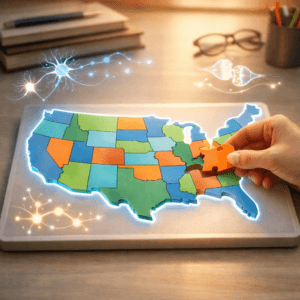
Geography is often mistaken for a subject of simple rote memorization—a dusty list of names, coordinates, and borders to be recited and forgotten. However, modern cognitive science reveals that engaging with a Quiz Map Of United States is far more than a trivia exercise; it is a profound workout for your brain’s spatial intelligence. When you attempt to locate Vermont on a blank map or distinguish Colorado from Wyoming, you are not just recalling a fact; you are activating the hippocampus, the brain’s center for navigation and memory formation.
In this deep dive into geographic mastery, we will explore how gamified learning transforms the way we understand the world. We will look beyond the simple “point and click” mechanics and delve into the science of “Active Recall,” demonstrating why a Quiz Map Of United States is the most effective tool for long-term retention. Whether you are a student, a teacher, or a lifelong learner looking to keep your mind sharp, understanding the cognitive map of America is your first step toward broader global literacy.
1. Spatial Intelligence and the “Mental Grid”
Spatial intelligence is the capacity to understand and manipulate spatial relations among objects. When you look at a map, your brain attempts to translate a two-dimensional image into a mental model of the real world. This process relies heavily on “grid cells”—neurons that allow us to understand our position in space. Using an interactive Quiz Map Of United States compels these grid cells to fire repeatedly, strengthening the neural pathways associated with location and adjacency.
Many learners struggle with geography because they try to memorize lists of names without anchoring them to a visual structure. This is where tools like Guess the US States become vital. By forcing the brain to make a decision based on visual cues—shape, size, and location—you move from passive observation to active participation. This shift is crucial for neuroplasticity, the brain’s ability to reorganize itself by forming new neural connections throughout life. [1]
Furthermore, the United States offers a unique cognitive challenge due to its mix of varied borders. The organic, river-defined borders of the East Coast require a different type of visual processing than the geometric, longitudinal borders of the West. Mastering a Quiz Map Of United States requires the brain to toggle between these processing modes, enhancing overall cognitive flexibility.
2. The Power of Active Recall in Geography
Why do we forget the state capitals a week after the test? The culprit is often passive study methods, such as re-reading a textbook or staring at a filled-in map. Cognitive psychology advocates for “Active Recall”—the process of retrieving information from memory with minimal cues. A Quiz Map Of United States is the quintessential active recall tool. Instead of being told “This is Nebraska,” the quiz asks, “Where is Nebraska?” and forces your brain to search its archives.
This struggle to retrieve the answer signals to your brain that the information is important, leading to stronger memory encoding. This phenomenon, known as the “testing effect,” suggests that the act of taking a quiz is more beneficial for learning than the act of studying the material. [2] To practice this, you might engage with the US State Name Quiz, which removes the visual crutch of the shape and relies entirely on your ability to link a name to a location purely through memory retrieval.
Incorporating active recall into your daily routine doesn’t take hours. Short, frequent bursts of quizzing—known as “spaced repetition”—are far more effective than cramming. By repeatedly challenging yourself with a Quiz Map Of United States over days or weeks, you convert volatile short-term memories into durable long-term knowledge.
3. Deconstructing Borders: A Lesson in Topology
To truly master the map, one must understand the relationships between the states. This is the study of topology—how spaces relate to one another. A common mistake in geography is treating states as isolated islands. In reality, they are puzzle pieces defined by their neighbors. For instance, knowing that Kentucky sits atop Tennessee helps you locate both, even if you are unsure of their exact coordinates.
This is why the US States by Borders Quiz is such a powerful educational resource. It strips away the labels and forces you to look at the geometry of the land. Does the state have a panhandle? Is it bordered by the Mississippi River? These geometric cues are easier for the visual cortex to retain than abstract names. [3]
For example, the “Four Corners” region is a distinct visual anchor. If you can identify where Utah, Colorado, Arizona, and New Mexico meet, you have a solid reference point to build the rest of your mental map. A Quiz Map Of United States that emphasizes these border relationships turns a chaotic jumble of 50 items into an organized network of interconnected shapes.
4. From Capitals to Context: deepening the Knowledge
Once the physical shapes of the states are mastered, the next layer of cognitive geography is political and urban geography—specifically, capitals. Learning capitals adds a layer of “semantic memory” to your spatial map. It connects a specific data point (the city name) to the spatial container (the state). This dual-coding helps reinforce the memory of the state itself.
Challenging yourself with the US State Capital Quiz does more than help you pass a civics exam. It builds a hierarchical mental structure. You learn to associate “Sacramento” not just with “California,” but with the northern interior of the state, distinct from the coastal cities of Los Angeles or San Francisco. This nuance is vital for true geographic literacy.
Moreover, understanding capitals often provides a window into history. Why is Albany the capital of New York and not New York City? Why is Sacramento the hub of California? These answers lie in historical trade routes and population centers of the past. For deeper historical context on how these borders and capitals were formed, the Library of Congress offers an incredible archive of historical maps that show the evolution of the Quiz Map Of United States over centuries.
5. Gamification: The Dopamine Loop in Learning
We cannot ignore the chemical aspect of learning. When you successfully identify a state on a Quiz Map Of United States, your brain releases a small burst of dopamine—the neurotransmitter associated with pleasure and reward. This positive reinforcement loop makes the learning process addictive in a healthy way. Gamification elements, such as timers, scoreboards, and streaks, leverage this biological mechanism to keep you engaged.
For those who prefer word puzzles over visual ones, the Wordle Geography Game offers a text-based entry point into geographic thinking. It combines vocabulary skills with geographic knowledge, engaging the language centers of the brain alongside the spatial centers. Similarly, the Scramble Words Game can help solidify the spelling and recognition of complex state names like “Massachusetts” or “Connecticut,” which are often stumbling blocks for learners.
By varying the type of game you play, you prevent cognitive fatigue. Switching from a visual map quiz to a text-based puzzle keeps the brain agile and prevents the boredom that often accompanies rote memorization. [4]
6. Expanding Horizons: Beyond the 50 States
Mastering the Quiz Map Of United States is often just the beginning. The cognitive skills you develop—identifying shapes, understanding borders, and recalling capitals—are directly transferable to global geography. Once you have solidified your mental image of North America, it is time to zoom out. The brain craves novelty, and expanding your scope to the rest of the globe provides a fresh challenge.
You can test your expanding worldview with the Countries of the World Quiz. You will find that the same strategies apply: chunking continents, using major rivers as dividers, and identifying distinct border shapes. Additionally, visual learners often find great success with the Flags of the World Quiz. Flags utilize the brain’s capacity for pattern recognition and color memory, which functions differently than spatial memory.
For a pure test of visual memory retention, the Flag Memory Game is an excellent exercise. It trains your working memory—the ability to hold information in your head for short periods—which is a critical skill for everything from mental math to reading comprehension.
7. Media Literacy and Geographic Awareness
In our interconnected digital age, geography is not just academic; it is essential for media literacy. When news breaks, knowing exactly where an event is happening changes your understanding of the story. It provides context regarding climate, economy, and political alignment. We see this intersection of media and geography clearly in modern political discourse.
For a unique, modern twist on geographic trivia that incorporates media literacy, check out the Trump Tweet Quiz. While seemingly pop-culture focused, quizzes like these often require you to identify locations, capitals, or regions mentioned in the media, grounding abstract news stories in physical reality. [5]
Resources like National Geographic Education emphasize that “geo-literacy” is essential for making decisions about the planet. A citizen who has mastered the Quiz Map Of United States is better equipped to understand election results, weather patterns, and economic shifts.
8. Techniques for Conquering the Hardest States
Even seasoned geography buffs struggle with certain areas of the Quiz Map Of United States. The “Mimal” states (Minnesota, Iowa, Missouri, Arkansas, Louisiana) form a recognizable chef silhouette, but the rectangular states of the Midwest and West can be notoriously difficult. Here are a few scientific strategies to distinguish them:
- Visualization (The Method of Loci): Imagining a journey through the states. Drive mentally from North Dakota to South Dakota, visualizing the climate getting slightly warmer.
- Chunking: Do not try to memorize all 50 at once. Break the map into regions: New England, the Deep South, the Pacific Northwest. Master one chunk before moving to the next.
- Etymology: Understanding what the names mean. “Vermont” comes from “Verd Mont” (Green Mountain). Knowing this helps you associate the state with its lush, mountainous terrain.
When you feel ready to test your precision, the Capital Cities of the World Quiz will show you how well your regional chunking strategy holds up on a global scale. The discipline required to distinguish Wyoming from Colorado is the same discipline needed to distinguish Slovakia from Slovenia.
Conclusion: Your Brain on Maps
Engaging with a Quiz Map Of United States is an investment in your cognitive health. It sharpens your memory, enhances your spatial reasoning, and broadens your understanding of the world. It transforms a static image into a dynamic mental playground where neurons are constantly firing and connecting.
Geography is not a static subject; it is a living, breathing discipline that connects history, politics, and science. By utilizing tools like the Guess the US States game or the challenging US States by Borders Quiz, you are doing more than killing time—you are building a more resilient, agile, and informed mind.
So, open the map. challenge your recall, and watch as the blurred lines of the continent snap into sharp, high-definition focus. For authoritative maps and geological data to supplement your learning, the US Geological Survey (USGS) remains the gold standard for American cartography.