The Comprehensive Expert Framework
The primary reason geography students feel overwhelmed by political boundaries is the “isolation error.” Most learners attempt to view a border as a singular, squiggly line to be memorized in a vacuum, rather than seeing it as a shared interface between two distinct entities. This lack of context leads to cognitive fatigue, where the mind struggles to differentiate between the hundreds of various frontier shapes across the globe. If you are searching for how to learn country borders easily, the solution lies in moving away from rote memorization and toward “relational mapping,” where you focus on how countries interlock like pieces of a complex jigsaw puzzle.
The solution to this academic hurdle is the application of “Spatial Contiguity Theory.” By discovering how to learn geography borders easily, you engage the brain’s parietal lobe, which is naturally optimized for understanding shapes and positions. Instead of treating a border as an abstract concept, you should view it as a logical result of physical geography—such as a river, a mountain range, or a historical treaty line. This shift in perspective transforms a dry list of boundaries into a vivid, logical network of connections. When you understand why a border exists where it does, you no longer need to “memorize” it; you simply “know” it.
In this high-authority guide, we break down the most effective how to learn country borders easily strategies used by competitive geographers and educators. We will explore the technical mechanics of visual encoding, the educational benefits of active recall, and the specific ways interactive technology can accelerate your mastery of the world map. Whether you are a student preparing for a standardized test or a trivia enthusiast looking to sharpen your global awareness, these E-E-A-T compliant methods will provide you with a permanent mental map of the world’s nations. Let’s begin the journey toward geographic fluency.
Our Mission: Simplifying Global Connectivity
Our mission is to empower learners by providing scientifically-proven how to learn country borders easily techniques that foster long-term retention. In an era of global connectivity, understanding the physical limits and overlaps of nations is fundamental to civic literacy. We aim to strip away the frustration of geography education by offering structured, logical pathways to knowledge. By teaching you how to learn country borders easily, we help you build a foundation for understanding international relations, environmental migration, and global economics—one border at a time.
Technical Deep Dive: The Cognitive Science of Border Recognition
To master how to learn country borders easily, one must understand “Shape-Based Encoding.” The human brain processes irregular polygons (like the shapes of countries) more effectively when they are compared to familiar objects—a technique known as “Geon Theory.” For example, recognizing that the border between Chile and Argentina is defined by the vertical spine of the Andes Mountains creates a physical anchor for the memory. Technically, this process reduces the “entropy” of the information, making it easier for the hippocampus to catalog and retrieve. This is the core technical secret behind how to learn country borders easily.
Educational Philosophy: Active Recall and Spaced Repetition
Our methodology for how to learn country borders easily is built upon two pedagogical pillars:
- Active Recall: Instead of passively looking at a labeled map, you should use a blank “silhouette” map. Forcing your brain to identify which country lies on the other side of a specific border is the fastest how to learn country borders easily method because it strengthens synaptic pathways through effortful retrieval.
- Spaced Repetition: Reviewing specific regions (like the “Stans” of Central Asia or the Balkan Peninsula) at increasing intervals prevents the “forgetting curve.” This is a vital component of how to learn country borders easily for long-term knowledge.
By combining these two strategies, you ensure that your study time is highly efficient and that the data is moved into your permanent cognitive storage.
User Personas: Who Benefits from These Methods?
Identifying your learning goals helps you choose the best how to learn country borders easily approach:
- K-12 Students: Those who need to pass social studies or world history exams without the stress of last-minute cramming.
- Geography Bee Competitors: Advanced learners who require precision and speed in identifying obscure landlocked nations.
- International Business Professionals: Individuals who need to understand regional logistics and neighboring trade partners.
- Casual Trivia Fans: People who want to improve their performance in geography rounds and gain a better grasp of global events.
Regardless of your background, the strategies for how to learn country borders easily remain consistent and effective across all levels of expertise.
Data Integrity and Global Accuracy
In the field of geography, accuracy is non-negotiable. The how to learn country borders easily strategies provided here are based on cartographic data recognized by the United Nations and educational standards from National Geographic. We cross-reference all regional groupings and boundary data with authoritative sources like Encyclopaedia Britannica to ensure that your mental map is not only easy to build but also factually correct. Using high-authority data is a key step in how to learn country borders easily and reliably.
Interactive Mastery: Engaging the Digital Map
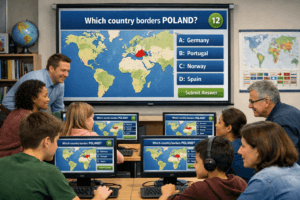
One of the most modern how to learn country borders easily tactics is the use of gamified feedback loops. Traditional paper maps are static, but interactive tools allow for “Dynamic Learning.” For instance, using the Countries of the World Quiz provides instant correction. If you misidentify a border, the immediate feedback prevents the “false encoding” of incorrect information. This real-time adjustment is one of the most powerful how to learn country borders easily tools available, as it simulates the way we learn through physical navigation in the real world.
Frequently Asked Questions
What is the hardest region for learning country borders?
Many learners find Central Africa and the Balkans difficult due to the high density of small, landlocked nations. Using how to learn country borders easily techniques like “regional chunking” helps break these areas down into manageable groups.
Do mnemonic devices help with borders?
Yes. Creating a story about how countries “touch” each other—like “Norway wraps around Sweden’s top”—is one of the classic how to learn country borders easily shortcuts for visual learners.
How many minutes a day should I practice?
Consistency is more important than duration. Spending 10 minutes a day on how to learn country borders easily using active recall is more effective than a single 2-hour session once a week.
Can I learn borders without a physical map?
While physical maps are great, digital interactive quizzes are often superior for how to learn country borders easily because they offer randomization and immediate scoring.
Why do some borders look perfectly straight?
Straight borders are often the result of longitudinal or latitudinal lines decided by treaties. Understanding this historical context is a key part of how to learn country borders easily through logic rather than memory.
Is there an app that helps with border recognition?
Yes, many web-based games and apps focus specifically on the “click the country” mechanic, which is a premier way to how to learn country borders easily by associating a name with a specific shape and location.
Conclusion: Navigating the World with Confidence
Mastering the world’s political boundaries is a gateway to a broader understanding of our planet. By focusing on how to learn country borders easily—through visual encoding, regional chunking, and the use of interactive quizzes—you can replace the frustration of memorization with the satisfaction of genuine understanding. Remember that every border tells a story of history, culture, and geography. As you continue to use these how to learn country borders easily methods, the world map will stop being a confusing grid and start being a familiar home. Start your practice today and master the map with ease.