Guess the US State by Border Shape: Mastering Spatial Intelligence
Geography is often mistaken for the rote memorization of lists, capitals, and flags. However, true geographic literacy is rooted in spatial intelligence—the ability to visualize relationships between objects in space. One of the most effective ways to train this cognitive muscle is to strip away the context. When you attempt to guess the US state by border shape, you are engaging in a high-level cognitive exercise that forces your brain to rely on pure visual data rather than relative positioning.
This guide explores the neuroscience behind map learning, offers strategies for identifying tricky territories, and explains why the challenge to guess the US state by border shape is the ultimate test for geography enthusiasts.
The Neuroscience of Shape Recognition
Why is it easy to identify Texas or Florida, but incredibly difficult to identify Wyoming or Colorado in isolation? The answer lies in how our brains process visual information. When you look at a standard map, your brain uses “anchoring”—it identifies a state based on its neighbors. Remove the neighbors, and you lose your anchors. To successfully guess the US state by border shape, you must transition from relative processing to absolute visual recognition.
This process heavily involves the hippocampus, the area of the brain responsible for spatial navigation and long-term memory. When you play a game like US States by Borders Quiz, you are stimulating neuroplasticity. You are forging new neural pathways that associate abstract geometric forms with specific semantic labels (names). The effort required to guess the US state by border shape without the crutch of a surrounding map triggers “active recall,” which is far more effective for retention than passive review.
Why Border Blindness Happens
Many students struggle when asked to guess the US state by border shape because educational maps rarely present states in isolation. We learn that Kansas is “in the middle” or that Oregon is “above California.” This creates a dependency on context.
To overcome this, we must break the country down into visual archetypes. If you want to accurately guess the US state by border shape, you need to categorize shapes into families: the boxes, the panhandles, the river-defined borders, and the coastlines. A visual memory game for adults often utilizes this categorization to enhance processing speed.
Category 1: The “Boxy” Western States
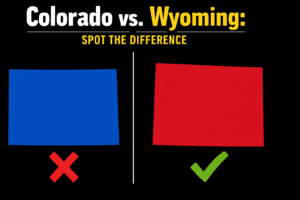
The most notorious difficulty when you try to guess the US state by border shape arises with the Western “square” states. Colorado and Wyoming appear nearly identical to the untrained eye. However, a keen observer knows that Colorado is a slightly taller rectangle, whereas Wyoming is more square. Furthermore, their borders are defined by latitude and longitude lines, making them geodetically perfect but visually indistinct.
Utah and New Mexico offer slightly more variation. New Mexico has a small “boot heel” in the southwest corner. If you see that heel, you can confidently guess the US state by border shape as New Mexico. Utah, conversely, has a “bite” taken out of its northeast corner where Wyoming sits. Spotting these negative spaces is crucial. Engaging with a Guess the US States game can help solidify these distinctions through repetition.
Category 2: The Mississippi River States
The eastern borders of states like Iowa, Missouri, Arkansas, Tennessee, and Mississippi are defined by the winding Mississippi River. This creates a “squiggly” edge that is a dead giveaway. When you are asked to guess the US state by border shape, look for the jagged river side. If the jagged edge is on the east, the state is likely on the west bank of the river (like Missouri). If the jagged edge is on the west, the state is on the east bank (like Tennessee).
Tennessee is particularly unique—a long, thin parallelogram with a river border. Recognizing this aspect ratio allows you to guess the US state by border shape instantly. You can test this specific knowledge with our US State Name Quiz, which pairs names with visual cues.
Strategies to Guess the US State by Border Shape
Improving your success rate requires systematic observation. Here are three techniques to help you guess the US state by border shape with higher accuracy.
- The Panhandle Rule: Only a few states have distinct panhandles. Oklahoma (long western panhandle), Florida (northwestern panhandle), Idaho (northern chimney), and Maryland (western neck). If you see an appendage, you can narrow down your options significantly to guess the US state by border shape correctly.
- The Coastal Curve: States along the Atlantic have a general slant from northeast to southwest. If the shape has a rugged coastline on its right side, it is an Atlantic state. Contrast this with California or Oregon, where the coast is on the left. This orientation is a fundamental key to help you guess the US state by border shape.
- The Straight Line Check: Look for straight lines created by surveyors. Most western states have at least one or two perfectly straight borders. Eastern states, defined by older colonial claims and natural geography, rarely do. If the shape is an amorphous blob with no straight lines, do not guess the US state by border shape as a western state.
Gamification and Active Recall
The most enjoyable way to learn these nuances is through gamification. Using a Wordle Geography Game or a scramble challenge forces the brain to retrieve information under pressure. However, the specific act to guess the US state by border shape is unique because it is purely visual. It is akin to recognizing a face.
We recommend starting with a US State Capital Quiz to build a foundation of knowledge. Once you know the capitals, try to visualize where they sit within the outline of the state. For example, knowing that Pierre is in the center of South Dakota helps you remember the state’s rectangular shape with a river cutting through it. This association makes it easier to guess the US state by border shape later on.
Advanced Challenge: No Outlines
For those who have mastered the standard map, the “no outlines” or “blank map” challenge is the next step. This is essentially the same as trying to guess the US state by border shape but for the entire country simultaneously. You must mentally reconstruct the puzzle pieces. This is often referred to as a “us states quiz no outlines” in educational circles.
If you find this difficult, try a Scramble Words Game related to geography first to warm up your verbal memory before taxing your visual memory. The interplay between verbal and visual processing is powerful. When you finally guess the US state by border shape correctly after a struggle, the dopamine release reinforces the memory trace.
Educational Benefits for Students
Teachers often ask how to make geography engaging for middle schoolers. The answer is competition and mystery. A blank US map for practice is useful, but an interactive tool where students must guess the US state by border shape is exciting. It turns a lecture into a detective game. “Identify the state by shape quiz” activities foster critical thinking.
Furthermore, this skill bridges the gap to global geography. If a student can guess the US state by border shape, they are better prepared to distinguish between the shapes of African or European nations. The cognitive skills are transferable. You can see this progression in our Countries of the World Quiz.
The Role of Cultural Geography
While shapes are physical, they often hold cultural significance. The “mitten” shape of Michigan is a cultural icon. The distinct “boot” of Louisiana is recognized globally. These cultural touchstones serve as mnemonic devices. When you attempt to guess the US state by border shape, you are often recalling these cultural symbols unknowingly.
Even political geography comes into play. A Trump Tweet Quiz might seem unrelated, but it engages the brain’s association with specific regions and states. Associating news or events with a specific location strengthens your ability to visualize that location on a map, and subsequently, to guess the US state by border shape.
Analyzing Difficult Shapes
Let’s look at some of the hardest states to identify. West Virginia is often described as “frog-shaped” or amorphous. It has no straight lines and many jagged edges. When you encounter a shape that defies geometric description, it is often West Virginia or Kentucky. To guess the US state by border shape here requires looking for the rivers: the Ohio River forms the northern border of Kentucky and the western border of West Virginia.
Another difficult pair is Vermont and New Hampshire. They are mirror images of each other (roughly). Vermont is wider at the top, while New Hampshire is wider at the bottom. A simple mnemonic is “V” for Vermont (which looks like a V shape roughly). Memorizing these tricks is essential if you want to guess the US state by border shape with 100% accuracy.
Integrating Flags and Capitals
To become a true geography master, you must integrate multiple data points. A Flags of the World Quiz tests color and symbol recognition. Similarly, connecting a state’s flag to its shape can provide a secondary mental hook. While the flag doesn’t physically help you guess the US state by border shape, the cognitive network you build around the state makes retrieval faster.
The same applies to capitals. Our Capital Cities of the World Quiz encourages this multi-faceted learning. When you see the shape of France, you think “Paris.” When you see the shape of Idaho, you should think “Boise.” If you can’t link the capital, you might struggle to guess the US state by border shape because the concept of the state is weak in your mind.
Training Your Visual Cortex
Regular practice is key. We suggest a regimen of “interleaved practice.” Do not just play one game repeatedly. Switch between a Flag Memory Game and a shape challenge. This switching forces your brain to reload the information each time, strengthening the connections. Every time you switch back and attempt to guess the US state by border shape, you are deepening the memory trace.
Resources like the US Geological Survey provide excellent maps that show physical topography. Studying these can explain why a border is shaped the way it is (e.g., following a mountain ridge). Understanding the “why” makes it infinitely easier to guess the US state by border shape.
Global Shape Recognition
Once you have conquered the US, the world awaits. The skills you develop when you learn to guess the US state by border shape apply directly to international borders. Can you distinguish Iraq from Syria by shape? Can you tell Uruguay from Paraguay?
Many users who excel at our Countries of the World Quiz started by mastering US states. The ability to rotate a shape mentally and recognize it is a hallmark of high spatial intelligence. So, start small. Master the ability to guess the US state by border shape, and then expand your horizons.
Practical Exercises for Mastery
Here is a step-by-step plan to master this skill:
- Study the Map: Spend 5 minutes on National Geographic studying the full US map.
- Isolate Regions: Focus only on New England. Close your eyes and draw them in the air.
- Play the Game: Use the US States by Borders Quiz. Attempt to guess the US state by border shape for 10 states.
- Review Errors: If you missed Wyoming, compare it to Colorado immediately.
- Repeat: Daily practice for one week will yield massive results.
By following this method, you aren’t just memorizing; you are training your brain. You will find that your ability to guess the US state by border shape becomes automatic. You will see a shape and the name will pop into your head instantly, a phenomenon known as “automaticity.”
Conclusion: The Ultimate Geography Flex
Being able to identify a state solely by its silhouette is an impressive party trick, but more importantly, it is a sign of a sharp mind. It demonstrates attention to detail and strong spatial reasoning. Whether you are a student preparing for a test or a senior looking to keep your mind agile with a visual memory game for adults, the challenge to guess the US state by border shape is rewarding.
Ready to test your skills? Don’t just read about it. Dive into the US States by Borders Quiz right now and see if you can guess the US state by border shape without making a single mistake. Good luck!