The Comprehensive Guide to Mastering the Flags of the World Quiz
For many students and geography enthusiasts, the sheer volume of national symbols—spanning nearly 200 sovereign nations—presents a significant cognitive barrier. The primary problem lies in the similarity of designs; many countries share identical color palettes, such as the Pan-African colors (red, yellow, green) or the Slavic tricolors (red, white, blue). Without a structured system, attempting a flags of the world quiz can result in “visual interference,” where the brain confuses similar patterns, leading to frustration and a lack of progress. Traditional rote memorization often fails here because it treats these symbols as static images rather than meaningful stories.
The solution to this academic challenge is the transition from passive viewing to active engagement. By identifying the specific “vexillological” patterns—the study of flags—and utilizing interactive technology, anyone can achieve 100% accuracy. A flags of the world quiz serves as a high-speed feedback loop, correcting misconceptions in real-time and anchoring the visual data to a specific country name. This method transforms a daunting list of images into a logical network of cultural and historical associations. When you understand why a flag looks the way it does, you no longer need to “memorize” it; you simply recognize it as a unique identity.
At GeoMapGame, we provide a robust framework for mastering global symbols. This guide explores the “Why” behind flag education, the technical mechanics of visual memory, and the psychological benefits of gamified learning. Whether you are a student preparing for a national geography competition or a traveler wanting to navigate international airports with ease, our flags of the world quiz methodology provides the most efficient path to expertise. Prepare to look at the world map with a new level of clarity and confidence.
Our Mission: Enhancing Global Visual Literacy
Our mission is to foster a deeper sense of global citizenship through visual literacy. We believe that recognizing the symbols of other nations is a fundamental step toward cultural empathy and international awareness. By offering a high-quality flags of the world quiz, we aim to make geography education both accessible and enjoyable for a global audience. We are dedicated to providing accurate, high-authority tools that allow learners of all ages to identify and respect the diverse identities represented on the world stage.
Technical Deep Dive: Visual Encoding and Vexillology
To excel at a flags of the world quiz, one must understand the mechanics of “Visual Encoding.” The human brain processes colors and shapes in the occipital lobe, but it stores them in the temporal lobe once they are attached to a meaning. Technically, flags are designed using heraldic principles to be easily recognizable from a distance.
By breaking a flag down into its components—cantons, fimbriations, and charges—you are performing “Feature Analysis.” This technical approach allows your brain to distinguish between the nearly identical flags of Chad and Romania or Indonesia and Monaco. Our flags of the world quiz leverages this by forcing the brain to differentiate between these subtle nuances under timed conditions.
Educational Philosophy: The Power of Active Recall
Our educational strategy relies on the principle of Active Recall. Unlike traditional study methods where you might look at a chart of flags, our flags of the world quiz requires you to retrieve the name of the country from your memory without hints.
- The Retrieval Effect: Every time you correctly identify a flag in a quiz, the neural pathway between that image and the country’s name is strengthened.
- Error Correction: Making a mistake on a flags of the world quiz is actually beneficial. The immediate feedback “shocks” the brain into correcting the neural map, ensuring you are less likely to repeat the error.
This active engagement is why digital quizzes are significantly more effective than physical flashcards for long-term retention.
User Personas: Who Should Play the Flags of the World Quiz?
The flags of the world quiz is designed to meet the needs of diverse learner groups:
- K-12 Students: Children learning about world cultures and history who need a fun, low-pressure way to memorize national symbols.
- International Sports Fans: Individuals following events like the Olympics or the FIFA World Cup who want to identify teams instantly.
- Diplomacy and History Buffs: Adults interested in the evolution of national identities and the symbolism behind revolutionary flags.
- Daily Learners: Anyone looking for a “brain break” that also builds a useful real-world skill through a flags of the world quiz.
Data Integrity and Peer-Reviewed Sources
In the world of vexillology, precision is paramount. All flag designs and data in our flags of the world quiz are cross-referenced with authoritative international standards. We utilize the United Nations for official state recognition and National Geographic for cartographic and symbolic accuracy. Additionally, historical context is provided in alignment with Encyclopaedia Britannica. When you use GeoMapGame, you are engaging with a curriculum that is both educationally rigorous and factually current.
Mastering the Quiz: Strategies for Success
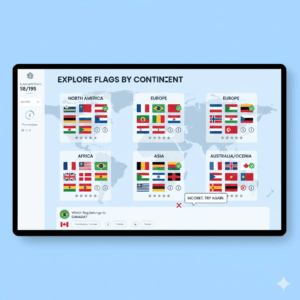
To improve your performance on the flags of the world quiz, we recommend the “Regional Layering” approach. Instead of trying to learn every flag globally, start by mastering the flags of Europe, then move to Africa, and then the Americas. This prevents cognitive saturation. Furthermore, look for “Flag Families”—for example, the Nordic Cross pattern used by Denmark, Sweden, and Norway. Recognizing these patterns is one of the most effective flags of the world quiz strategies, as it allows you to group information logically rather than memorizing individual pixels.
For an immediate challenge, try the Flags of the World Quiz on our platform. The interface is optimized for both desktop and mobile, ensuring you can practice during your commute or in the classroom. Consistency is the key; five minutes of daily play will result in better retention than a two-hour “cram” session.
Frequently Asked Questions
What is the hardest flag to identify in a flags of the world quiz?
Many people find the flags of Central Asian or Oceania nations difficult because they are less frequently featured in Western media. Using our flags of the world quiz daily helps bring these underrepresented symbols into your permanent memory.
Why are so many flags red, white, and blue?
These colors often represent common themes like revolution, liberty, and blood shed for the country. Learning these themes is part of the flags of the world quiz experience that adds historical depth to your geographic knowledge.
Can I play the flags of the world quiz on my phone?
Yes. GeoMapGame is fully responsive. Practicing the flags of the world quiz on mobile is a great way to utilize “micro-moments” throughout the day for self-improvement.
How many flags are there in total?
While there are 193 UN member states, there are many more territories and regions with their own flags. Our flags of the world quiz focuses on the most recognized national symbols to give you a strong foundation.
Are there any flags that are not rectangular?
Yes! Nepal is famous for having the only non-rectangular national flag. Finding “outliers” like this is a fun part of becoming an expert in the flags of the world quiz.
Does knowing flags help with other geography skills?
Absolutely. Flags are visual anchors. Once you know a flag, your brain more easily remembers that country’s location and capital, as the flags of the world quiz builds a more complete mental model of the nation.
Conclusion: A World of Color and Identity
Mastering the flags of the world quiz is more than just a memory exercise; it is an exploration of the world’s history and diversity. By moving from passive memorization to active, gamified learning, you can achieve a high level of geographic literacy with ease. The symbols you learn today will help you navigate global news, international events, and travel experiences for years to come. Start your journey with the flags of the world quiz on GeoMapGame today and see how quickly the world becomes a familiar, recognizable place.