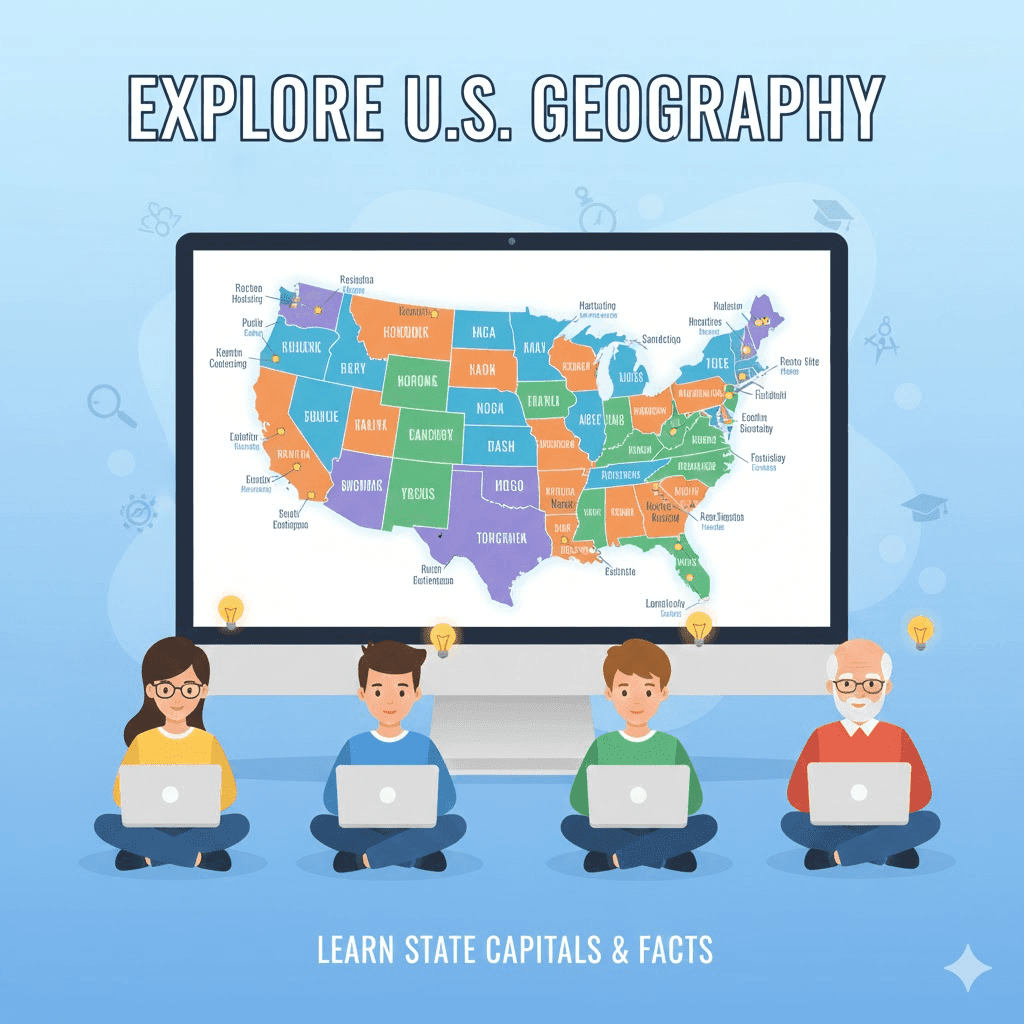
Learning geography is often reduced to rote memorization, a method that can feel tedious and ineffective for many learners. Whether you are a student preparing for a test or an adult looking to sharpen your cognitive skills, finding an easy way to remember the state capitals is a common goal. The challenge usually lies not in the complexity of the information, but in how our brains process abstract data like names and locations. By leveraging the science of spatial intelligence and cognitive geography, we can transform this learning process from a chore into an engaging mental exercise.
The human brain is wired to understand the world through maps and spatial relationships rather than isolated lists of text. When you look for an easy way to remember the state capitals, you are essentially asking how to encode specific data points—city names—onto the mental map of the United States that resides in your hippocampus. This area of the brain, responsible for memory and navigation, thrives on context, visual cues, and active recall. This article will explore scientifically grounded methods to master US geography, moving beyond simple repetition to deep, durable learning.
The Neuroscience of Geography Learning
To truly find an easy way to remember the state capitals, it helps to understand how memory works. Neuroplasticity, the brain’s ability to reorganize itself by forming new neural connections, plays a massive role in learning geography. When you actively engage with a map, you are not just memorizing words; you are physically altering the structure of your brain. Spatial intelligence is the capacity to visualize the world in your mind, and it is a skill that can be developed. For many, the easy way to remember the state capitals involves tapping into this spatial ability rather than relying on verbal loops.
The hippocampus acts as the brain’s GPS. When you navigate a new city, your brain creates “place cells” that help you remember where you are. We can hijack this system for education. Instead of treating Albany merely as a word associated with New York, you visualize its location on the map. This spatial anchoring provides an easy way to remember the state capitals because it gives the data a physical “home” in your mind. Without this spatial context, state capitals are just floating abstractions that are easily forgotten.
Cognitive load theory suggests that our working memory has limits. Trying to memorize all fifty capitals at once overwhelms the system. An easy way to remember the state capitals is to reduce this cognitive load by using “chunking,” a method where you break large amounts of information into smaller, manageable groups. By combining chunking with spatial visualization, you create a robust framework for retention. This scientific approach ensures that the information moves from short-term working memory into long-term storage.
Gamification and Active Recall

One of the most effective tools in modern education is gamification. Turning the learning process into a game triggers the release of dopamine, a neurotransmitter associated with pleasure and motivation. This is why using an interactive quiz is often an easy way to remember the state capitals compared to staring at a textbook. When you challenge yourself with a US State Capital Quiz, you are engaging in active recall. Active recall is the process of retrieving information from memory, which strengthens the neural pathways more effectively than passive review.
If you are looking for an easy way to remember the state capitals, consistency is key, and games make consistency effortless. Interactive tools that force you to identify locations, such as the Guess the US States game, provide immediate feedback. This feedback loop is crucial for error correction. If you mistakenly identify a capital, the immediate correction helps your brain adjust its mental map instantly. This is far superior to studying a static list where errors might go unnoticed for days.
Furthermore, isolating specific variables helps. Sometimes the shape of the state is the best cue. Engaging with a US States by Borders Quiz can help you associate the physical outline of a state with its capital city. When you recognize the “mitten” shape of Michigan, your brain should automatically trigger “Lansing.” This dual-coding of visual shape and verbal name creates a strong associative link, offering an easy way to remember the state capitals through visual geometry.
Mnemonic Devices and Associative Imagery
For decades, memory champions have used mnemonic devices as an easy way to remember the state capitals. A mnemonic is a tool that helps you remember an idea or phrase with a pattern of letters, numbers, or relatable associations. Since the brain recalls images better than words, creating vivid, sometimes absurd, mental pictures can lock a capital city into your memory forever. For example, to remember that the capital of Arkansas is Little Rock, you might visualize a simplified map of the state with a tiny pebble resting on it.
Let’s look at another example. To remember that the capital of Kentucky is Frankfort, you might picture a hot dog (frankfurter) in the shape of the state. These silly associations are sticky. They provide an easy way to remember the state capitals because they rely on existing neural pathways. You already know what a hot dog looks like; you are simply attaching that existing knowledge to a new piece of data. This technique leverages the “bizarre imagery effect,” where strange or unusual images are more easily recalled than common ones.
You can also play with words to strengthen these connections. Games that focus on language, like the Scramble Words Game, force you to look at the structure of the names themselves. Manipulating the letters of “Tallahassee” or “Sacramento” helps with spelling and recognition. Similarly, a Wordle Geography Game challenges you to recall capitals based on letter patterns, adding another layer of cognitive depth. This linguistic approach, combined with spatial awareness, provides a comprehensive and easy way to remember the state capitals.
Regional Chunking Strategy
As mentioned earlier, trying to memorize all fifty capitals at once is a recipe for failure. A much more manageable and easy way to remember the state capitals is to divide the US map into distinct regions: the Northeast, the South, the Midwest, and the West. By focusing on one region at a time, you lower the barrier to entry and allow your brain to form a detailed regional map.
The Northeast
Start with the New England states. These are smaller geographically and often grouped together. Maine (Augusta), New Hampshire (Concord), and Vermont (Montpelier) form a natural cluster. Using a US State Name Quiz specifically for this region can help solidify these pairs. Because the states are small and dense, visualizing them requires precise spatial attention, which improves your overall cognitive resolution.
The South
The South covers a vast area with distinct cultural and geographical sub-regions. From Richmond, Virginia to Austin, Texas, the capitals here often have historical significance. An easy way to remember the state capitals in the South is to trace the coastline. Move from Maryland down to Florida, then across the Gulf Coast. This narrative journey creates a “memory palace” effect, where the order of the journey helps recall the locations.
The Midwest
The Midwest is characterized by larger states with blockier shapes. Here, the US States by Borders Quiz becomes exceptionally useful. Recognizing the rectangular nature of the Dakotas or the distinct shape of Illinois helps anchor the cities of Bismarck, Pierre, and Springfield. Visualizing the Great Lakes also provides a physical anchor for capitals like Madison, Wisconsin and Lansing, Michigan. Utilizing these physical landmarks is an easy way to remember the state capitals in this region.
The West
The Western states are massive, and their capitals are often located far from the most famous cities. For instance, remembering Sacramento instead of Los Angeles for California, or Olympia instead of Seattle for Washington. This distinction is vital. A Guess the US States challenge helps clarify these misconceptions by forcing you to pinpoint the actual political centers. Focusing on the distinct topography—mountains and coastlines—serves as an easy way to remember the state capitals of the West.
The Role of Repetition and Spaced Repetition
While we want to avoid mindless rote memorization, repetition is still necessary for long-term retention. However, the timing of that repetition matters. Spaced repetition is a learning technique that incorporates increasing intervals of time between subsequent review of previously learned material. This is scientifically proven to be an easy way to remember the state capitals over the long term. You might review a state capital today, then again in two days, then in a week, and finally in a month.
Digital tools are excellent for this. You can find a list of state capitals online to create your own schedule, or use automated apps. Many learners find that a printed 50 states quiz for 5th grade or a us state capitals quiz printable can serve as great physical trackers for this spaced repetition. Marking off the ones you know and physically writing down the ones you missed engages motor skills, which reinforces memory.
Moreover, mixing up the format of your repetition prevents boredom. One day you might use flashcards; the next day you might play a Flag Memory Game or a Flags of the World Quiz to expand your horizon. While flags are different from capitals, the skill of associating symbols with regions transfers well. It keeps the brain flexible and adaptable, which indirectly supports your goal of finding an easy way to remember the state capitals.
Expanding Spatial Intelligence Beyond the US
Once you have mastered the easy way to remember the state capitals of the US, your brain is primed for broader geographic challenges. The cognitive skills you built—chunking, visualization, and active recall—apply globally. You can transition to a Countries of the World Quiz or a Capital Cities of the World Quiz. The neural pathways are already established; you are simply feeding them new data.
This expansion reinforces your US knowledge. By understanding where the US fits on the global map, you deepen your spatial awareness. Comparing the size of US states to European countries using an interactive map of us states and capitals can be an eye-opening exercise. It contextualizes the information, making it more meaningful. Meaningful information is always easier to retain, providing yet another easy way to remember the state capitals through contextual depth.
Even unrelated geography games can keep your mind sharp. A Trump Tweet Quiz might seem irrelevant, but it engages the brain’s critical thinking and pattern recognition centers. Similarly, a visual memory game for adults keeps the hippocampus active. A healthy, active brain is better equipped for memorization tasks of all kinds. Therefore, maintaining general cognitive health is an indirect but powerful easy way to remember the state capitals.
Common Pitfalls to Avoid
In the quest for an easy way to remember the state capitals, learners often fall into specific traps. The most common is the “illusion of competence.” This occurs when you read a list of capitals and nod your head, thinking you know them. However, recognition is not recall. You must test yourself without looking at the answers. Us states quiz no outlines are particularly good for shattering this illusion because they remove the visual crutch of borders, forcing you to rely entirely on spatial positioning.
Another pitfall is relying solely on audio. While songs can be a fun and easy way to remember the state capitals for children, they often fail to convey the spatial location of the city. You might remember the rhyme but have no idea where the city is on a map. Always pair audio mnemonics with visual verification on a map from a reputable source like National Geographic. This ensures your knowledge is grounded in geographic reality.
Lastly, don’t ignore the confusion between similar names. Charleston, West Virginia, and Columbia, South Carolina, or the various “Springfields” and “Madisons” can be tricky. Explicitly highlighting these confusing pairs and studying them side-by-side is an easy way to remember the state capitals that are easily mixed up. Differentiation is a key component of accurate memory.
A Step-by-Step Study Plan
To synthesize all this information, here is a practical plan that serves as an easy way to remember the state capitals:
- Week 1: The Northeast. Focus on visual shapes and small clusters. Use the US State Capital Quiz daily.
- Week 2: The South. Create a narrative story moving along the coast. Integrate the Scramble Words Game to master spelling.
- Week 3: The Midwest. Use border shapes as your primary cue. The US States by Borders Quiz is essential here.
- Week 4: The West. Focus on distinguishing major cities from capitals.
- Week 5: Review and Integration. Mix all regions together.
This structured approach prevents burnout. It effectively provides an easy way to remember the state capitals by pacing the learning process. It respects the biological limits of your memory while maximizing retention through variety and active engagement.
Why Spatial Intelligence Matters
Ultimately, finding an easy way to remember the state capitals is about more than just trivia. It is about building spatial intelligence—a critical life skill. Spatial intelligence correlates with success in STEM fields, navigation, and even strategic planning. By training your brain to map the US states and their capitals, you are exercising the hippocampus and protecting your brain against cognitive decline.
The satisfaction of knowing your geography is immense. It makes watching the news, reading history, and traveling more enriching. When you hear about an event in Pierre, South Dakota, your brain instantly lights up that portion of your mental map. This instant connection is the result of using a scientifically sound and easy way to remember the state capitals.
We encourage you to use the resources available at GeoMapGame to facilitate this journey. From the US State Capital Quiz to the global challenge of the Countries of the World Quiz, these tools are designed to make learning an active, enjoyable pursuit. There is indeed an easy way to remember the state capitals, and it starts with treating your brain like the incredible, map-loving machine that it is.
Remember that learning is a journey, not a destination. Whether you are using a printable map or an interactive game, the goal is progress. Every time you correctly identify a capital, you strengthen a synapse. Every time you visualize a state border, you refine your spatial perception. This cumulative effort is the true secret and the most reliable easy way to remember the state capitals for a lifetime. For more detailed maps and data, you can always refer to the US Geological Survey.
So, take a deep breath, open a map, and start playing. You have the tools, the strategy, and the science on your side. There has never been a more accessible or easy way to remember the state capitals than there is right now.