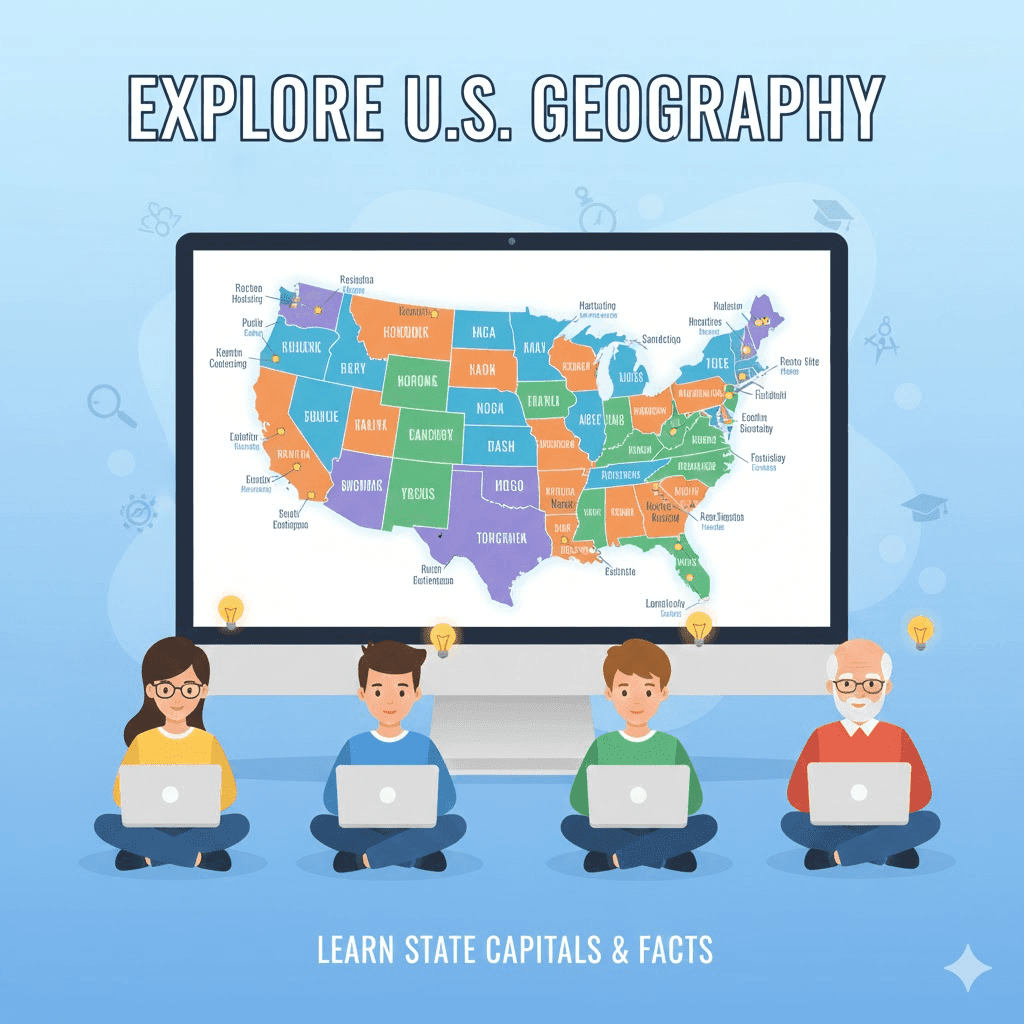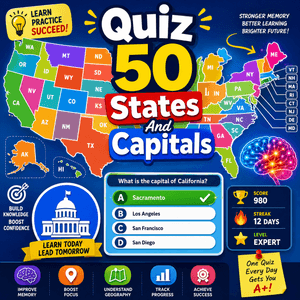
Geography becomes easier to learn when the brain works through patterns, locations, and repeated recall instead of passive memorization. Many learners spend hours reading lists of states and capitals only to forget them later. Modern cognitive science offers a better approach. A quiz 50 states and capitals learning method helps strengthen memory while improving spatial understanding.
Researchers studying cognitive geography explain that humans naturally create mental maps. The brain evolved to remember environments, pathways, and locations. Because of this, a quiz 50 states and capitals activity becomes more than a classroom exercise. It turns into an effective way to build stronger memory systems.
Students who regularly practice a quiz 50 states and capitals challenge often notice improved recall, stronger map awareness, and greater confidence in geography.
How the Brain Learns Geography
The brain processes locations differently from isolated facts. Instead of storing information randomly, it creates relationships between places and patterns.
When learners repeatedly practice a quiz 50 states and capitals activity, the hippocampus becomes involved. The hippocampus helps organize memory and spatial navigation.
This process supports neuroplasticity, which refers to the brain’s ability to strengthen neural connections through repeated experiences.
As learners continue using a quiz 50 states and capitals strategy, recall gradually becomes easier and faster.
Spatial Intelligence Creates Stronger Memory
Spatial intelligence involves understanding where objects and places exist relative to one another.
A quiz 50 states and capitals activity helps learners connect states with positions, neighboring regions, and recognizable patterns.
- Recognize state locations
- Understand regional patterns
- Identify neighboring states
- Remember state shapes
- Build cognitive maps
Students can improve visual learning using Guess the US States.
Many learners also enjoy identify the state by shape quiz exercises because visual patterns improve retention.
Active Recall Builds Long-Term Learning
Active recall requires learners to retrieve information directly from memory rather than rereading it repeatedly.
A quiz 50 states and capitals approach naturally applies this principle.
Each successful retrieval strengthens neural pathways associated with geographic memory.
Students often strengthen learning through US State Capital Quiz.
Repeated retrieval with a quiz 50 states and capitals activity improves long-term retention more effectively than passive review.
Gamification Makes Learning More Engaging
Games create motivation because they introduce challenge and progression.
A quiz 50 states and capitals experience becomes more enjoyable through:
- Timed challenges
- Daily streak goals
- Score systems
- Difficulty progression
- Achievement tracking
Students can expand learning through US States by Borders Quiz.
Advanced learners may also enjoy guess the us state by border shape activities.
Expand Beyond States and Capitals
Strong foundations often improve broader geography skills.
Continue learning with Countries of the World Quiz.
Improve recognition with Flags of the World Quiz.
Build international knowledge through Capital Cities of the World Quiz.
World capitals quiz multiple choice activities and world map quiz educational games can also strengthen geographic understanding.
Why Repetition Improves Geographic Recall
Learning researchers often describe repetition as one of the strongest tools for building long-term memory. However, repetition becomes more effective when learners repeatedly retrieve information instead of simply rereading it.
A quiz 50 states and capitals activity works because learners repeatedly challenge themselves to remember information under different conditions. Sometimes they identify locations on a map. Other times they match capitals with states or recognize shapes and borders.
This variation strengthens multiple memory pathways simultaneously.
Repeated exposure helps learners:
- Reduce forgetting over time
- Strengthen long-term retention
- Recognize patterns faster
- Increase confidence during tests
- Improve recall speed
Instead of memorizing isolated lists, learners gradually create a connected network of geographic knowledge.
Regional Learning Makes Geography Simpler
Many students feel overwhelmed when trying to memorize all fifty states at once. Dividing learning into regions often creates a more manageable process.
A quiz 50 states and capitals routine becomes easier when learners study geographic regions individually.
Examples include:
- Northeastern states
- Southern states
- Midwestern states
- Western states
- Pacific states
Regional learning allows the brain to organize information into categories.
For example, learners may notice patterns such as nearby states sharing similar climate conditions, economic activities, or historical connections.
The brain naturally groups related information together, making later recall easier.
Visual Memory and State Recognition
Visual learning plays a major role in geographic understanding. Some people remember images more effectively than text alone.
State outlines often create unique visual patterns that improve memory retention.
When learners repeatedly observe state shapes during a quiz 50 states and capitals exercise, they begin recognizing states instantly without relying on labels.
Visual learners frequently use techniques such as:
- Color-coded maps
- State outline practice
- Shape association exercises
- Map labeling activities
- Interactive geography games
Over time these visual patterns become part of long-term memory.
Students often discover that recognizing shapes becomes almost automatic after repeated exposure.
Geography Skills Help Beyond the Classroom
Geography knowledge extends beyond school assignments and examinations.
A strong understanding developed through quiz 50 states and capitals practice can support practical skills in daily life.
Examples include:
- Understanding news and current events
- Planning travel routes
- Improving map-reading ability
- Learning about cultures and regions
- Developing global awareness
Students who build strong geography foundations often become more comfortable discussing world events and understanding regional relationships.
Geographic knowledge also supports subjects such as history, economics, environmental science, and social studies.
Building a Daily Geography Habit
Consistency often produces better results than occasional intensive study sessions.
Even spending five to ten minutes each day on a quiz 50 states and capitals challenge can create noticeable improvement over time.
Daily habits can include:
- Completing one short geography quiz
- Identifying states on a map
- Learning one new capital city
- Reviewing difficult locations
- Playing educational geography games
Small learning sessions reduce mental fatigue while keeping information active inside long-term memory.
Many successful learners focus on consistency rather than duration.
Over weeks and months, these small efforts accumulate into stronger geographic understanding and faster recall abilities.
Daily Practice Creates Stronger Results
Small daily sessions usually outperform long study sessions.
Many learners use Wordle Geography Game, Scramble Words Game, and Geo Connections Game to maintain consistency.
A quiz 50 states and capitals routine strengthens memory retrieval.
A quiz 50 states and capitals routine improves spatial thinking.
A quiz 50 states and capitals routine develops cognitive geography skills.
A quiz 50 states and capitals routine supports long-term learning.
Learning geography becomes easier when the brain actively participates. Through active recall, neuroplasticity, and spatial intelligence, a quiz 50 states and capitals experience becomes a powerful way to improve memory and understand geography more deeply.
Helpful resources:
National Geographic,
Britannica,
USGS.