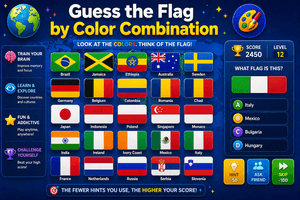
The guess the flag by color combination approach is one of the most visually engaging ways to learn world geography. Instead of focusing on names or locations first, learners begin with colors, patterns, and design elements. This taps into visual memory, making it easier to recognize and recall flags over time.
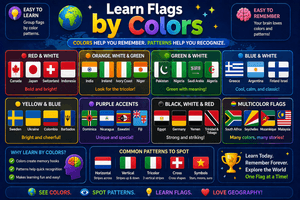
Flags are powerful symbols. They represent nations, cultures, and identities. When learners use a guess the flag by color combination method, they start to notice patterns—red, white, and blue combinations, tricolor layouts, and unique symbols. These patterns create strong mental anchors that support long-term memory.
Unlike traditional memorization, the guess the flag by color combination method turns learning into a game. Each attempt challenges the brain to identify patterns and make connections, which strengthens cognitive processing and recall ability.
Why visual learning is so effective
The human brain processes visual information much faster than text. This is why the guess the flag by color combination technique works so well. Instead of reading country names, learners instantly recognize colors and shapes.
Visual memory plays a key role in learning geography. When learners repeatedly engage in guess the flag by color combination activities, they strengthen neural pathways associated with pattern recognition. This makes it easier to recall flags in the future.
For additional reinforcement, learners can combine this method with the Flags of the World Quiz. This helps connect visual recognition with factual knowledge.
The role of pattern recognition
Pattern recognition is a fundamental cognitive skill. The guess the flag by color combination method trains this skill by requiring learners to identify similarities and differences between flags.
For example, many countries share similar color schemes, but differ in arrangement or symbols. The guess the flag by color combination approach helps learners distinguish these subtle differences.
Over time, players develop the ability to quickly identify flags based on minimal information. This improves both speed and accuracy.
Active recall and memory strengthening
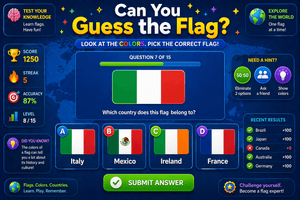
One of the key benefits of the guess the flag by color combination method is its reliance on active recall. Instead of passively viewing flags, learners must retrieve information from memory.
This retrieval process strengthens neural connections and improves long-term retention. Each correct guess reinforces knowledge, while incorrect guesses highlight areas for improvement.
To expand learning, players can use the Countries of the World Quiz to connect flags with geographic locations.
Gamification and engagement
Gamification makes learning more enjoyable. The guess the flag by color combination method often includes scoring, levels, and challenges that keep learners engaged.
This engagement leads to repeated practice, which is essential for memory formation. When learners enjoy the process, they are more likely to continue improving.
Other interactive tools like the Geo Connections Game and the Scramble Words Game can add variety to the learning experience.
Building a global understanding
The guess the flag by color combination method helps learners build a broader understanding of the world. Flags often reflect history, culture, and regional identity.
By recognizing patterns, learners begin to understand relationships between countries. For example, similar color schemes may indicate shared history or cultural connections.
This deeper understanding makes geography more meaningful and engaging.
Combining visual and spatial learning
While the guess the flag by color combination method focuses on visuals, it becomes even more effective when combined with spatial learning.
After identifying a flag, learners can locate the country using the Countries of the World Quiz. This reinforces both visual and spatial memory.
Similarly, the Capital Cities of the World Quiz helps connect flags with capitals.
Tips to improve faster
To get the most out of the guess the flag by color combination method, practice regularly. Short, frequent sessions are more effective than long, infrequent ones.
Focus on patterns rather than memorizing individual flags. Look for common color combinations and design elements.
Use mistakes as learning opportunities. Each incorrect guess helps refine your understanding.
The science behind visual memory
Visual memory is closely linked to the brain’s ability to process and store images. The guess the flag by color combination method strengthens this ability by repeatedly exposing learners to visual patterns.
Research shows that combining visual and active recall techniques leads to better retention. This is why the guess the flag by color combination method is so effective.
Over time, learners develop a strong mental library of flags, making recall faster and more accurate.
Trusted resources for deeper learning
For those who want to explore flags and geography further, trusted resources provide valuable information. Websites like National Geographic, Britannica, and USGS offer reliable content.
These resources complement the guess the flag by color combination method by providing historical and cultural context.
Final thoughts
The guess the flag by color combination method is more than just a game. It is a powerful learning tool that combines visual recognition, active recall, and pattern recognition.
By incorporating the guess the flag by color combination approach into your routine, you can improve memory, build visual intelligence, and develop a deeper understanding of global geography. With consistent practice, learning becomes both effective and enjoyable.