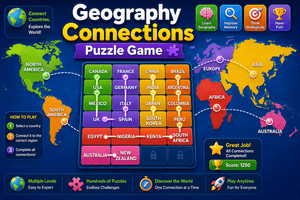
The geography connections puzzle game is redefining how people approach geography learning. Instead of memorizing isolated facts about countries, capitals, or regions, learners engage in pattern recognition, logical grouping, and meaningful connections. This approach activates deeper cognitive processes, making learning more efficient and long-lasting.
At its core, the geography connections puzzle game challenges players to identify relationships between places. These relationships might be based on location, language, borders, population, or cultural similarities. By discovering these links, learners move beyond surface-level knowledge and develop a structured understanding of the world.
Traditional geography education often relies on repetition without context. While repetition has value, it becomes far more powerful when combined with connection-based learning. The geography connections puzzle game provides that missing layer by encouraging learners to think critically and actively engage with information.
Why connection-based learning works
The human brain is naturally wired to find patterns. The geography connections puzzle game leverages this ability by presenting information in a way that requires grouping and association. When learners identify connections, they create stronger neural pathways, which improves recall and understanding.
Instead of memorizing that Paris is the capital of France, learners might connect France with neighboring countries, shared languages, or cultural regions. The geography connections puzzle game turns these associations into a mental network, making it easier to retrieve information later.
This method aligns with how memory actually works. The brain does not store information in isolation. It stores it in interconnected networks. The geography connections puzzle game strengthens these networks by encouraging learners to build multiple links between concepts.
The role of spatial intelligence
Spatial intelligence is a critical component of geography learning. The geography connections puzzle game enhances this skill by requiring players to think about how places relate to each other in space. This includes understanding proximity, borders, and regional groupings.
When learners repeatedly engage with the geography connections puzzle game, they develop a mental map of the world. This map is not just a collection of locations but a structured system of relationships. Over time, this makes it easier to recall information and understand global patterns.
For example, recognizing that countries in South America share certain geographic and cultural traits helps learners group them more effectively. The geography connections puzzle game reinforces these patterns through repeated exposure and active recall.
Active recall and cognitive effort
One of the key strengths of the geography connections puzzle game is its reliance on active recall. Players must retrieve information from memory rather than simply recognizing it. This process strengthens neural connections and improves long-term retention.
Cognitive effort plays an important role here. When a task requires thinking and problem-solving, the brain is more likely to remember the information. The geography connections puzzle game introduces just the right level of challenge to maximize learning without causing frustration.
Each puzzle solved reinforces knowledge and builds confidence. Over time, learners become faster and more accurate, which further motivates continued practice.
Gamification and motivation
Gamification is a powerful driver of engagement. The geography connections puzzle game incorporates elements like scoring, levels, and progression to keep learners motivated. These features transform learning into an enjoyable experience.
When learners enjoy the process, they are more likely to continue practicing. The geography connections puzzle game reduces the mental resistance often associated with studying. Instead of feeling like a chore, it feels like a challenge.
This increased engagement leads to more repetition, which is essential for memory formation. The more often learners interact with geographic information, the stronger their understanding becomes.
Building a deeper understanding of geography
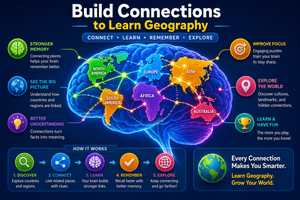
The geography connections puzzle game goes beyond basic memorization. It encourages learners to explore why certain connections exist. This leads to a deeper understanding of geography as a system rather than a collection of facts.
For example, players might connect countries based on shared borders, climates, or economic characteristics. These connections reveal patterns that are not immediately obvious but become clear through repeated practice.
This approach helps learners develop critical thinking skills. They begin to ask questions, analyze information, and draw conclusions. The geography connections puzzle game fosters curiosity and exploration.
Combining puzzle games with other learning tools
While the geography connections puzzle game is highly effective on its own, it becomes even more powerful when combined with other learning tools. This creates a multi-dimensional approach to geography education.
For example, after solving a puzzle, learners can test their knowledge using the Countries of the World Quiz. This reinforces factual recall.
Similarly, the Capital Cities of the World Quiz helps learners connect countries with their capitals. The Geo Connections Game further expands connection-based learning.
Word-based challenges like the Wordle Geography Game and the Scramble Words Game add another layer by strengthening vocabulary and pattern recognition.
The importance of repetition with variation
Repetition is essential for learning, but it must be varied to remain effective. The geography connections puzzle game provides this variation by presenting new challenges in each round. This keeps the brain engaged and prevents boredom.
Each new puzzle introduces different combinations of information, requiring learners to adapt and think critically. This strengthens cognitive flexibility and improves problem-solving skills.
Over time, learners develop a more comprehensive understanding of geography. The geography connections puzzle game ensures that learning remains dynamic and engaging.
How to improve faster
To get the most out of the geography connections puzzle game, consistency is key. Short, regular practice sessions are more effective than occasional long ones. This helps reinforce memory and build strong neural connections.
Focus on understanding patterns rather than memorizing individual facts. Look for relationships between places and try to explain them. This deepens understanding and improves retention.
Mix different types of games to create multiple learning pathways. The geography connections puzzle game works best when combined with quizzes, memory challenges, and map-based activities.
Real-world applications of connection-based learning
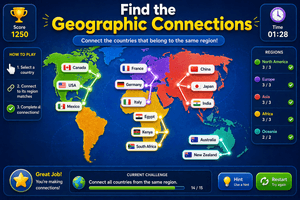
The skills developed through the geography connections puzzle game extend beyond geography. Pattern recognition, logical reasoning, and critical thinking are valuable in many areas of life.
For example, these skills can improve decision-making, problem-solving, and data analysis. The ability to identify connections is essential in fields like business, science, and technology.
By practicing with the geography connections puzzle game, learners develop transferable skills that can be applied in various contexts.
Trusted resources for deeper exploration
For those who want to explore geography further, trusted resources provide valuable insights. Platforms like National Geographic, Britannica, and USGS offer reliable information.
These resources complement the geography connections puzzle game by providing context and deeper understanding.
Final thoughts
The geography connections puzzle game is more than just a game. It is a powerful learning tool that combines logic, memory, and spatial reasoning to create a rich educational experience.
By incorporating the geography connections puzzle game into your routine, you can build stronger cognitive skills, improve geography knowledge, and develop a deeper understanding of the world. With consistent practice, learning becomes both effective and enjoyable.