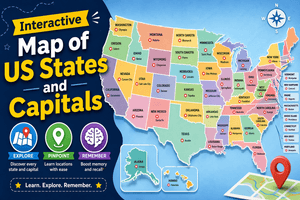
The interactive map of us states and capitals is one of the most effective ways to move geography from short-term recognition into long-term memory. Instead of passively reading names on a list, learners actively retrieve, compare, and place each state in relation to its neighbors, borders, regions, and capital cities. That process strengthens spatial intelligence, builds cognitive geography, and supports the kind of active recall that makes facts stick.
For students, families, teachers, and lifelong learners, the interactive map of us states and capitals works because it turns a static subject into a dynamic challenge. The brain does not remember geography best by repetition alone. It remembers best when it can connect a place to context: shape, location, adjacency, region, and meaning. That is why map-based practice often outperforms simple memorization.
If you have ever struggled to remember whether Jefferson City belongs to Missouri or Montana, you are not alone. Geography learning improves when the hippocampus is engaged through retrieval, comparison, and visual pattern recognition. The interactive map of us states and capitals gives the brain multiple hooks at once, which is exactly why it is such a powerful learning tool.
Why map-based learning is so effective
Geography is not just a list of facts. It is a network of relationships. When learners use the interactive map of us states and capitals, they are training the brain to organize places by spatial structure rather than by isolated labels. That matters because the hippocampus, a region deeply involved in memory and navigation, helps encode location-based information into mental maps. Over time, repeated recall strengthens those neural pathways and makes the knowledge easier to access later.
This is one reason gamified learning feels more memorable than passive review. A student using the interactive map of us states and capitals has to make decisions: Which state is this? Which capital sits near the center? Which border does this state share with another? Every decision creates a small retrieval event. Each retrieval event is a learning event.
The same principle appears in other geography experiences too. A learner who enjoys the US State Capital Quiz can reinforce the same memory pathways from a different angle. Someone who likes the Guess the US States game can practice shape recognition, while the US States by Borders Quiz sharpens border awareness and adjacency. The interactive map of us states and capitals becomes even more powerful when used alongside these formats.
In cognitive geography, the goal is not simply to know a state’s name. The goal is to understand how that state fits into the larger mental model of the country. The interactive map of us states and capitals supports that goal because it encourages learners to see the United States as an interconnected spatial system. That shift from isolated facts to structured knowledge is what makes retention last.
How the brain learns geography
Memory research consistently shows that meaningful context improves recall. The brain loves pattern, novelty, and repetition with variation. The interactive map of us states and capitals combines all three. It presents familiar states in a visual field, introduces uncertainty through quiz-style prompts, and rewards repeated exposure with better performance over time.
Neuroplasticity is the brain’s ability to change in response to practice. Every time a learner uses the interactive map of us states and capitals, they reinforce pathways tied to visual memory, spatial reasoning, language, and decision-making. That is why a student who begins by guessing often becomes faster, more accurate, and more confident after a few sessions.
Active recall is especially important. Reading a map caption is not the same as retrieving a state from memory. The interactive map of us states and capitals forces retrieval. That challenge is what helps the memory consolidate. In other words, a little difficulty is a good thing. Struggle, when properly scaffolded, deepens learning.
Gamification also matters. Points, streaks, quick rounds, and immediate feedback turn geography into a low-friction habit. The interactive map of us states and capitals benefits from that same design logic. Instead of feeling like homework, it feels like a puzzle. That emotional shift reduces resistance and increases repetition, which is exactly what memory needs.
For learners who prefer variety, pairing the interactive map of us states and capitals with the US State Name Quiz can reinforce spelling and recognition. The Wordle Geography Game adds a deduction layer, while the Scramble Words Game strengthens vocabulary and letter-pattern awareness. Each format activates a slightly different cognitive route, which makes the overall memory network more resilient.
What makes this learning method especially powerful for the United States
The United States is ideal for spatial practice because it contains fifty states with clear borders, regional clusters, recognizable shapes, and memorable capital cities. The interactive map of us states and capitals helps learners link those features together. A state becomes easier to remember when it is tied to its neighbors, its region, and its capital.
For example, many learners remember Florida because it is a long peninsula, Texas because of its size and distinct outline, and Colorado because of its simple rectangular border. The interactive map of us states and capitals builds on those natural anchors. Once a state’s location is encoded, the capital can be attached to that anchor. That pairing makes both facts easier to retrieve.
This is also why border-based practice is so useful. When a learner can place a state in the right region, they are already halfway to remembering the capital. The US State Capital Quiz and the Guess the US States game work well with the interactive map of us states and capitals because they build a layered mental model instead of a single memorized list.
Teachers often find that students improve faster when they move between different retrieval formats. One round may ask for the capital. Another may ask for the state. Another may highlight neighboring borders. That mix keeps attention high and reduces rote fatigue. The interactive map of us states and capitals fits neatly into that kind of rotation.
How to use map games for deeper retention
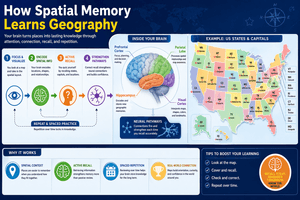
The best geography practice is short, focused, and repeatable. A learner can spend five minutes on the interactive map of us states and capitals and still make meaningful progress if the session requires active thinking. The key is not duration alone. The key is retrieval quality.
Start with broad recognition. Identify the states you already know. Then move to weaker regions. Use the interactive map of us states and capitals to narrow uncertainty by comparing shapes, coastal positions, and adjacent states. Once location is familiar, connect the capital city. The memory chain becomes stronger each time the learner moves from “I think I know it” to “I can recall it confidently.”
Next, layer in more specialized practice. The US States by Borders Quiz helps learners notice geography as a system of neighbors, while the US State Name Quiz supports fast recognition under time pressure. The interactive map of us states and capitals becomes the central reference point that ties those skills together.
Another useful strategy is mixed practice. Instead of studying only one format, rotate between the interactive map of us states and capitals, the Capital Cities of the World Quiz, and the Countries of the World Quiz. Even though these games cover different scopes, they share the same learning principle: retrieve, check, adjust, repeat.
For learners who enjoy visual flash recall, the Flag Memory Game can be a useful companion. It trains pattern recognition and strengthens visual discrimination. That makes the interactive map of us states and capitals even more effective because the brain becomes better at noticing the details that distinguish one place from another.
Why active recall beats passive review
Passive review feels easier, but it often creates weaker memory. Reading the same list of states and capitals over and over does not demand much from the brain. The interactive map of us states and capitals is more demanding, and that is the advantage. When the learner has to answer before seeing the correct location, the brain has to search memory rather than simply recognize an answer.
That search process is essential. Retrieval practice tells the brain which memories matter. The more often the learner successfully recalls a state or capital from the interactive map of us states and capitals, the more stable that knowledge becomes. This is why quiz-based learning has such strong educational value.
There is also a confidence benefit. Geography can feel overwhelming at first, especially for learners who think of themselves as “not map people.” The interactive map of us states and capitals changes that narrative. Every correct answer becomes feedback that spatial intelligence is not fixed. It can be trained.
That message matters for students and adults alike. A fifth grader preparing for class, a middle schooler studying for a quiz, or an adult refreshing long-forgotten knowledge can all improve through the same mechanism. The interactive map of us states and capitals offers a clear path from uncertainty to fluency.
How to make geography stick for different ages
For younger learners, simple repetition works best when it is colorful and playful. The interactive map of us states and capitals can be paired with naming games, border clues, and short recall rounds. Students can identify a state, then point to its capital, then explain why they chose it. That verbal explanation deepens encoding.
For middle school learners, challenge matters more. The map can be used alongside harder prompts that require faster recall, fewer hints, and more switching between states and capitals. This is a good time to use outline-free map practice, because it encourages shape recognition without relying on visual borders alone.
For adults, geography practice often works best when it is framed as skill maintenance or brain training. The interactive map of us states and capitals is ideal for that purpose because it is simple to start, easy to repeat, and cognitively rich. It also pairs well with a Higher Or Lower Population Game, which adds a data-based layer to spatial learning.
Adults who enjoy word-based challenges may also like the Autocomplete Game or the Geo Connections Game. Both reinforce pattern discovery and category thinking. Used together with the interactive map of us states and capitals, they create a broader cognitive workout that supports memory and flexibility.
The role of visual memory in geography
Visual memory is central to map learning. Shapes, coastlines, and relative positions become visual anchors in the mind. The interactive map of us states and capitals takes advantage of that by repeatedly showing learners how states occupy space. Over time, the brain stops seeing a set of separate boxes and starts seeing a coherent map.
This shift from detail to pattern is a hallmark of expertise. Beginners often memorize one item at a time. More advanced learners build a mental grid. The map helps that transition happen naturally by linking a state’s outline to its exact location and then to its capital.
Some learners benefit from color, but the most important factor is structure. Even without decorative aids, the brain can learn the map when it receives enough meaningful repetition. That is why the interactive map of us states and capitals is so effective: it teaches structure, not just trivia.
For learners who want a lighter entry point, the Flags of the World Quiz can be a playful companion. Flags and maps are different tasks, but both reward visual discrimination. The more the brain practices this kind of noticing, the easier the interactive map of us states and capitals becomes.
Building a stronger geography routine
A strong routine does not have to be long. It has to be consistent. Ten focused minutes on the interactive map of us states and capitals is often more productive than a long passive study session. Frequent retrieval, spaced over time, gives the brain repeated opportunities to consolidate information.
One effective routine is to begin with familiar states, move to neighboring ones, and finish with the most difficult capitals. Another is to alternate between states and capitals on each round. The interactive map of us states and capitals makes both approaches easy because it provides immediate spatial feedback.
When learners want a broader challenge, they can rotate in world geography. The Countries of the World Quiz, the Capital Cities of the World Quiz, and the Wordle Geography Game style of play all support the same memory skills, though the primary focus remains the interactive map of us states and capitals. That broader rotation helps learners transfer spatial reasoning beyond one set of facts.
For families, this kind of routine can be surprisingly social. A parent and child can compete in a few rounds, compare scores, and explain mistakes. The interactive map of us states and capitals becomes less like studying and more like a shared challenge. That emotional engagement matters because people remember what they enjoy.
Where geography learning meets confidence
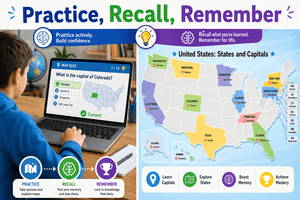
One of the most overlooked benefits of the interactive map of us states and capitals is confidence. Learners who start out unsure often discover that their map sense is stronger than they expected. That realization is powerful. It encourages persistence, and persistence is what turns practice into mastery.
Confidence also improves performance. When a learner trusts their spatial memory, they answer more quickly and hesitate less. The interactive map of us states and capitals supports that growth by providing immediate, low-stakes opportunities to succeed. Each round is a chance to do slightly better than before.
That success can be especially motivating when paired with other friendly games. The Flag Memory Game, the Geo Connections Game, and the Wordle Geography Game each offer a distinct cognitive angle, but the interactive map of us states and capitals remains the most direct route for building state-and-capital fluency.
A few trusted geography resources
If you want to explore geography beyond game-based practice, a few high-authority references are especially helpful. National Geographic offers strong geographic education content and visual storytelling through its main site. Britannica provides reliable background on states, capitals, and world regions through its encyclopedia. The USGS is a valuable source for map science, landforms, and spatial data through its official portal.
Those resources complement the interactive map of us states and capitals by giving learners a broader sense of place. Games train recall, while reference sources deepen understanding. Together, they create a richer geography habit.
Final thoughts
Geography is easiest to remember when it is learned as a living system rather than as a list. The interactive map of us states and capitals succeeds because it engages the hippocampus, rewards active recall, and strengthens spatial intelligence through meaningful repetition. It helps the brain see connections, not just names.
For anyone trying to improve state knowledge, sharpen memory, or make geography more engaging, the interactive map of us states and capitals is an excellent place to start. It works for classrooms, home practice, independent learners, and brain-training routines. More importantly, it teaches a lasting skill: how to think spatially.
To keep growing, mix the interactive map of us states and capitals with quizzes, shape games, border challenges, and memory-based rounds. Add in the US State Capital Quiz, the US States by Borders Quiz, the Countries of the World Quiz, and the Higher Or Lower Population Game to create a richer learning loop. The more varied the practice, the stronger the memory.
Geography becomes memorable when the brain is asked to do real work. That is the promise of the interactive map of us states and capitals. It is not just a game. It is a system for building durable knowledge, one recall at a time.