The human brain is fundamentally designed to seek order within chaos. When we study the physical world, we often focus exclusively on visual maps, tracing borders and memorizing geometric shapes. However, cognitive geography teaches us that our understanding of the planet is deeply intertwined with language. The names we assign to mountains, rivers, and sovereign states are just as critical to our spatial intelligence as the physical coordinates on a map.
This is exactly where the intersection of orthography and cartography creates a fascinating educational landscape. Engaging with a scramble words geography game represents a unique, highly effective method for bridging this cognitive gap. By taking the familiar linguistic structure of a location and jumbling it, a scramble words geography game forces the brain to abandon passive reading and engage in intense, active decoding.
For decades, traditional geographic education relied on rote memorization—staring at a textbook and mindlessly repeating the spelling of foreign capitals until they temporarily stuck in the short-term memory. Modern neuroscience, however, reveals that the mind requires cognitive friction to forge lasting neural pathways. A scramble words geography game provides exactly this friction. When you look at a chaotic jumble of letters in a scramble words geography game, your visual word form area must work in absolute overdrive to rearrange them into a coherent spatial identifier. This process transforms a simple spelling test into a rigorous workout for your executive function.
In this comprehensive, science-backed guide, we will explore the neuroplastic benefits of anagrammatic reasoning, how a scramble words geography game enhances active recall, and why blending linguistic puzzles with traditional cartography is the ultimate strategy for lifelong cognitive health. We will dive deep into the specific brain regions activated during these puzzles and provide a roadmap for scaling your geographic knowledge from localized state spelling to absolute global mastery.
The Neuroscience of Orthographic Mapping
To understand why a scramble words geography game is so effective, we must closely examine how the brain processes written language. Reading is not an inherent biological trait; it is a learned, complex skill that repurposes the brain’s existing visual processing centers. The visual word form area, located in the occipital-temporal cortex, is primarily responsible for recognizing the shape of letters and instantly assembling them into recognizable words. When you engage with a scramble words geography game, you are actively disrupting the visual word form area’s default expectations. The brain can no longer rely on instant, subconscious word recognition; it must break the anagram down and consciously rebuild it piece by piece.
This mental reconstruction required by a scramble words geography game stimulates incredible neuroplasticity. Neuroplasticity is the brain’s remarkable ability to form new synaptic connections in response to learning, challenge, and experience. As you try to mentally shift letters around in a scramble words geography game, your prefrontal cortex—the center of logic, problem-solving, and working memory—must hold multiple hypothetical letter combinations in its temporary workspace. The Society for Neuroscience frequently highlights that rigorous working memory exercises are critical for maintaining cognitive agility as we age. Therefore, regularly playing a scramble words geography game is not just a fun diversion; it is a targeted neuroplasticity workout that strengthens the very foundation of your working memory capacity.
Furthermore, the successful resolution of a complex puzzle triggers a powerful chemical response. The moment you suddenly recognize that the chaotic letters “ANICDA” magically rearrange to “CANADA” in your scramble words geography game, the dopamine release chemically reinforces the newly forged neural pathway associated with that specific geographic name. Dopamine is not just a feel-good chemical; it is the brain’s internal save button. This chemically enhanced learning ensures that future retrieval of the word “Canada” will be significantly faster, highly reliable, and permanently anchored to its spatial location on the map.
Active Recall and Anagrammatic Reasoning
The pedagogical core of a scramble words geography game lies in its forced use of active recall. Active recall is the cognitive process of intentionally and effortfully retrieving information from your memory, rather than passively reviewing notes or reading a textbook. If you simply read a list of countries, your brain is doing very little metabolic work. But when a scramble words geography game presents you with a jumbled string of fifteen letters, you have no choice but to actively search your mental database. You must meticulously cross-reference the available letters with your existing, long-term knowledge of global nomenclature to find a perfect match.
This anagrammatic reasoning is a surprisingly complex cognitive feat. A well-designed scramble words geography game requires you to intuitively recognize common prefixes, suffixes, and letter frequencies that are unique to different regions of the world. For example, recognizing a high concentration of the letter “K” or “Z” in a scramble words geography game might immediately steer your active recall toward Eastern Europe or Central Asia. This means that a scramble words geography game is actively teaching you the subtle linguistic fingerprints of different global cultures, turning spelling into an exercise in cultural anthropology.
Moreover, the intellectual struggle is entirely the point. When you stare at a difficult prompt in a scramble words geography game, the cognitive strain you feel is the physical manifestation of deep learning. Your brain is rapidly sorting through hundreds of spatial possibilities, immediately discarding incorrect orthographic associations, and narrowing down the map. When you finally solve the anagram in a scramble words geography game, the resulting memory trace is incredibly deep and highly resilient. Cognitive psychologists consistently prove that the active struggle provided by a scramble words geography game is essential for long-term mastery, vastly outperforming the fleeting retention provided by standard multiple-choice quizzes.
Building Domestic Linguistic Foundations
Before tackling the extreme linguistic complexities of the entire globe in a scramble words geography game, it is highly strategic to build a foundational understanding using domestic geography. For learners in North America, mastering the fifty states serves as an ideal, controlled orthographic training ground. The names of the US states offer a fantastic, diverse variety of letter patterns, ranging from the vowel-heavy orthography of “Hawaii” to the complex, consonant-dense spelling of “Massachusetts.”
Integrating domestic puzzles into your daily study routine will prepare your brain for the mechanics of a global scramble words geography game. You must start by cementing the correct spelling and the exact spatial location of each state. Playing Guess the US States helps the visual cortex memorize the geometric shape, while a US State Name Quiz demands absolute perfection in spelling recall. Once these names are firmly locked into your long-term memory banks, introducing a domestic-focused scramble words geography game adds the necessary cognitive friction to test that knowledge. By scrambling the names you just learned, the scramble words geography game forces you to access that stored spatial information from an entirely new, analytical and deductive angle.
Additionally, expanding this linguistic training to include political centers is highly effective for building associative memory. After successfully navigating a state-level scramble words geography game, the next logical step is to tackle the capitals. Preparing with a comprehensive US State Capital Quiz ensures you know the raw textual data. Then, utilizing anagram puzzles to decode those specific capitals engages advanced dual-coding. You must first unscramble the letters to reveal “Sacramento,” and then instantly, spatially associate it with the boundaries of California. This multi-layered cognitive processing, born from the mechanics of a scramble words geography game, builds an incredibly robust internal mental map that will serve as the bedrock for all future learning.
Expanding to Global Nomenclature
Once the domestic foundation is securely laid, the true power of geographic word puzzles is unleashed on the international stage. The Earth contains nearly two hundred sovereign nations, offering an incredibly rich, historically dense dataset for linguistic deduction. When you engage in a global scramble words geography game, you are no longer just practicing spelling; you are navigating the intricate orthographic history of the world. The names of modern countries reflect centuries of colonization, ancient indigenous languages, and massive geopolitical shifts.
A global scramble words geography game challenges your brain to handle highly unfamiliar, non-native letter combinations. As you attempt to scramble letters to make country names, you must rely heavily on deductive reasoning rather than rote memory. If a prompt in a scramble words geography game ends in “STAN,” your spatial memory must instantly jump to Central Asia. If the anagram features multiple accented vowels or specific consonant clusters, your brain might naturally pivot toward Western Europe or the linguistic patterns of South America. Therefore, a scramble words geography game acts as an implicit lesson in global etymology and cultural geography.
To succeed at this elite level, strong foundational knowledge is an absolute prerequisite. You simply cannot unscramble a spatial word you have never seen. Regularly participating in a rigorous Countries of the World Quiz ensures that your mental dictionary is fully populated with the correct global vocabulary. Once that baseline vocabulary is established, the scramble words geography game serves as the ultimate test of retrieval speed and working memory optimization. Every session of a global scramble words geography game ensures your spatial and linguistic networks remain sharp, intensely agile, and deeply interconnected, ready to recall obscure nations at a moment’s notice.
Synergistic Puzzle Mechanics and Gamification
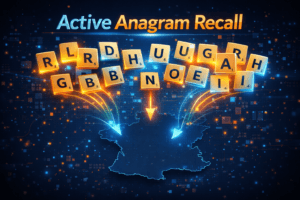
The architecture of a scramble words geography game does not exist in isolation. It belongs to a much broader, highly effective ecosystem of gamified learning tools that utilize orthography to teach complex spatial concepts. To maximize the neuroplastic benefits of your study time, learners should proactively create a diverse rotation of linguistic map puzzles. By shifting between different puzzle mechanics, you prevent cognitive habituation and ensure the brain is always encountering novel challenges.
For instance, alternating your scramble words geography game sessions with a Wordle Geography Game provides a complete, full-spectrum cognitive workout. While the scramble words geography game forces you to work with all the necessary letters in a chaotic order, the deductive style of Wordle forces you to build the word from scratch based purely on structural clues and logic. Engaging in a long session of geography wordle unlimited play allows you to stay in a continuous, uninterrupted flow state, rapidly testing the limits of your global vocabulary. When you switch back to a scramble words geography game, your brain feels refreshed by the sudden change in cognitive mechanics, preventing mental fatigue while maintaining exceptionally high-level geographic engagement.
For younger learners or adults specifically focused on orthographic perfection, treating the experience like a high-stakes geography spelling bee game can be incredibly motivating. By combining the perfect spelling required by a spelling bee with the rapid decoding required by a scramble words geography game, students build unshakeable confidence in their geographic literacy. Gamification elements—such as daily tracking streaks, digital badges, or timed leaderboards—transform the scramble words geography game from a simple puzzle into an addictive daily geography word challenge. This highly gamified environment triggers consistent dopamine release, ensuring that the learner returns to the scramble words geography game day after day, ultimately turning a fleeting interest in trivia into a deeply ingrained, lifelong educational habit.
Lateral Connections and Multisensory Geography
True geographic mastery extends far beyond knowing how to correctly spell a country’s name. It involves lateral thinking—the high-level executive ability to connect an abstract name to a physical location, a vibrant cultural symbol, and complex human demographics. Anagram puzzles serve as the perfect launchpad for this lateral exploration. Once you have successfully decoded a location, the next vital cognitive step is to intentionally attach multisensory data to that newly organized textual word.
Dual-coding theory dictates that memory retention is dramatically optimized when textual information is paired with striking visual information. Therefore, after solving a prompt, learners should immediately attempt to visualize the country’s national flag. Proactively practicing with a Flags of the World Quiz or a fast-paced Flag Memory Game builds the immense visual database needed for this dual-coding process. When your brain links the chaotic letters of the anagram to the organized, meaningful colors of a national flag, the resulting memory becomes practically indestructible. The Department of Education highly supports interdisciplinary learning models, and strategically blending spelling puzzles with visual arts and spatial mapping is a prime example of this pedagogical philosophy in action.
Furthermore, linking the unscrambled word to demographic scale creates a truly holistic, three-dimensional understanding of the world. After conquering a tough session of word puzzles, playing the Higher Or Lower Population Game forces your prefrontal cortex to assign a realistic quantitative value to the word you just solved. Is the nation you unscrambled a sprawling superpower home to hundreds of millions, or a tiny, isolated island of just a few thousand citizens? By actively adding these layers of demographic and visual data, the simple spelling exercise ceases to be just a word puzzle; it becomes the master key that unlocks a vast, intelligently interconnected network of global geographic intelligence.
Topography, Relational Cartography, and Trivia
The ultimate goal of engaging with intense orthographic puzzles is to successfully translate that linguistic knowledge back to the physical, topological map. Once a learner has developed immense speed and accuracy with spelling decoding, they must test their ability to place those unscrambled words into their correct spatial context. The brain must smoothly transition from the isolated, linguistic workspace of word decoding back to the expansive, visual canvas of topological relationships and borders.
After completing a difficult puzzle session, a learner should challenge themselves with interactive tools that specifically test these geographic relationships. For example, if a puzzle session heavily featured European nations, the learner should immediately tackle a regional map quiz to visualize exactly how those specific nations interlock. Utilizing the US States by Borders Quiz (for domestic puzzles) or exploring advanced global topologies teaches the brain to associate the newly unscrambled name not just with an isolated geometric shape, but with a highly specific neighborhood of surrounding countries.
This lateral, relational thinking is further developed and tested by the Geo Connections Game. In this unique environment, the vocabulary mastered through anagrams is utilized to find hidden thematic and historical links between places. You might need to group four countries you previously unscrambled based on a shared massive mountain range, a specific climate zone, or a historical economic treaty. By constantly shifting the cognitive demand from pure linguistic decoding to thematic categorization, the learner builds an incredibly agile, highly adaptable intellect. Exploring the sociological aspects of mapping, such as how modern populations search for these names via the Autocomplete Game, adds a final, fascinating layer of cultural context to the hard-earned orthographic data.
The Competitive Edge and Cognitive Longevity
For many adult learners and ambitious students, the solitary pursuit of cognitive improvement is eventually superseded by the thrilling desire for social competition. The rapid processing speeds developed through intensive anagram and orthographic training provide a massive, undeniable competitive advantage in any trivia or fast-paced geographic setting. When you have successfully trained your brain to instantly recognize complex letter patterns and associate them with spatial locations, your overall reaction time and recall speed skyrockets.
Taking these newly sharpened skills into a live, competitive environment like a Global Showdown puts your working memory to the ultimate stress test. In a strictly timed scenario against other skilled players, the individual who has spent hours mentally rotating letters and unscrambling geographic terms will consistently outperform those who relied solely on passive reading or static map viewing. The high-stakes competitive environment triggers a rush of adrenaline, which, when combined with the dopamine of correct answers, creates a powerful neurochemical cocktail for instantaneous, permanent memory recall.
Beyond the thrill of competition, the long-term, profound benefits for cognitive longevity are undeniable. As we naturally age, our baseline processing speed and working memory capacity begin to gradually wane. By committing to a daily, rigorous routine of complex, multi-layered cognitive tasks—specifically those that seamlessly blend language, logic, and spatial reasoning—we actively build a massive “cognitive reserve.” This reserve acts as a physical neurological buffer against age-related decline. The anagrammatic exercises provided by these unique geographic puzzles are far superior to standard crossword puzzles because they require simultaneous visual, spatial, and linguistic processing. This offers a comprehensive, full-brain workout that guarantees the mind remains vibrant, quick, and highly resilient for decades to come.
Practical Implementation for Educators and Parents
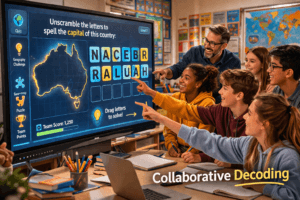
Understanding the deep cognitive neuroscience behind anagram mapping is essential, but practical, daily application is where the actual neuroplastic transformation takes place. For educators looking to revitalize their social studies, geography, or language arts curricula, word-based map games offer a versatile, highly engaging, and low-cost digital tool. Instead of starting a Monday morning lesson with a dry, uninspiring lecture, a teacher can project a scrambled country name onto the smartboard as an interactive warm-up activity. This immediately captures the students’ attention, forces them into a state of active recall, and perfectly primes their brains for the complex geographic concepts that will follow in the lesson plan.
Furthermore, linguistic map puzzles are highly effective for implementing differentiated instruction within diverse classrooms. Within a single group, students will inevitably possess varying levels of spatial and linguistic intelligence. A well-designed digital platform often allows for scalable, adjustable difficulty. Beginners can confidently tackle the relatively short names of local states or simple European countries, while highly advanced students can be challenged with the complex, multi-word names of obscure island nations or difficult international capitals.
This customization ensures that every single student remains in their optimal zone of proximal development, constantly challenged but never overwhelmed by the task at hand. Utilizing a Capital Cities of the World Quiz in an anagram format is a perfect example of scaling difficulty for gifted learners.
Parents seeking to directly support their children’s cognitive development at home can also leverage the incredible power of these linguistic games. By deliberately replacing passive television watching or mindless social media scrolling with just a ten-minute daily session of geographic word puzzles, parents transform a standard tablet from a distraction into a powerful educational ally. By actively playing alongside their children, parents can foster a deeply collaborative learning environment, verbally discussing the phonetic patterns, historical origins, and geographical locations of the words they uncover together. In this way, the puzzle becomes a beautiful bridge not only between language and maps, but also between parent and child, making cognitive growth a shared, joyful, and deeply bonding experience.
Conclusion: The Ultimate Orthographic Workout
In the rapidly evolving landscape of cognitive education and digital learning, we must constantly seek out tools that challenge the human brain in novel, multidimensional, and exciting ways. Rote memorization is an ineffective artifact of the past. The true future of geographic literacy and spatial intelligence lies entirely in the consistent application of active recall, the stimulation of neuroplasticity, and the seamless integration of distinct cognitive disciplines like linguistics and cartography.
By eagerly embracing the linguistic chaos of a jumbled word puzzle, you forcefully demand that your mind build stronger, significantly more efficient neural pathways. You successfully transform the passive, boring act of reading a static map into a dynamic, highly engaging mental workout that leaves you feeling intellectually invigorated. Through the consistent, daily application of anagrammatic reasoning, dual-coding theory, and lateral thinking, you elevate your understanding of the world from simple, isolated trivia to profound, interconnected spatial intelligence.
Do not let your geographic vocabulary remain static or untested. Challenge your visual word form area, push the boundaries of your working memory, and actively bridge the gap between how a place is spelled and where it resides on the globe. Unscramble the letters, test your cognitive agility, and unlock the true, limitless potential of your global cartographic knowledge today.