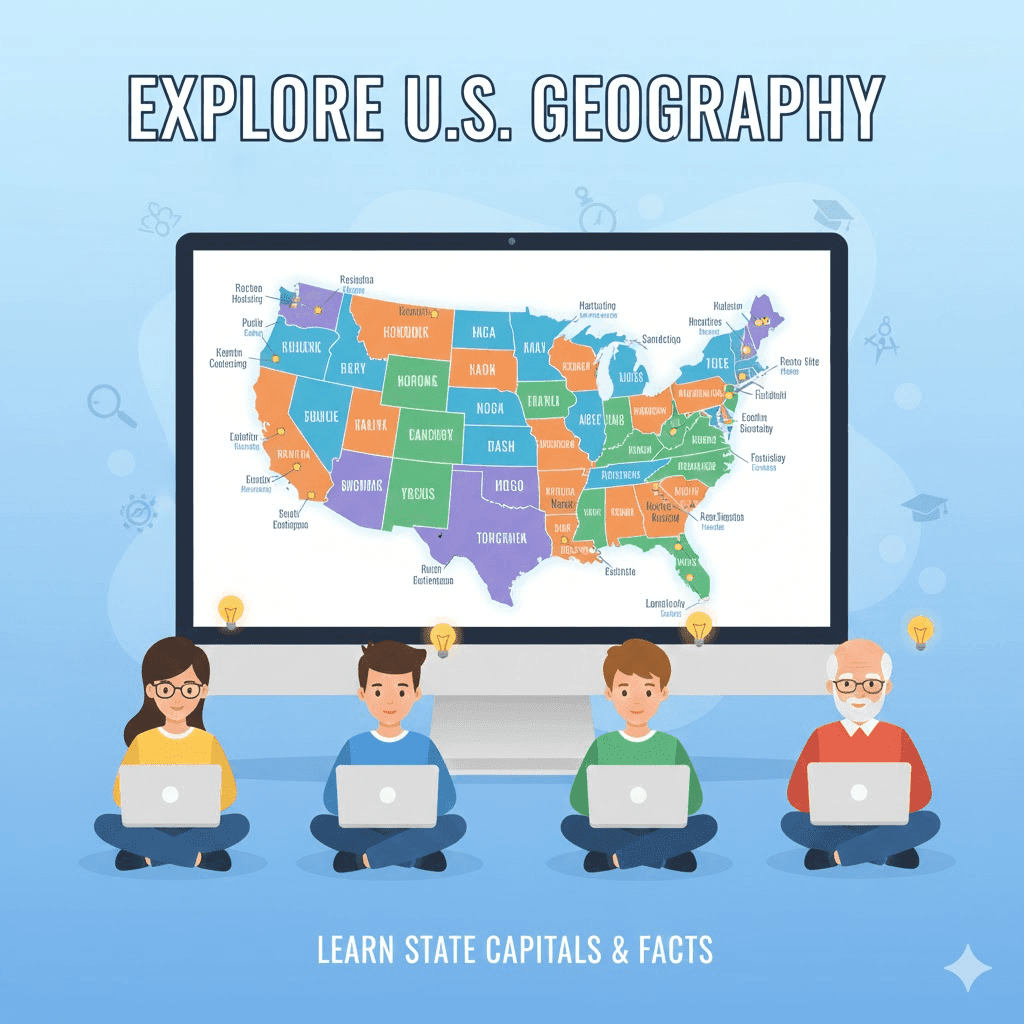
When you close your eyes and visualize the United States, what do you see? For most people, the image is a blurry outline, a vague collection of shapes where Texas and Florida stand out, but the middle remains a mystery. This mental image is your cognitive baseline. To transform that blur into a sharp, high-definition mental model, you need more than just a textbook; you need to engage deeply with an america map of america. This isn’t just about memorizing names for a test. It is about exercising your brain’s spatial intelligence and leveraging neuroplasticity to build permanent knowledge pathways.
Geography is often mistaken for rote memorization, but it is actually a complex cognitive task. When you study a detailed america map of america, you are engaging the hippocampus, the part of the brain responsible for spatial navigation and long-term memory. By interacting with maps through gamification and active recall, you move beyond passive observation. You begin to understand the relationships between borders, capitals, and physical terrain. Whether you are a student preparing for a 50 states quiz for 5th grade or an adult looking to keep your mind sharp, understanding how to navigate the america map of america is a powerful way to boost your cognitive health.
The Neuroscience of Map Reading
Spatial intelligence is the ability to comprehend three-dimensional images and shapes. This skill is crucial for everything from driving a car to packing a suitcase. When we look at an america map of america, our brains are doing heavy lifting. We are translating a two-dimensional representation into a mental model of the real world. This process strengthens neural connections. Every time you correctly identify a state or a capital, you reinforce a specific pathway in your brain. This is why interactive tools are far superior to static images. They force the brain to retrieve information actively rather than just recognizing it passively.
Consider the difference between staring at a wall map and playing a game. When you use a static america map of america, your eyes might glaze over. However, when you are challenged to locate a specific region, your brain switches gears. You are no longer just seeing; you are searching, analyzing, and deciding. This is the essence of active recall. To test this theory, you can try to Guess the US States in an interactive environment. The pressure of the game forces your brain to access its stored version of the america map of america and compare it against the visual data on the screen.
Decoding the Shapes: Morphology and Memory
One of the most effective ways to master the america map of america is through shape recognition. Every state has a unique morphological signature. Some are easy, like the distinct “mitten” of Michigan or the boot of Louisiana. Others, particularly the “square” states in the West, require a sharper eye for detail. Cognitive geography suggests that we learn best by breaking complex images down into smaller, manageable components. Instead of trying to memorize the entire america map of america at once, focus on the borders and distinct shapes of individual states.
For example, looking at the jagged border between Idaho and Montana tells a story of mountain ranges. The straight lines of Colorado and Wyoming speak to political decisions rather than natural boundaries. By paying attention to these details on an america map of america, you anchor the information in reality. You can challenge yourself to identify these subtle differences with the US States by Borders Quiz. This specific type of challenge removes the context of neighboring states, forcing you to rely entirely on your mental image of the state’s shape as it appears on the america map of america.
This method of learning utilizes “chunking,” a psychological phenomenon where the brain groups information to make it easier to recall. By grouping states by region or shape on the america map of america, you reduce the cognitive load. You aren’t learning 50 separate items; you are learning a few distinct groups. This makes the task of mastering the map far less daunting and much more rewarding.
Capital Cities: The Anchors of the Map
If states are the puzzle pieces, capital cities are the pins that hold the map together. Learning capitals adds a layer of precision to your mental america map of america. It is one thing to know where New York is; it is another to pinpoint Albany relative to New York City. This requires a higher resolution of spatial understanding. Many people struggle with capitals because they try to memorize them as a list of text pairs (e.g., “California – Sacramento”) rather than as locations on a map.
To truly learn, you must visualize the capital’s location within the state on the america map of america. Visualizing the star on the map creates a spatial anchor. When you think of the state, your mind should zoom in on that specific point. This is why an interactive map of us states and capitals is so effective. It combines the textual name with the visual location. You can test your proficiency with the US State Capital Quiz. This exercise reinforces the connection between the state shape and its political center, adding depth to your understanding of the america map of america.
Furthermore, understanding capitals often provides historical context. Why is the capital of Nevada in Carson City and not Las Vegas? Why is Tallahassee the capital of Florida? These questions often lead to a deeper investigation of the america map of america, turning a simple geography lesson into a fascinating historical journey. The more context you have, the stronger your memory retention will be.
Linguistic Geography: Names and Origins
The names on the america map of america are a tapestry of history, indigenous languages, and colonial influences. From “Mississippi” (Ojibwe for “Great River”) to “Vermont” (French for “Green Mountain”), every name holds a clue to the past. Engaging with the etymology of state names engages the verbal centers of the brain, creating a multisensory learning experience. When you look at an america map of america, you are reading a history book written on the land.
Integrating word games into your geography practice can surprisingly boost your spatial recall. It forces you to think about the spelling and sound of the place names associated with the america map of america. For instance, playing the US State Name Quiz helps solidify the correct terminology. Additionally, games that scramble letters or challenge your vocabulary, like the Scramble Words Game, keep the brain agile. This verbal processing supports visual memory, making the labels on the america map of america stick in your mind more effectively.
For those who enjoy a daily brain teaser, a Wordle Geography Game offers a fun, low-pressure way to interact with geographical terms. It keeps the concepts fresh without the intensity of a timed quiz. Regular exposure to these names ensures that when you next view an america map of america, the labels feel familiar and intuitive rather than foreign and abstract.
Global Context: America in the World
While mastering the america map of america is a significant achievement, it is essential to place it in a global context. Spatial intelligence involves understanding scale and relative position. How big is Texas compared to France? How does the latitude of New York compare to Madrid? Comparisons like these refine your mental map. You begin to see the america map of america not as an isolated island, but as a crucial piece of a global puzzle.
Expanding your horizons to include international geography actually helps reinforce your domestic knowledge. It creates a comparative framework. After mastering the local map, you might tackle the Countries of the World Quiz. Seeing the United States alongside other nations on a world map adjusts your perception of size and distance. It prevents the cognitive distortion often caused by standard Mercator projection maps, which can make the america map of america appear larger or smaller relative to other continents depending on the projection used.
Visual symbols like flags also play a role in this broader understanding. While a standard america map of america focuses on borders, flags represent the identity of the people within those borders. Connecting a flag to a location utilizes associative memory. You can build this skill with the Flags of the World Quiz or specifically for memory retention, the Flag Memory Game. These exercises serve as a visual memory game for adults and students alike, enhancing the overall cognitive toolkit used for geographic mastery.
Gamification and Neuroplasticity
The reason an interactive america map of america works better than a textbook is dopamine. When you play a game and get a correct answer, your brain releases a small hit of dopamine, the “reward” neurotransmitter. This chemical reinforces the neural pathway that led to the correct answer. essentially, your brain tells itself, “Do that again!” This cycle of challenge, action, and reward is the core of gamified learning. It turns the study of the america map of america into an addictive, positive feedback loop.
This is particularly important for neuroplasticity—the brain’s ability to reorganize itself by forming new neural connections. Whether you are a child using a us map quiz drag and drop interface or a senior using a blank us map for practice, you are physically changing your brain structure. The more you engage with the america map of america in a dynamic way, the more plastic and adaptable your brain becomes. This “use it or lose it” principle applies heavily to spatial memory.
We often see this in competitive memory champions who use “memory palaces.” They visualize a physical space to store information. By mastering the america map of america, you are essentially building a massive, permanent memory palace. You can “place” news events, historical facts, and even personal travel memories onto this mental map. For a different kind of cultural memory challenge, you might even try the Trump Tweet Quiz. While not strictly geographical, it tests your ability to recall cultural context, which is often tied to specific regions and demographics found on the america map of america.
Practical Applications of Spatial Mastery
Why does this matter in the real world? Why should you care about a high-fidelity america map of america in your head? The answer lies in how we process information. In the digital age, we are bombarded with data that has a geographic component. Election results, weather patterns, economic shifts, and travel logistics all require a working knowledge of the america map of america to be fully understood. Without a mental map, you are reliant on external sources to interpret the world for you.
For example, understanding the path of a hurricane requires knowing the coastal geography of the Gulf states. Analyzing an election map requires knowing the difference between the Rust Belt and the Sun Belt. A solid grasp of the america map of america allows you to be a more informed citizen. You can verify information, understand logistical challenges, and appreciate the scale of national events. Resources like the US Geological Survey offer incredible detailed maps that can further deepen this understanding, moving beyond political borders to physical realities like elevation and watersheds.
Furthermore, this skill translates to better travel experiences. When you can visualize the america map of america, road trips become more intuitive. You understand the “lay of the land.” You know intuitively that driving from Denver to Salt Lake City involves crossing the Rockies, a detail that a flat line on a GPS might not fully convey until you are on the road. This spatial intuition is derived directly from time spent studying the america map of america.
Advanced Challenges for the Geography Buff
Once you have the basics down, it is time to increase the difficulty. A standard america map of america might show state names, but what about a version with no text? Or a version that only shows rivers? Advanced learners thrive on removing scaffolds. Attempting to fill in a blank map forces the brain to rely entirely on internal coordinates. This is the ultimate test of your internalized america map of america.
You can also expand your scope to global capitals. If you have mastered the US capitals, try the Capital Cities of the World Quiz. The skills transfer seamlessly. The same techniques of shape recognition, relative location, and active recall you used for the america map of america apply to the map of Europe or Asia. It is about training the brain’s spatial processor, not just storing specific data points.
For those looking for specific educational tools, finding a blank us map for practice is a great offline activity. However, digital tools often provide immediate feedback which accelerates learning. High-quality educational resources like National Geographic often emphasize this blend of physical and digital learning. Using a physical america map of america on the wall in conjunction with digital quizzes creates a robust learning environment.
The Future of Cognitive Geography
As technology evolves, so does the way we interact with the america map of america. Virtual Reality (VR) and Augmented Reality (AR) are on the horizon, promising to let us walk through a virtual map. Imagine standing in your living room and walking from Florida to Washington on a giant projected america map of america. This will take spatial intelligence to new heights, making the abstract concrete.
Until then, 2D interactive screens remain the gold standard for accessibility and training. They bridge the gap between the static atlas and the immersive future. By committing to regular practice with an america map of america, you are keeping your brain ready for these future advancements. You are building a cognitive infrastructure that is adaptable and resilient.
Remember that learning is a journey. You might start by struggling to find Nebraska on the america map of america, but with consistency, you will soon be identifying obscure capitals and river systems. The transformation from confusion to clarity is one of the most satisfying experiences in learning. It changes your perception of the world and your place in it.
Conclusion: Your Map, Your Mind
The america map of america is more than a drawing of a nation; it is a tool for mental expansion. By engaging with it through quizzes, games, and active study, you are sharpening your spatial intelligence and protecting your cognitive health. You are moving from a passive viewer to an active explorer.
Whether you are using a detailed america map of america to plan a trip, teach a student, or just challenge your own memory, the benefits are tangible. The neural pathways you build today will serve you for years to come. So, do not just look at the map—master it. Dive into the shapes, the names, and the locations. Let the america map of america become a permanent, vivid part of your mind’s eye.
Ready to test your mental mapping skills? Start by seeing if you can conquer the US State Capital Quiz and prove that you have truly mastered the map.