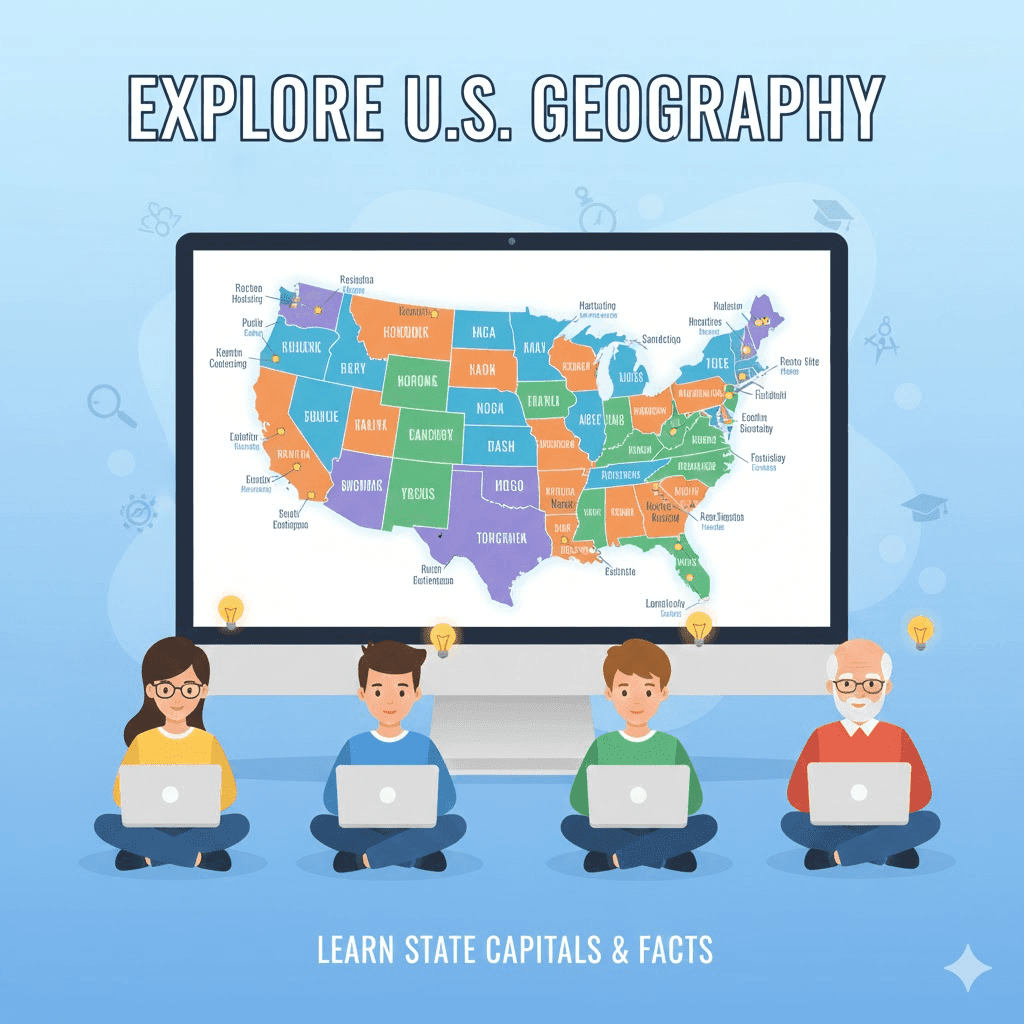
Geography is often mistaken for a simple memory game, a rote list of names and locations that we recite until they stick. However, true geographic literacy goes far beyond memorization. It is an exercise in spatial intelligence, a workout for the hippocampus, and a way to build a mental framework of the world we inhabit. At the center of this cognitive workout for American students and lifelong learners is the us capitals and states map. This fundamental tool serves as the grid upon which we build our understanding of North American political geography. By engaging with a us capitals and states map through interactive play, you are not just learning names; you are rewiring your brain to recognize patterns, borders, and spatial relationships.
When you look at a static us capitals and states map, your brain processes visual data. But when you actively test yourself against that map, you engage in a process known as active recall. This is the secret sauce of learning. It transforms a passive activity into a dynamic cognitive challenge. Whether you are a student preparing for a 50 states quiz for 5th grade or an adult looking to sharpen your mind, the humble us capitals and states map is your training ground. In this comprehensive guide, we will explore the neuroscience behind map learning, strategies to master the fifty states, and how gamification makes the process effortless.
The Neuroscience of Navigation and the US Capitals and States Map
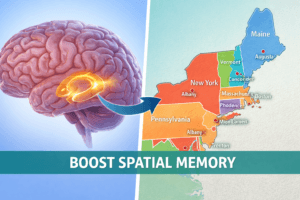
To understand why the us capitals and states map is such a powerful learning tool, we must first look at the human brain. The hippocampus is the region of the brain responsible for memory and navigation. It contains “place cells” and “grid cells” that create a cognitive map of our surroundings. When you study a us capitals and states map, you are essentially feeding data to this internal GPS. However, simply staring at the map is rarely enough to foster long-term retention. To truly cement this information, you need to engage the brain’s neuroplasticity—its ability to form new neural connections.
Using an interactive us capitals and states map forces your brain to make decisions. You have to recall a location, verify its shape, and place it in context with its neighbors. This decision-making process strengthens the synaptic pathways associated with spatial memory. Every time you correctly identify a location on the us capitals and states map, you get a hit of dopamine, the brain’s reward chemical. This is why gamified learning is so effective. It turns the rigorous study of the us capitals and states map into a rewarding feedback loop. If you want to put this science into practice immediately, try our US State Capital Quiz and feel those neural connections firing.
Moving Beyond Rote Memorization
Many of us remember the old-school method of learning geography: flashcards and repetition. While these have their place, they often fail to provide the spatial context provided by a us capitals and states map. Context is king in cognitive geography. Knowing that “Albany” is the capital of “New York” is a semantic fact. Knowing exactly where Albany sits on a us capitals and states map, relative to the Hudson River and the Atlantic Ocean, is spatial knowledge. This distinction is crucial.
A high-quality us capitals and states map allows you to visualize the “why” behind the “where.” For instance, why are so many capitals located on rivers? Why are the western states so much larger and boxier than the eastern states? When you explore a us capitals and states map with an inquisitive mind, you start to see the history and geology encoded in the borders. This deep processing makes the information stickier. You aren’t just memorizing a list; you are understanding a system. To test your ability to recognize these distinct shapes without their labels, jump over to our Guess the US States challenge.
Regional Mastery of the US Capitals and States Map

Trying to memorize the entire us capitals and states map in one go can be overwhelming. This is where the concept of “chunking” comes in. Cognitive science tells us that the working memory can only hold a few items at a time. Therefore, the best strategy to master the us capitals and states map is to break it down by region. Let’s traverse the map and see how breaking it down helps active recall.
The Complex Northeast
The Northeast corner of the us capitals and states map is arguably the most difficult for beginners. The states are small, the shapes are irregular, and the density is high. Here, precision is key. On a standard us capitals and states map, finding the difference between Vermont and New Hampshire requires attention to detail (hint: Vermont is shaped like a V, New Hampshire like an n). The capitals here—Montpelier, Concord, Augusta—are historic and often tucked away inland. Mastering this section of the us capitals and states map requires zooming in and focusing on the intricate borders. For a challenge that focuses specifically on these outlines, try the US States by Borders Quiz.
The Sprawling South
Moving down the us capitals and states map to the South, the shapes get larger and the history deeper. From the peninsula of Florida to the vast expanse of Texas, this region dominates the bottom half of the visual field. Learning the capitals here often involves distinguishing between major cultural hubs and political centers. For example, on a us capitals and states map, you will see that Austin is central to Texas, while Atlanta is the beating heart of Georgia. The active recall challenge here is often keeping the rectangular states of “Mississippi” and “Alabama” straight. Regular practice on a us capitals and states map helps your brain create a distinct mental image for each.
The Midwestern Grid
The Midwest section of the us capitals and states map is defined by rivers and straight lines. This is where the grid cells in your brain truly get a workout. States like North Dakota, South Dakota, Nebraska, and Kansas appear stacked on the us capitals and states map. The challenge here is vertical ordering. Which one is on top? Which capital belongs to which rectangle? Pierre, Bismarck, Lincoln, Topeka—placing these correctly on a us capitals and states map requires establishing a strong mental north-to-south sequence. It is a perfect scenario for testing your knowledge with our US State Name Quiz.
The Wild West
Finally, the West offers massive shapes and diverse geography on the us capitals and states map. From the jagged coast of California to the boxy distinctiveness of Wyoming and Colorado, this region is visually striking. The capitals here can be tricky; many people look at a us capitals and states map and assume the biggest city is the capital, but Sacramento and Salem often surprise learners who expect Los Angeles or Portland. Using an interactive us capitals and states map helps correct these misconceptions through immediate feedback. If you want a break from standard maps, try mixing things up with our Wordle Geography Game to test your spelling of these western names.
Active Recall: The Engine of Learning
We have mentioned active recall, but how do you specifically apply it to a us capitals and states map? The process is simple but rigorous. Instead of reading the names off the map, you must cover them and force your brain to retrieve the information. When you use a digital, interactive map of us states and capitals, the software does this for you. It presents a blank shape or a location and demands an answer.
This retrieval effort signals to your brain that this information is vital. It strengthens the myelin sheath around the neural pathways, making future retrieval faster. This is why a us state capitals quiz printable or a digital equivalent is vastly superior to a textbook diagram. The more you struggle to retrieve the answer from your mental us capitals and states map, the more durable the memory becomes. It is a concept supported by educational psychologists and institutions like the National Council for the Social Studies, which emphasizes inquiry-based learning. Even games like our Scramble Words Game can contribute to this by forcing you to reconstruct names from memory.
Gamification and the US Capitals and States Map
Gamification applies game-design elements to non-game contexts. When we apply this to a us capitals and states map, we add elements like timers, scores, and streaks. This taps into our intrinsic motivation. We want to beat our high score. We want to see the map turn green. This emotional engagement is crucial for learning. A dry us capitals and states map might be boring, but a race against the clock to identify 50 capitals is thrilling.
By using a gamified us capitals and states map, you reduce the “cognitive load” or the mental effort felt during learning. The game mechanics scaffold the learning process. You might start with just the states, then add capitals, then remove the borders. This progression ensures that the us capitals and states map remains a challenge without becoming frustrating. For a global perspective on how gamification aids memory, you might also enjoy our Countries of the World Quiz.
Adapting the Map for Different Ages
The versatility of the us capitals and states map makes it suitable for all ages, but the approach should vary. The brain of a fifth grader is different from that of a high schooler or an adult.
For Young Learners (Grades 3-5)
At this age, visual association is powerful. A 50 states quiz for 5th grade should focus on the shapes and major colors of the us capitals and states map. Kids respond well to bright, interactive elements. The goal isn’t just rigorous accuracy but familiarity. They should be able to look at a us capitals and states map and generally point to where they live and where major landmarks are. Tools like the Flag Memory Game can be a great supplementary activity to build visual memory skills alongside map work.
For Middle and High School
As students mature, the us capitals and states map becomes a tool for understanding political and physical systems. A us geography quiz for high school should demand more. It should require students to know not just the location, but the capital, the abbreviation, and perhaps bordering states. The us capitals and states map becomes a reference point for history class—understanding the Civil War or Westward Expansion requires a solid mental map. This is where the Trump Tweet Quiz or similar cultural trivia can provide a fun, albeit different, type of engagement with political figures often associated with specific map locations.
For Adults and Lifelong Learners
Adults often turn to the us capitals and states map to stave off cognitive decline or simply to fill gaps in their knowledge. For this demographic, the us capitals and states map is a tool for “neurobics”—aerobics for the brain. The complexity can be higher. Adults might enjoy the challenge of a us states map quiz for middle school just to see if they can still pass it, or they might dive into global challenges like the Flags of the World Quiz.
Digital vs. Physical Maps
In the age of technology, is there still a place for a physical us capitals and states map? Absolutely. Large wall maps provide a constant visual reference that reinforces spatial awareness passively. However, for active learning, the digital us capitals and states map reigns supreme. Digital maps allow for immediate feedback, which is critical for the correction of errors. If you think the capital of Kentucky is Louisville, a static map won’t stop you. An interactive us capitals and states map will immediately correct you (it’s Frankfort), preventing the fossilization of incorrect information.
Furthermore, digital platforms allow for “spaced repetition.” Software can track which parts of the us capitals and states map you struggle with and present them more frequently. This targeted practice is impossible with a paper map. For comprehensive global practice, expanding beyond the US, you can use our Capital Cities of the World Quiz.
Strategies for Mastering the Map
So, you are ready to conquer the us capitals and states map. Here is a step-by-step strategy based on cognitive principles:
- Start with the Corners: Anchor your mental us capitals and states map by learning Maine, Florida, Washington, and California first. These provide the boundaries of your mental canvas.
- Follow the Water: Use the Mississippi River as a dividing line on your us capitals and states map. It creates a natural spine that helps organize the vertical columns of states.
- Mnemonic Devices: Create stories. “MIMAL” (Minnesota, Iowa, Missouri, Arkansas, Louisiana) looks like an elf on the us capitals and states map. These visual tricks act as hooks for memory retrieval.
- Interleave Your Practice: Don’t just study the us capitals and states map for hours. Mix it up. Do a round of capitals, then switch to a Flag Memory Game, then come back. This “interleaving” forces your brain to reload the information, strengthening the memory.
- Use Multiple Modalities: Look at the us capitals and states map, say the names out loud, and click the locations. Combining visual, auditory, and kinesthetic actions creates a richer memory trace.
Resources like the US Geological Survey offer incredible detailed maps that can deepen your appreciation for the physical terrain underlying the political boundaries of the us capitals and states map. Additionally, National Geographic provides resources that frame these maps in cultural and environmental contexts.
The Role of Spatial Intelligence in Everyday Life
Why does mastering the us capitals and states map matter outside of a quiz? Spatial intelligence—the ability to visualize and manipulate objects in space—is correlated with success in fields like engineering, architecture, and even medicine. When you practice with a us capitals and states map, you are honing this fundamental cognitive skill. You are training your brain to interpret abstract representations of the real world.
Furthermore, a solid grasp of the us capitals and states map fosters civic literacy. Understanding news about election results, climate patterns, or economic shifts is difficult without a mental us capitals and states map to pin that information to. It grounds abstract data in physical reality. Whether you are analyzing a political map or just planning a road trip, the mental facility you build using the us capitals and states map is invaluable.
Conclusion: Your Map to Cognitive Fitness
The us capitals and states map is more than a classroom wall hanging; it is a gateway to a sharper mind and a better understanding of the world. By engaging with this map through active recall, gamification, and consistent practice, you are doing more than memorizing names—you are building a resilient, agile brain. The journey across the us capitals and states map is one of discovery, challenge, and ultimately, mastery.
Don’t let your knowledge rust. Challenge yourself today. Look at the us capitals and states map with fresh eyes and test your recall. It is time to turn passive viewing into active winning. Are you ready to prove your mastery?
Would you like to start your journey now? Click here to play the US State Capital Quiz and see how well you know the map!