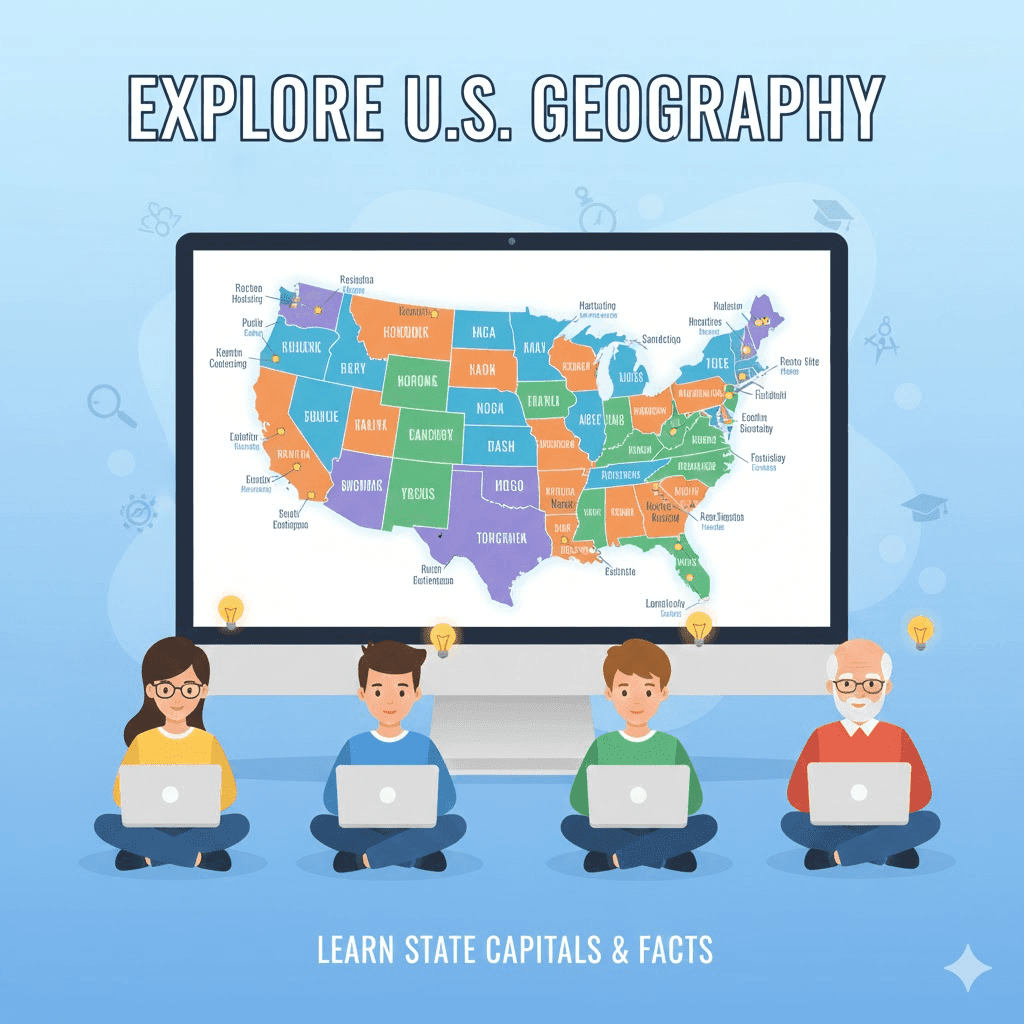
The Comprehensive Strategy to Master the Map of Capitals and States
Developing a flawless internal map of capitals and states is an essential academic milestone that bridges the gap between basic geography and true civic literacy. For many students and adult learners, the primary hurdle is “cognitive overload”—the frustration of attempting to ingest 100 disconnected facts without a logical framework. When you treat a map as a flat, static list to be memorized, the information often fails to move into long-term storage, leading to rapid memory decay.
The solution lies in “active encoding”—a transition from passive observation to engagement with the spatial logic of the country. By understanding the map of capitals and states through relationships, shapes, and narratives, you can build a mental atlas that remains permanent. Whether you are preparing for a assessment, a citizenship exam, or looking to sharpen your general knowledge, this guide provides the science-backed strategies needed for mastery.
At GeoMapGame, our mission is to simplify geographic literacy through interaction. We believe that a strong understanding of the map of capitals and states is the first step toward becoming a more informed global citizen. Geographic data shouldn’t be a chore to memorize; it should be a tool for understanding the world around you. In the sections below, we will explore the technical mechanics of spatial memory, provide actionable tips for rapid recall, and introduce interactive tools that make learning geography both effective and enjoyable.
Our Mission: Strengthening National Geographic Literacy
Our mission is to foster a deeper understanding of the American landscape by providing the best strategies for learning the map of capitals and states. Geographic literacy allows citizens to understand regional economies, follow national news with precision, and appreciate the historical migration patterns that shaped our nation. We live in an era where GPS technology is ubiquitous, which has unfortunately led to a decline in internal spatial awareness. By providing high-quality resources, we aim to bridge this literacy gap and foster a generation that is more spatially aware.
We believe that when the barrier to memorization is removed through gamification and cognitive science, curiosity about the world can truly flourish. Our goal is to transform the way people interact with a map of capitals and states, moving from rote memorization to a sense of place. This proficiency serves as the bedrock for critical thinking in history, environmental science, and international relations.
Technical Deep Dive: The Neuroscience of Spatial Memory
To master a map of capitals and states, we must engage the hippocampus, the part of the brain responsible for navigation and memory. Unlike a list of vocabulary words, geographic data is processed by “place cells” that fire only when you recognize a specific spatial location. Research suggests that “Dual Coding”—using both a verbal name and a visual image—is the most powerful way to learn geography. When you see a state shape on a map of capitals and states and pair it with a visual anchor, you are creating multiple neural pathways for retrieval.
Furthermore, the brain prioritizes information that has “spatial logic”. For example, recognizing that state capitals are often positioned near major waterways or central transport hubs provides a functional reason for their existence. This technical shift from verbal memory to visual-spatial memory is the most efficient way to achieve geographic fluency without the burnout of traditional methods. By training your brain to see the map of capitals and states as a network of connections rather than isolated dots, you ensure the information remains accessible for years.
Educational Philosophy: Active Recall and Spaced Repetition
Our educational framework for learning the map of capitals and states is built on two pillars of cognitive science: Active Recall and Spaced Repetition.
- Active Recall: Instead of looking at a labeled map, you should use blank “silhouette” versions of a map of capitals and states.
- Forcing Retrieval: Forcing your brain to identify which state lies on the other side of a specific border strengthens synaptic pathways through effortful retrieval.
- Spaced Repetition: Reviewing specific regions at increasing intervals prevents the “forgetting curve”.
- Retention Rates: Revisiting previously learned information on the map of capitals and states after a couple of days, weeks, or months raises the retention rate significantly compared to a single “cram” session.
These methods ensure that your time spent with geography is high-yield, resulting in genuine expertise rather than temporary memorization.
User Personas: Who Is This Mastery Guide For?
Geography proficiency is a universal skill, but we tailor our map of capitals and states content for these specific groups:
- The Academic Student: Individuals who need to pass social studies tests or meet state-mandated geography standards with confidence.
- The New Citizen: People preparing for the naturalization exam who must understand the administrative structure and map of capitals and states.
- The Trivia Enthusiast: Competitive learners who use interactive tools to sharpen their recall speed and prepare for geography bees.
- Teachers and Educators: Professionals seeking interactive tools like the US State Name Quiz to engage their students in the classroom.
Regardless of your background, the strategies for mastering the map of capitals and states remain consistent: engage, recall, and repeat.
10 Expert Tips for 100% Accuracy on Your Mental Map
If you want to master the map of capitals and states fast, follow these proven strategies:
- Regional Chunking: Focus on one of the five US regions at a time to avoid cognitive fatigue.
- Chef MIMAL: Look for the “chef” figure made by central states (MN, IA, MO, AR, LA) to anchor the map of capitals and states.
- Visual Mnemonics: Create word associations, such as “Lincoln is the heart of Nebraska”.
- Active Retrieval Games: Engage with the Guess the US States challenge to force spatial memory.
- Alphabetical Recall: Practice naming all states alphabetically to ensure you aren’t skipping any obscure entries.
- Boundary Puzzles: Use online puzzles to understand how state borders interlock on the map of capitals and states.
- Interactive Quizzes: Use the US State Capital Quiz to pair cities with their parent states.
- Daily Micro-Practice: Spend five minutes every day with geography tools to fight memory decay.
- Contextual Learning: Link each location on the map of capitals and states to a famous sports team or historical event.
- Visual Consistency: Always study with high-quality, bright versions of the map of capitals and states.
Advanced Practice: Boundary Logic and Neighbor States
Once you have the basics of the map of capitals and states down, it’s time to test your “Boundary Logic.” Most people can point to a state, but can you name all the states it touches? This level of mastery is what separates a beginner from a geography expert. Using the US States by Borders Quiz helps you visualize how the states interlock as a system rather than individual islands.
This approach forces you to look at the “negative space” on a map of capitals and states. For example, when studying the Four Corners region, you learn how Utah, Colorado, Arizona, and New Mexico meet. By understanding these intersections, your mental map becomes much more robust and less prone to errors during high-pressure recall situations like exams or trivia competitions.
Data Integrity: Sourcing from Reliable Authorities
Accuracy is paramount when dealing with a map of capitals and states. Our geographic frameworks are built using data from the National Geographic Society. We also cross-reference our regional classifications with Encyclopaedia Britannica to ensure that the historical and administrative context of each center is accurate. When you use our guide to study the map of capitals and states, you are learning from a high-authority source that prioritizes factual precision.
Frequently Asked Questions
What is the hardest part of learning a map of capitals and states?
Many learners struggle with the small, clustered states of the Northeast. Using “regional chunking” and focusing on the distinct border silhouettes on a map of capitals and states helps bridge this gap.
How can I remember the capitals better?
Try the Scramble Words Game. Unscrambling the names helps reinforce their spelling and makes them more “sticky” in your memory.
Why are some locations chosen as capitals?
Historically, many centers on a map of capitals and states were chosen for their central geographic location within the state or their role in early administrative networks.
Are there daily challenges for geography?
Yes! We offer a Wordle Geography Game and even a topical Trump Tweet Quiz to keep your skills sharp and contextualized.
How long does it take to learn the map of capitals and states?
Using 15 minutes of daily practice with interactive tools, most learners can achieve total mastery of the map of capitals and states in about 7 to 10 days.
Can I learn these maps on my phone?
Yes, GeoMapGame and our other interactive tools are fully mobile-optimized, allowing you to study anywhere using active recall techniques.
Conclusion: Achieving Fluency with American Geography
In conclusion, becoming proficient in the map of capitals and states is a goal that is entirely achievable with the right approach. By moving away from rote memorization and toward active recall, regional chunking, and interactive play, you can build a permanent and accurate mental atlas. Geography knowledge is not just about passing a test; it’s about expanding your worldview and understanding the spatial relationships that govern our national life. Start your journey today and discover how engaging and rewarding a map of capitals and states can truly be.