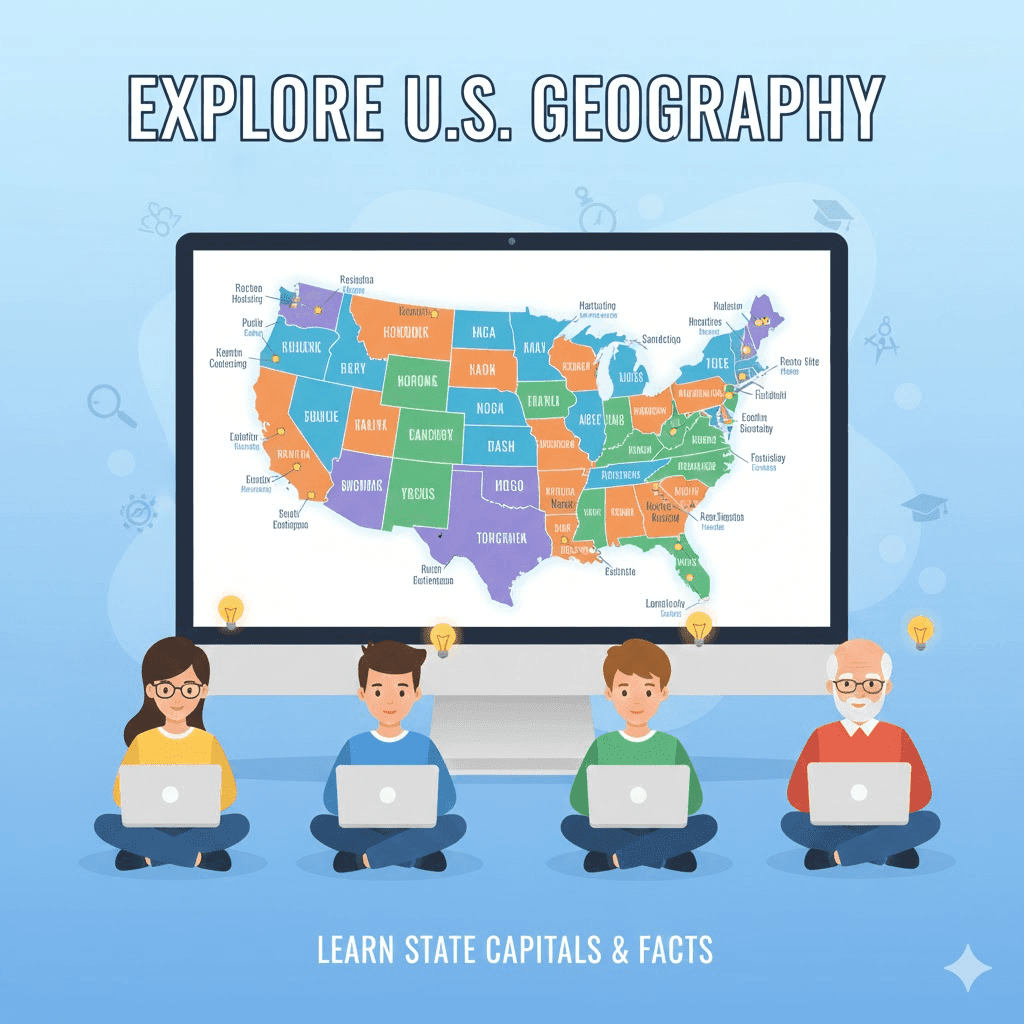
The Comprehensive Strategy for Mastering the US Map of the States and Capitals
Developing a perfect mental US map of the states and capitals is a foundational academic milestone that many students and adult learners find surprisingly difficult. The primary problem lies in the traditional “rote memorization” approach, where individuals attempt to ingest a list of 100 disconnected facts without any spatial or logical framework. When you simply stare at a static, printed US map of the states and capitals, your brain often enters a passive state, leading to rapid memory decay. This is why you might remember that the capital of California is Sacramento one day, but find yourself drawing a blank during a quiz or a real-world conversation the next.
The solution is not to work harder, but to learn smarter by transitioning from passive observation to active cognitive engagement. This guide provides a high-authority framework for mastering the US map of the states and capitals using neuroscientific principles like “Dual Coding” and “Active Recall.” By the end of this deep dive, you will understand how to transform the map from a confusing grid of lines into an intuitive, permanent mental atlas. Whether you are a student preparing for a standardized social studies exam, a teacher looking for better classroom tools, or a trivia enthusiast, these methods will ensure you never forget the placement of a state or the name of its administrative center again.
At GeoMapGame, our mission is to empower learners of all ages with the tools needed for geographic literacy. We believe that a strong grasp of the US map of the states and capitals is essential for civic participation, allowing citizens to follow national news, understand political distribution, and plan travel routes with ease. In the following sections, we will explore why traditional methods fail, the technical mechanics of spatial memory, and how you can use interactive games to accelerate your progress toward 100% accuracy on any geography challenge.
Why Finding the Right US Map of the States and Capitals Strategy Matters
In a digital world where information is always available via a search engine, many wonder why they should bother memorizing the US map of the states and capitals. The answer lies in cognitive efficiency. When you have a built-in mental map, you can process complex information—such as interstate commerce, regional climate patterns, or national election results—much faster than someone who has to look up every location. A well-encoded US map of the states and capitals acts as a scaffolding for all future learning, providing a logical place to “hang” new information about American history and current events.
Furthermore, geographic proficiency boosts overall spatial awareness. According to researchers, the ability to visualize the US map of the states and capitals strengthens the same neural pathways used in mathematics and complex problem-solving. By choosing effective ways to study the American landscape, you aren’t just memorizing names; you are training your brain to think more logically and organized. This confidence makes learning geography more enjoyable and significantly less stressful for students facing high-stakes testing.
The Technical Science: How the Brain Maps the USA
To understand the best way to master the US map of the states and capitals, we must look at the hippocampus—the part of the brain responsible for spatial navigation. Unlike a list of vocabulary words, geographic data is processed by “place cells” that fire only when you recognize a specific location. When you interact with a digital US map of the states and capitals, your brain performs a “spatial update.” It records where the capital is located relative to the state’s borders and its neighboring states.
This is why interactive tools are so much more powerful than paper maps. When you use the Guess the US States challenge, your brain is forced to retrieve the image of the state silhouette from memory. This effortful retrieval strengthens the synaptic connections between the “name” and the “location.” When you pair this with a capital quiz, you are effectively “zipping” the city and state together in your long-term memory, ensuring that the US map of the states and capitals stays accessible even under pressure.
Educational Philosophy: Active Recall and Spaced Repetition
Our educational framework for learning the US map of the states and capitals is built on two pillars of cognitive science: Active Recall and Spaced Repetition. These aren’t just buzzwords; they are the most effective ways to ensure information sticks for a lifetime. Active Recall involves testing yourself before you feel “ready.” By looking at a blank US map of the states and capitals and forcing your brain to identify the names, you are engaging in a much higher level of mental effort than simply rereading a list.
Spaced Repetition involves reviewing the US map of the states and capitals at increasing intervals. If you learn the Midwest region today, you should review it tomorrow, then again in three days, and then in a week. This cycle interrupts the “forgetting curve,” preventing the memory from fading. Integrating linguistic games like the Scramble Words Game can further enhance this by focusing on the spelling of capitals like Tallahassee or Montpelier, which are often the hardest to recall on a standard US map of the states and capitals.
User Personas: Who Is This Mastery Guide For?
The US map of the states and capitals is a vital resource for several key groups. Our content is designed to meet the specific needs of each:
- K-12 Students: Those facing social studies benchmarks who need a stress-free, engaging way to learn.
- Teachers and Educators: Professionals looking for reliable classroom tools like the US State Name Quiz to improve student engagement.
- ESL and Citizenship Applicants: Individuals preparing for the US citizenship exam who must be able to identify states and their administrative roles.
- Trivia and Map Fans: Lifelong learners who use tools like the Wordle Geography Game to sharpen their daily recall.
Regardless of your background, the strategies for mastering the US map of the states and capitals remain consistent: small, frequent study sessions always beat one-time cramming.
Advanced Interactive Practice: Moving Beyond the Basics
Once you have the foundation of the US map of the states and capitals, it is time to increase the challenge. Advanced learners should focus on “Boundary Logic”—knowing not just where a state is, but which states it touches. The US States by Borders Quiz is an excellent tool for this, as it forces you to think about the map as a system of connections rather than independent islands. This deeper level of understanding is what separates a beginner from a geography expert.
You can also increase your recall speed by using the US State Capital Quiz. By decreasing the time you take to answer, you train your brain to retrieve geographic data instantly. For those who want to broaden their international perspective after mastering the US map of the states and capitals, exploring the Countries of the World Quiz or the Capital Cities of the World Quiz is the natural next step toward global literacy.
Data Integrity and Authoritative Sources
Accuracy is paramount in geography education. Every study tool and guide we provide for the US map of the states and capitals is cross-referenced with high-authority entities to ensure your mental map is factually correct. We align our cartographic data with the standards of the National Geographic Society and political boundary updates recognized by the United Nations. Furthermore, historical context for capitals is sourced from Encyclopaedia Britannica. When you use our methods to master the US map of the states and capitals, you are engaging with a curriculum that is both neurologically sound and geographically precise.
7 Expert Tips for 100% Accuracy on the US Map of the States and Capitals
If you want to master the US map of the states and capitals fast, follow these proven strategies:
- Chunk by Region: Focus on one region (like the Midwest) per day.
- Use Visual Mnemonic Devices: “MIMAL” for the states along the Mississippi (MN, IA, MO, AR, LA).
- Practice Passive Exposure: Keep a US map of the states and capitals on your wall or as your desktop background.
- Apply Active Recall: Use blank maps to test yourself daily.
- Connect to Real Context: Link a capital city to a famous sports team, historical event, or landmark.
- Play Geography Games: Use games like the Flag Memory Game to build general cognitive memory skills.
- Teach Someone Else: Explaining the US map of the states and capitals to a friend is the ultimate way to solidify your own knowledge.
Frequently Asked Questions
What is the easiest way to learn the US map of the states and capitals?
The “Chunking” method is the easiest. By breaking the US map of the states and capitals into five regional groups, you reduce the information into manageable sizes, preventing burnout and improving speed.
Why do I always forget the Northeastern state capitals?
The Northeast has a high density of small states. To master this part of the US map of the states and capitals, focus on the shapes of the states first, then pair them with capitals like Augusta or Concord using mnemonic stories.
Can geography games really improve my test scores?
Yes. Studies show that gamified learning increases retention by up to 40% compared to reading. Games like the Flags of the World Quiz or Trump Tweet Quiz build the “recall reflex” needed for exams.
How many minutes a day should I spend studying the map?
Consistency is key. 10 to 15 minutes of daily focused play with a US map of the states and capitals is significantly more effective than three hours of cramming once a week.
Is there a difference between a political map and a physical map?
Yes. When learning the US map of the states and capitals, you are using a political map. However, physical features like the Appalachian Mountains often explain why certain borders and capitals were placed where they are.
What is the best age to start learning the US map of the states and capitals?
Children can start as early as 7 or 8 with visual identification. Interactive US map of the states and capitals tools are excellent for sparking interest in geography at a young age.
Conclusion: Mastery of the US Map of the States and Capitals
In conclusion, becoming proficient in the US map of the states and capitals is a goal that is well within your reach if you use the right strategies. By moving away from rote memorization and toward active recall, regional chunking, and interactive play, you can build a permanent and accurate mental atlas of the United States. Geography knowledge isn’t just about passing a test; it’s about expanding your worldview and understanding the spatial relationships that govern our national life. Start your journey with the US map of the states and capitals today and discover how engaging and rewarding geography can truly be.